men i hate: A Memoir in Essays
- By Lynette D’Amico
- Mad Creek Books
- 192 pp.
- Reviewed by Jennifer Bort Yacovissi
- March 18, 2026
A couple in transition finally starts a long-overdue conversation.
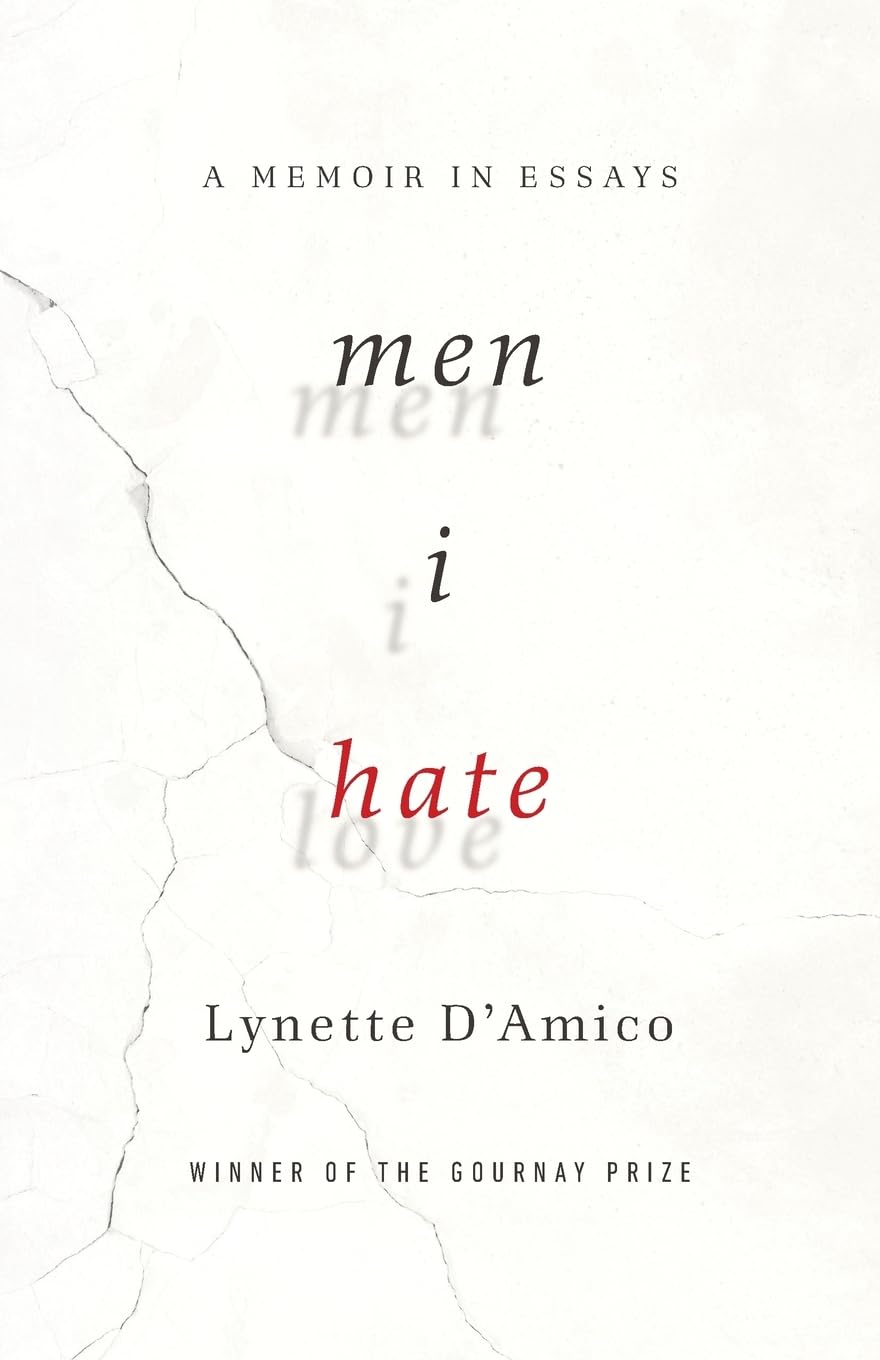
On the cover of Lynette D’Amico’s new essay collection, there’s shadow text behind the title, men i hate, which reads, men i love. Readers might intuitively understand that, sometimes, they’re one and the same. But D’Amico’s case is especially thorny. The author is a lesbian who married a woman. Many years into that marriage, as middle age approached, her wife announced she could no longer bear to live as a woman — and had, in fact, never been female. Rather, she’d always been a boy stuck in a girl’s body and refused to remain so any longer.
Reading this, I had questions. SO many questions.
How could it possibly be that after her wife, P---, has top surgery and starts testosterone, the author is startled to learn that gender markers are on the table, as well? “I blurt, ‘You’re a man now? We never talked about that!’” D’Amico writes. Which made me wonder: What have they been talking about?
The idea of malfunctioning communication plagued me throughout the memoir. If Carl, D’Amico’s now husband, always knew he was a man trapped in a woman’s body but never mentioned it during their decades together, it’s hard to see his later-in-life revelation as anything but a betrayal.
The author recounts the two of them sharing backstories that speak to their queer identities, and Carl offers one that feels like a non sequitur about being in a car accident years before. It isn’t until later that the full story comes out: The then 24-year-old P--- had driven against traffic in an effort to destroy the alien body in which he was trapped. Thus, he knows why the episode is revelatory but fails to share the meaningful part with his wife. Was D’Amico supposed to intuit it? Is this how their expectations became so mismatched?
One of my issues with any memoir — and it’s one that D’Amico openly wrestles with here — is that we’re hearing many people’s stories filtered through one person’s lens, which doesn’t feel fair. On the other hand, why shouldn’t D’Amico be allowed to use her voice to tell a story that’s just as transformative for her as it is for the other person? (Plus, in this case, that other person has already written his own memoir, Becoming a Man: The Story of a Transition, which I haven’t read.) As D’Amico says:
“it’s not about who has the right to write about things, places, experiences, and other people. Rather, it’s about how we take consideration of others. How we treat others. How we value them as fully human.”
Still, it’s hard to imagine living for 19 years with someone who hates their own identity and not grasping as much on some level. It’s an area D’Amico doesn’t fully explore. “My husband had never talked to me about being a man — a boy, yes.” He dreaded “the stigma of being a middle-aged woman.” (Boy howdy, Carl, can we relate.)
“My husband’s original intention was to live somewhere in the nonfemale nonmale in between,” she explains. Maybe that was her view of his “original intention,” but my take-away is that Carl was simply doing a slow reveal of the path he’d already chosen. Someone who intends to kill himself at age 50 rather than go on living in a woman’s body has plans.
D’Amico is stunned that suddenly gender — not gender fluidity but gender rigidity — becomes a constant and fraught topic in her life. As she describes him, Carl is petite, small-boned, delicate even, but with a desire to be fully masculine: bearded, all bro, turned out in a crisply tailored suit. I picture him (perhaps unfairly) sitting with a manspread as he mansplains to women while talking loudly in an attempt to one-up the guy next to him at the bar — all the traits that are unattractive in any man.
Indeed, as Carl races ahead of her on New York streets, D’Amico is reminded of his father, who regularly forges ahead in parking lots and leaves his mother behind without a backward glance. “What a fucking asshole, I think. Nineteen years together and now I’m married to a fucking asshole.”
I kept coming back to this: Carl could have brought his wife along on his journey from the beginning; they would’ve been in it together. But that would have required honest and open communication, vulnerability, and possibly compromise. Instead, he kept secret all the things he knew about himself, getting angry when D’Amico wasn’t instantly and gleefully onboard with every news-to-her sea change. That doesn’t feel like a partnership.
Even so, D’Amico — not a big fan of men in general — seems to truly hate only one: Brendan, their thoroughly (and destructively) clueless neighbor. We hate Brendan, too, well before her essay “the man next door” concludes. (Be forewarned: It involves a puppy.) “Is there anything more impenetrable than a stupid man’s certainty about a subject he knows nothing about?” she writes. No. In this case, I don’t want to hear Brendan’s side; I just want to punch him in the face.
These essays fill out D’Amico’s origin story, including her early influences in queerness and, of course, her family. Looming over all is her unhappy, angry mother, who exercised a tractor-beam pull over her daughter (on whom the message about china patterns and frilly dresses and women’s duties was nonetheless lost). D’Amico’s method for leaving home was to announce that she was queer, knowing it would be enough to get her booted out the door.
In the end, this slender book held straight, cis me rapt as it tossed my emotions — and my blood pressure — into the spin cycle. I found myself affronted on D’Amico’s behalf (Did you always do all the cooking or has someone decided we’ve got gender roles now? Why is it always your job to pick up his ginger ale?), but she has no need of my umbrage.
As she asks from the get-go, who among us hasn’t at some point gaped at our beloved and thought, “How is it that I’m even with you?” before once more remembering the how and the why. The author makes her “why” clear in the book’s dedication. “For Carl,” it reads, “my presence of possibility, who makes my life livable.”
Jennifer Bort Yacovissi’s novel, Up the Hill to Home, tells the story of four generations of a family in Washington, DC, from the Civil War to the Great Depression. She reviews regularly for the Independent and serves on its board of directors as president. Follow Jenny on Bluesky at @jbywrites.bsky.social.