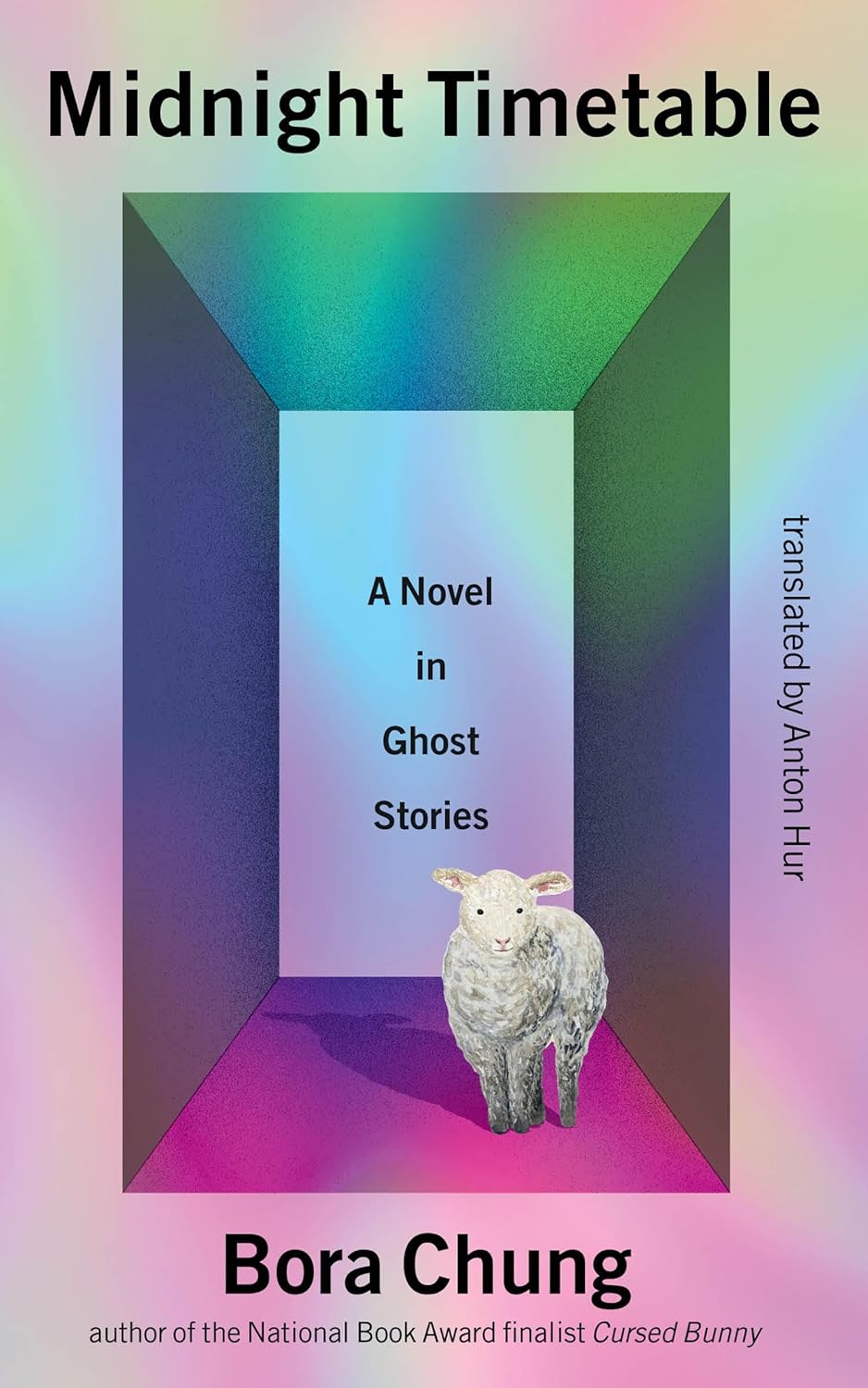
Midnight Timetable: A Novel in Ghost Stories
- By Bora Chung; translated by Anton Hur
- Algonquin Books
- 208 pp.
- Reviewed by Karl Straub
- January 1, 2026
Researchers study the paranormal in a spooky Korean lab.
Horror fiction gives us violence, death, and monstrous behavior right up close. Its weird-fiction sibling tends to prefer the unsettling mood over the gratuitous shock, but the border between the two isn’t always easy to spot. Another border is the one that divides genre fiction from anything deemed “literary.”
Ghost stories — tales about people and other animals who’ve died and returned to haunt us — are about the ultimate border, of course. Appropriately, this kind of tale has long been a vehicle for writers who want to travel repeatedly back and forth across literary borders until readers lose sight of the lines altogether. In the hands of a modern master like Korean author Bora Chung, the borders are porous indeed.
Chung sees ghost stories as a great cure for writer’s block. “Once I start thinking about at which point the appearance of the ghost would prove the scariest,” she says in her new collection’s afterword, “the writing starts to flow again.” But ghost stories are tonally most effective when short; they thrive on mystery, and the longer a story gets, the harder it is for the author to avoid explaining things. A ghost story that effectively fills up an entire novel is not easy to pull off.
For Midnight Timetable, Chung invents a setting that links her stories, allowing her to develop depth without skimping on mystery. Her locale is a dull professional building where employees conduct scientific research, their specialization being physical objects involved in supernatural phenomena. The housing and study of these objects — handkerchiefs, shoes, and even cats, birds, and sheep — render the facility a conduit for the spirit world. Whenever its employees have their inevitable encounters with ghosts, stories are born.
The tales are mostly told by one worker to another. About half of these conversations are between a cleaning-woman narrator and her sunbae (an older employee who helps guide newcomers). The sunbae tells a lot of the spooky stories; others are shared by the facility’s deputy director and by the cleaning woman herself. At one point, a narrator reads a story in a book that is itself haunted.
The device of having the sunbae tell stories to the younger subordinate means that even dark and creepy exchanges can have the antiseptic flavor of a corporate team-building exercise, and the amusing contrast comes to life with Chung’s usual light touch. At one point, the sunbae explains some spectral phenomenon this way:
“They say that the undead move in a northwesterly direction.”
Chung’s real-life social activism drives a lot of her plotting, and she deftly integrates examples of injustice and mistreatment into her narratives. Political conviction can sometimes tip a writer into heavy-handedness, but this is where the plainness and economy of Chung’s prose help her pull off a kind of magic trick, blending a folk-storytelling tradition with a liberal, modern perspective.
In folktales, characters are typically abstract archetypes, and a detached tone replaces the overtly emotional characterizations you often find in literature. But Chung marries that kind of understatement to a contemporary understanding of bigotry and the ways it can ruin lives. It’s a neat trick; folktales often employ the misogyny and racism prevalent in their eras, but Chung turns this tradition on its head.
Her stories don’t reinforce stereotypes and prejudices. Instead, their power comes from her calm but unblinking observation of the ruinous effects of such toxicity. For this approach to succeed, a plain style free of exaggeration and hysteria is needed, but Chung brings more than that to the task. Like many of the best horror-fiction writers, she combines the empathy of a social worker with the coldblooded temperament of a murderer.
Sometimes, her characters make it back safely, and sometimes they don’t, but we’re with them either way. Chung’s empathy is infectious and extends not just to the collection’s victims, but even to many of its ghosts.
We can see Chung’s apt blend of horror, social justice, and understatement in this passage from a story about Chan, a gay man trying to get his life on track after dealing with his family’s homophobia:
“This job he got at a research center for haunted objects, where he would check the doors of rooms along corridors that either existed or didn’t exist, according to some midnight timetable, was Chan taking his first steps toward ‘normality.’”
In Chung’s imagination, abused people often get better treatment from the spirit world than from the physical one.
Karl Straub studied music education at Howard University and writes about music, books, film, and TV at karlstraub.substack.com. He lives in Delaware.