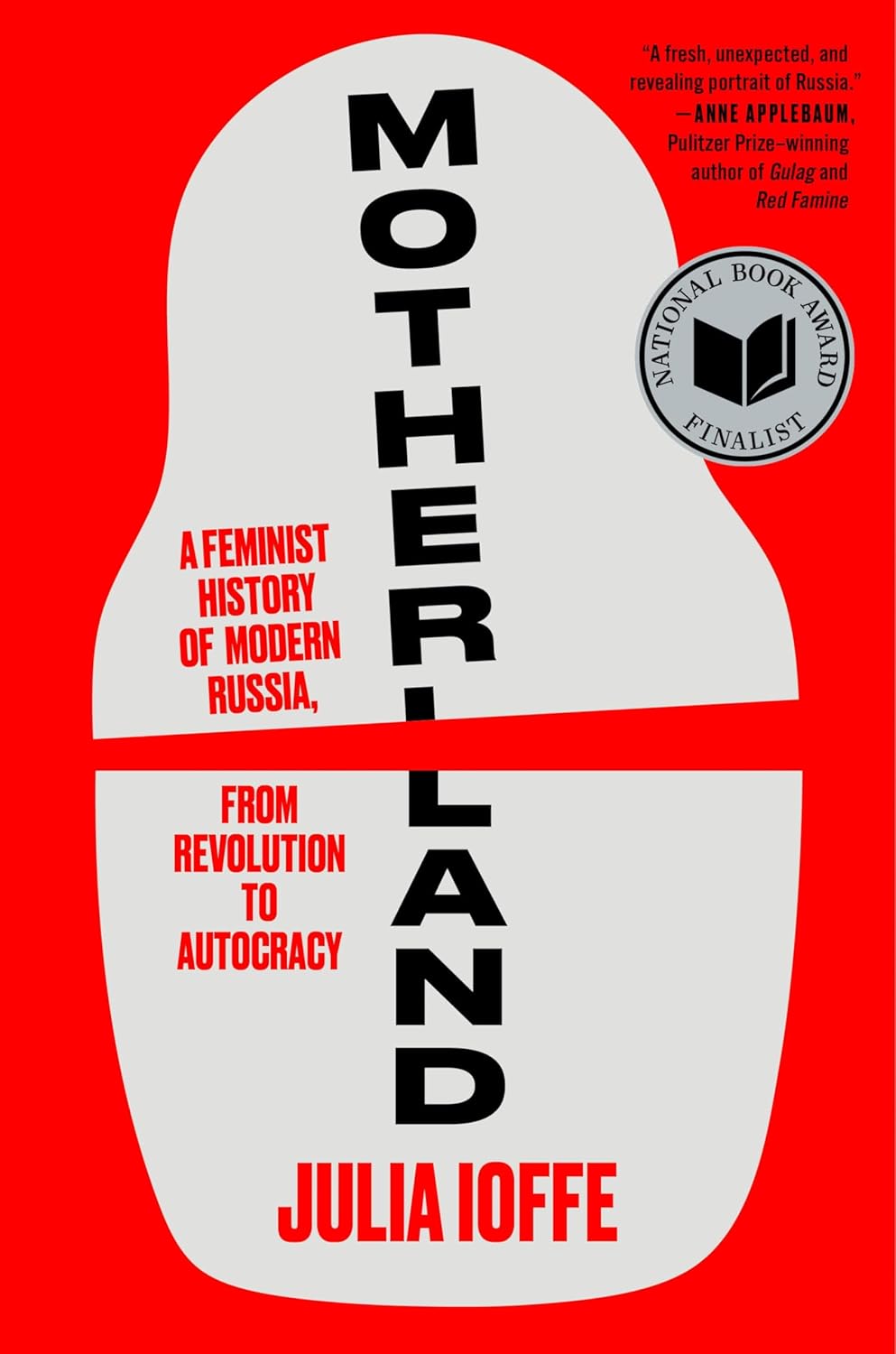
Motherland: A Feminist History of Modern Russia, from Revolution to Autocracy
- By Julia Ioffe
- Ecco
- 512 pp.
- Reviewed by Chris Bort
- January 23, 2026
Perhaps Russia’s future, if not its present, will be female.
Sometime in the 1990s, a certain type of woman emerged in Russia. You saw her at restaurants, salons, inside exclusive hotels that sprang up around Moscow in the years after the Soviet Union’s collapse. Impeccably dressed, with a pursed-lip look of boredom on her face. This was the Russian dev, short for devushka, or girl, who usually had secured a place in those chaotic days alongside a gangster or businessman — which, at the time, were often one and the same.
In Motherland, an engagingly written and accessible narrative of modern Russian feminism, author Julia Ioffe picks up the dev type a decade or so later in the story. Her emergence, with her constant struggle to keep the attention of her wealthy husband or boyfriend, is a milestone in the devolution of Russian feminism. From the heady reforms of revolutionaries such as Alexandra Kollontai and Nadezhda Krupskaya, feminism sank into the suffocating patriarchy of Vladimir Putin’s Russia.
As Ioffe makes clear, “feminism” hasn’t enjoyed a good reputation in Russia. Russians tend to regard the concept as alien and Western. Kollontai, a Lenin collaborator, felt contemporary feminists too bourgeois. Russia’s best-known feminist activists, Pussy Riot, found little support even among liberal Russians for a “punk anthem” they staged in Moscow’s main cathedral in 2012. After Putin then launched a traditionalist counteroffensive, facing little pushback from liberals, a progressive editor lamented, “When it comes to questions of gender, the liberal crowd has been quite traditionalist.”
Russia’s patriarchal mentality reasserted itself shortly after the Revolution, and by Stalin’s time, women were essentially absent from any leadership roles. Still, many of the reforms — regarding marriage and divorce, labor, childcare, literacy, and abortion — stuck, yielding some of the biggest wins for women anywhere in the 20th century. Long before it became the norm for American women to work outside the home or obtain no-fault divorce, Russian women were already doing so. What’s more, they were disproportionately employed in science and medicine.
Hence Ioffe’s dismay at women’s retreat after the Soviet breakup into more traditional gender roles. Burnout was partly to blame; women were tired of having to do everything. Much of the fault was with the Russian men who emerged after World War II — fewer in number and spiritually broken, dying young in a paternalistic state that reinforced their redundancy. Yet their relative scarcity made them more valuable. Ioffe conveys both the shortage of men and their fecklessness and casual infidelity in a series of vignettes about her own then-boyfriend (a supposedly great catch who brought out the worst in her) and trips to the remote provinces, where men are in acutely short supply.
The rise of the athletic, sober, take-charge Putin accelerated traditionalism. Suddenly, women had an attractive model of masculinity. But they took it too far, ending up in overwhelming numbers as “loyal foot soldiers” of Putin’s regime. Pussy Riot became the pretext for a fusion of church and state, to the point of Orthodox Church-promoted legislation decriminalizing domestic violence. Ioffe suggests that enabling men to beat their wives paved the way for Putin’s violence against Ukraine in 2022, perhaps stretching an analogy too far. Or perhaps not.
Ioffe weaves her family’s story among those of the notable women of the past century-plus, including Raisa Gorbacheva and Putin’s ex-wife, Lyudmila. Each “first lady” comes across as a living being with both merits and flaws, but each lives in the shadow of her husband. One wishes that Ioffe had dwelt more on Valentina Tereshkova, whose legacy as the first woman in space earns only passing praise in the book’s introduction. Tereshkova’s evolution (devolution?) into a person who implored Putin to change the country’s constitution to prolong his reign encapsulates both the triumphs and tragedies of modern Russian women.
Arguably the most sensitive and layered of these portraits is that of Yulia Navalnaya, the unbowed widow of late opposition leader Alexey Navalny. Navalnaya was her husband’s collaborator and confidante, and it’s hard to envision him without her or to think of her influence as derivative of his.
Ioffe is Jewish, and her family history is often powerful but is less about women per se and more about the plight of Jews in Russia. They suffered mass pogroms during Russia’s Civil War, even worse under the Nazis, and were about to suffer more before Stalin died. One senses that much of this — for instance, the stories of relatives who fled their hometown in time vs. those who didn’t — should’ve been reserved for a separate book. Ioffe herself draws the distinction between her Jewish and Russian identities, and thus between the narrative threads in the book, when she calls out the ignorance of Americans who refer to her as “Russian.”
She’s right to reject old tropes about Russian women’s supposedly superhuman capabilities, but what stands out about generations of women in Russia, Jewish and not, is their resilience and moral centeredness. It often works against them, as when the authorities overlook women precisely because they’re resilient, whereas it’s the men who need help. But if there is salvation for Russia someday, it seems more likely to come from women than men. Perhaps not from the pouty, oligarch-chasing women of post-Soviet Russia, but possibly from women like Yulia Navalnaya.
Chris Bort was the National Intelligence Officer for Russia and Eurasia on the National Intelligence Council from 2017-21. All statements of fact, opinion, or analysis expressed are those of the author and do not reflect the official positions or views of the U.S. Government. Nothing in this review’s contents should be construed as asserting or implying U.S. Government authentication of information or endorsement of the author’s views.