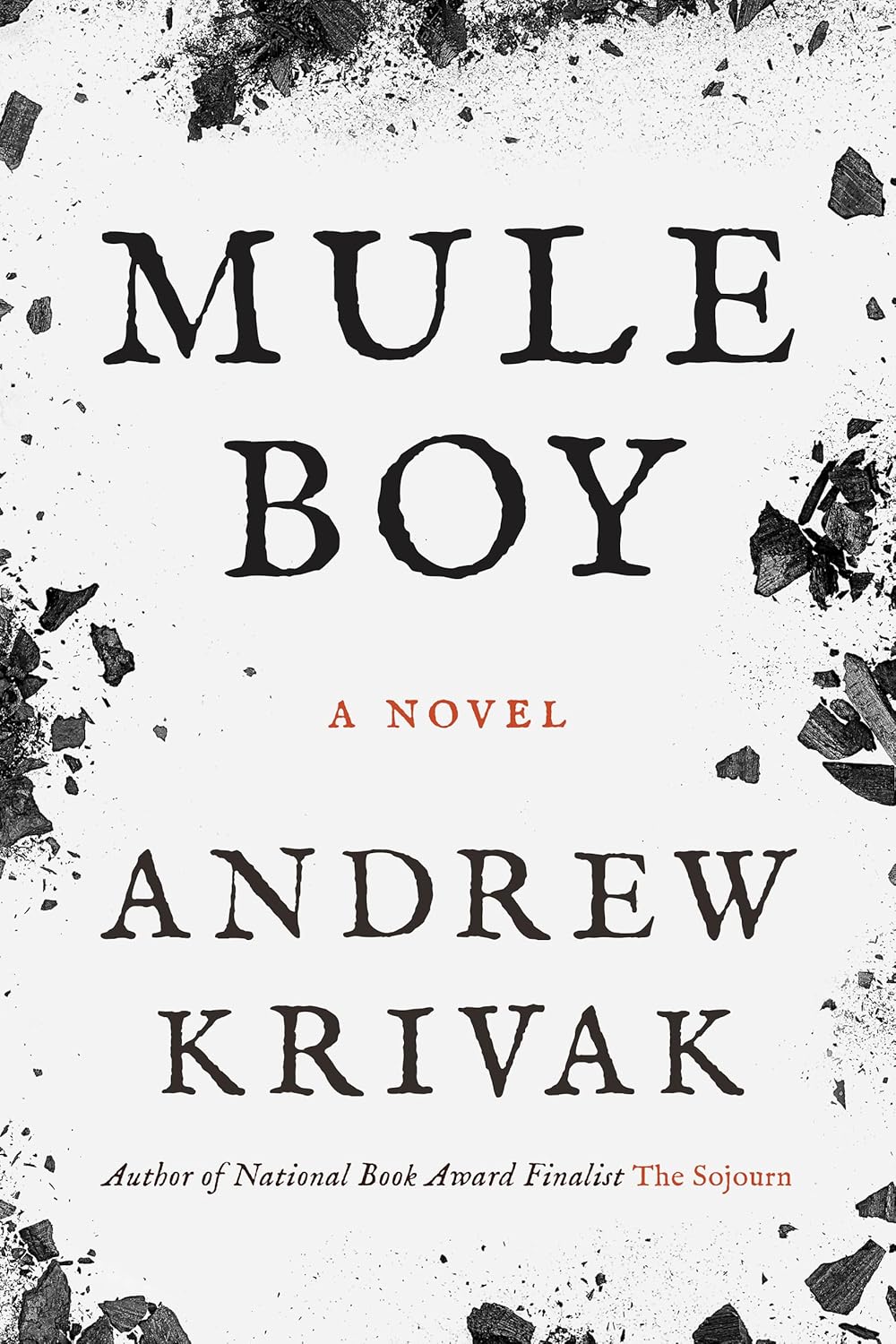
Mule Boy: A Novel
- By Andrew Krivak
- Bellevue Literary Press
- 192 pp.
- Reviewed by Raima Larter
- March 16, 2026
A young man reckons with tragedy in this poetic, mesmerizing tale.
On New Year’s Day in 1929, 13-year-old Ondro Prach starts a new job in the coal mine where his late father worked. Ondro is in charge of the mule that pulls coal-filled wagons through the Pennsylvania mine. On his first day of work, a catastrophe occurs, launching Ondro’s life onto a remarkable trajectory.
Andrew Krivak’s Mule Boy is, in a word, incredible. Told in a single, poetic sentence — with no full-stop periods anywhere — it could’ve been a challenge to read. Yet I was swept up by the deep and beautiful language and soon was so immersed in the story that I couldn’t put it down.
Krivak is a poet, and perhaps that explains his brave choice to eschew almost all punctuation, but he somehow makes it work. I was never lost or confused, even when the narrative shifts abruptly to Ondro as an old man, then back to him as a middle-aged inmate, and then back further to him as that boy in the mine.
The short novel explores the myriad effects trauma can have on a young life through unflinching depictions of addiction, problems connecting with others in intimate relationships, and the overarching, driving need for a person who suffered early trauma to achieve closure and, ultimately, to confess his own role in the tragedy. And the author does it all in exquisite prose that explores a fascinating period in American history.
Despite the book’s lack of ordinary sentence structure, Krivak is even able to convey dialogue, giving voice to characters other than his protagonist. Consider this short passage, where Ondro is released from prison:
“I wanted to kneel and weep and say an Ave, but the guard was watching and he had only my discharge on his mind that day
Let’s go, Prach, put all that stuff away so we can get you out of here, he said
and I changed into the clothes I hadn’t worn in almost three years, a little baggy on me now”
Some of the best dialogue involves conversations between the child Ondro and the miners and others in the community, including his mother. As Ondro listens to the incessant pounding of the mine machinery outside his bedroom window, he asks her if the noise will ever stop:
“and without turning to look at the structure that hulked there lit and monstrous against the banks of culm and Blue Mountain hills and sky, she said, When all creation has ceased to groan, Ondro, when all creation has ceased to groan”
The people in the community are mostly Slovaks who speak the Šariš dialect, and Krivak does an amazing job working phrases and expressions from the language into the story. He also weaves in passages in Hebrew, particularly from the book of Jonah, which plays a role in Ondro’s recovery from the disaster.
The prose shines in the sections describing the mining accident, which is rendered in vivid and unforgettable images. Some of the scenery is gritty but very realistic. Much of the action takes place in the Scranton and Wilkes-Barre area of Pennsylvania, which probably still looks very much like it did in the 1930s and 1940s. Later sections of the book unfold in a different sort of place, an isolated cabin in the woods where a much older Ondro has retreated to live a quiet life:
“And on this morning he walks down the dirt path from the house to the pond, stepping between thick white pine roots that stretch across the path like ranges across a continent and past blueberry bushes that in the summer are bent and weighed down by their plentiful and ripened fruit”
Krivak’s earlier book The Sojourn was a finalist for the National Book Award, and I wouldn’t be a bit surprised if he receives similar honors for Mule Boy. It is, quite simply, one of the most brilliant books I’ve come across in a long time. Do yourself a favor and read it.
Before moving to Colorado, Raima Larter was a chemistry professor who secretly wrote fiction and poetry and tucked it away in drawers. She has published four novels, a nonfiction book, and numerous short stories. Her most recent book, Silver Rush, is the first in a series of historical novels and novellas. Read more at raimalarter.com.