Murderland: Crime and Bloodlust in the Time of Serial Killers
- By Caroline Fraser
- Penguin Press
- 480 pp.
- Reviewed by Diane Kiesel
- May 27, 2025
Might toxic chemicals give birth to maniacs?
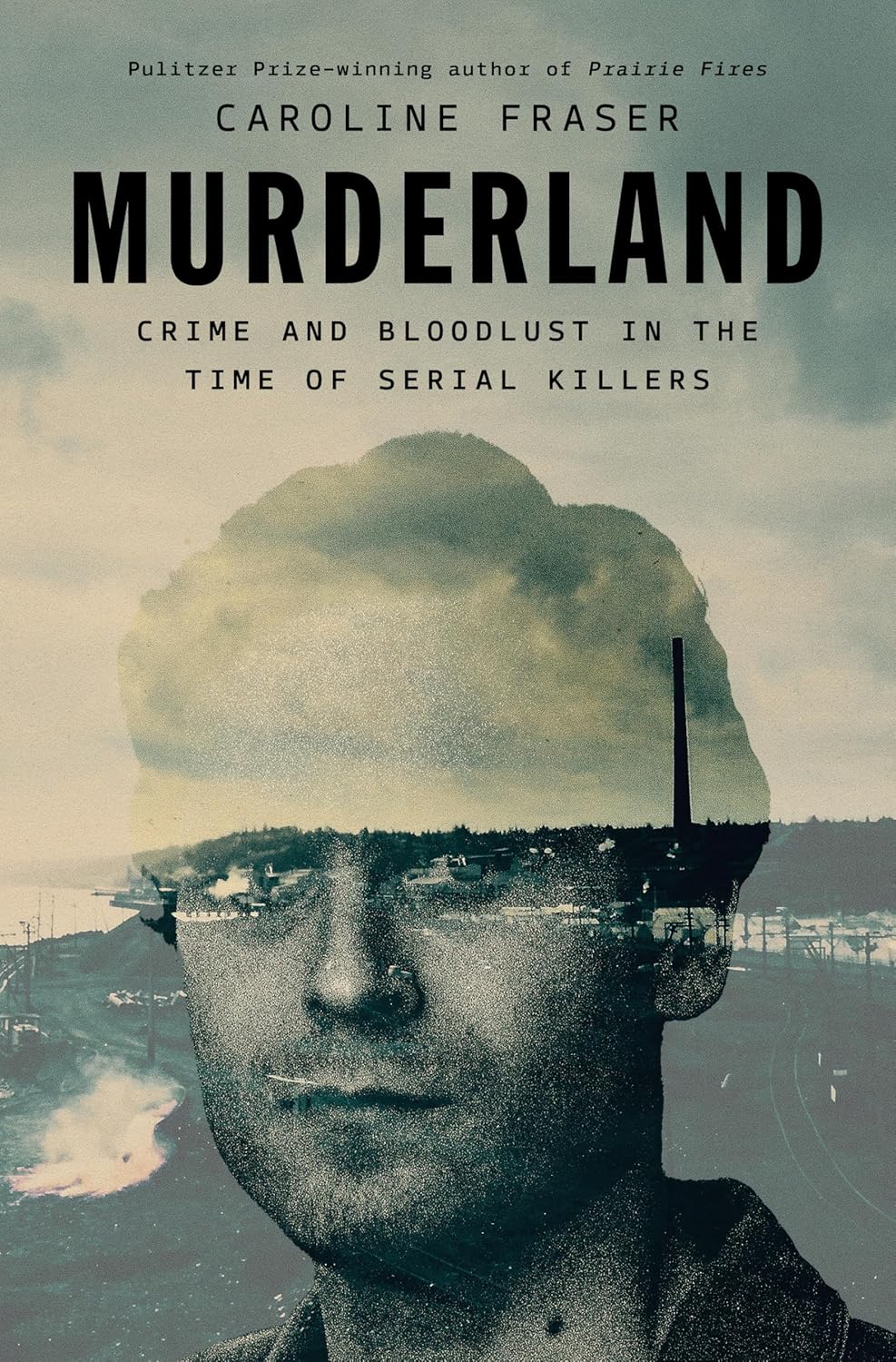
In attempting to connect the dots among the proliferation of serial killers populating the Pacific Northwest in the 1970s and 80s, the toxic chemicals spewing from smokestacks in Tacoma, Washington, and a deadly bridge design in the area, author Caroline Fraser has written a strange and compelling tale. Have we environmentally engineered a world filled with psychopaths?
The reader is left to wonder who’s more dangerous: Ted Bundy, industrial polluters, or the engineer who dreamed up the reverse-rush-hour traffic pattern to and from Mercer Island on I-90?
Initially, Murderland seems as crazy as the killers it portrays. But Fraser, a Pulitzer Prize-winning author, has the skills to pull it off, and once she gets going, the theory she espouses seems plausible. She makes the case that living within breathing distance of factories spitting out sulfur, chlorine, ammonia, lye, lead, arsenic, mercury, benzene naphthalene, cyanide, and God knows what else is more than enough to drive the inhalers nuts. Furthermore, the lush yet desolate typography of the Pacific Northwest, with its pine trees, tall mountains, and rushing rivers, makes it an ideal dumping ground for dead bodies. The result is an A+ chemistry project that yields — and shields — multiple mass murderers.
The author tells us that, by the late 1970s, America had entered “the golden age of serial murderers.” She hints that environmental criminality at worst — or environmental carelessness at best — is also responsible for a long list of other late-20th-century ills, from Watergate to the proliferation of violent street crime, but that connection seems more tenuous than the one tying epic murderers to bad air.
Fraser intersperses the disturbing stories of multiple serial killers with her own; in August 1961, when she’s 7 months old, she lives in the same Tacoma area where Charlie Manson served a 10-year federal-prison sentence on nearby McNeil Island for forgery and where Ted Bundy and Gary Ridgway (the Green River Killer) grew up. That is the month, Fraser suggests, that Bundy might’ve gotten his murderous start by sneaking into a local home during a thunderstorm and snatching an 8-year-old girl in her nightgown. The child was never seen again.
Fraser’s home life is weird; her father is a cheap, controlling, and devout Christian Scientist who drains the oil from her mother’s car so she can’t go anywhere. When Fraser’s grandmother dies of a stroke, her father blames the old lady’s death on the fact she didn’t pray hard enough.
The toxic stew cooking over Tacoma was the result of manmade structures that offered an economic lifeline to the community while simultaneously destroying it. In 1905, the wealthy Guggenheim family (one of the patriarch’s seven sons, Benjamin, died as a first-class passenger aboard the Titanic in 1912) had a controlling interest in what became ASARCO, a giant smelter responsible for 90 percent of the country’s lead production. Lead was ubiquitous in 20th-century life, used in cosmetics, bullets, paint, batteries, and ink and added to gasoline. It also eats into the brains and bones of children exposed to it.
Adding to the daily danger was the construction of a floating bridge to convey privileged commuters from the Hades-like conditions of Tacoma to what House & Garden magazine called the “upper-level suburbia” of the “vacation-like” nearby Mercer Island. “In 1961, the bridge kills more people than Ted Bundy,” writes Fraser. This death trap was created via a confusing, cockamamie feature that switched the direction of rush-hour traffic with the only warning being a series of lighted green arrows or red X’s. “People call it Suicide Lane,” she adds.
When Louise Cowell comes home to Philadelphia after giving birth in 1946 to her baby boy (the future Ted Bundy) at a Catholic home for wayward girls, she is living a stone’s throw from one of 36 lead-smelters spewing raw ore filled with mercury, arsenic, benzene naphthalene, anthracene, and cyanide. Was her son’s exposure to this poison sufficient to create a killer out of what should’ve been a normal child of the baby boom? Likewise, did air pollution leave an entire postwar generation of toddlers struggling with their inner maniac?
When little Ted is 3, Louise moves with him to Tacoma to live near an uncle. Now the boy is doing figure-eights on his tricycle in the middle of a town with 53 industrial plants pumping out even more toxins. By the time Ted is 11, he’s smacking other boys and pulling girls’ pants down. Before dying in Florida’s electric chair in 1989, Bundy confessed to 30 murders of women and was suspected of at least 36. In 1960, when annual lead emissions from the Tacoma smokestack are estimated at 226 tons, another neighborhood child, the future Green River Killer, is a dimwitted, 12-year-old bed-wetter who dreams of having sex with his mother while slitting her throat. He would go on to be convicted of 49 murders and suspected of as many as 40 more.
Fraser lists some two-dozen other psychos born right before or after World War II, including all-stars Richard Speck (the butcher of eight student nurses in Chicago in 1966), Rodney Alcala (the Dating Game Killer), and Ted Kaczynski (the Unabomber). She writes:
“Recipes for making a serial killer may vary, including such ingredients as poverty, crude forceps deliveries, poor diet, physical and sexual abuse, brain damage, and neglect. Many horrors play a role in warping these tortured souls, but what happens if we add a light dusting from the periodic table on top of all that trauma?”
There is no answer — only the question asked first by William Butler Yeats in his famous 1919 poem, “The Second Coming,” and appropriated by Joan Didion in 1968 as the title of her collection of essays about the drug-addled disintegration of California in the Age of Aquarius. “And what rough beast, its hour come round at last, Slouches towards Bethlehem to be born?” asked the poet. Replies Fraser: Perhaps a serial killer with a mind filled with rage and a body filled with poison.
Diane Kiesel is a retired judge. She is currently an adjunct professor of law and author. Her latest book, When Charlie Met Joan: The Tragedy of the Chaplin Trials and the Failings of American Law, was published this year by University of Michigan Press.