Murmurs from the Hills: Rwandan Tales
- By Scholastique Mukasonga; translated by Mark Polizzotti
- Archipelago
- 136 pp.
- Reviewed by Bárbara Mujica
- November 12, 2026
Storytelling becomes an act of defiance in this stunning collection.
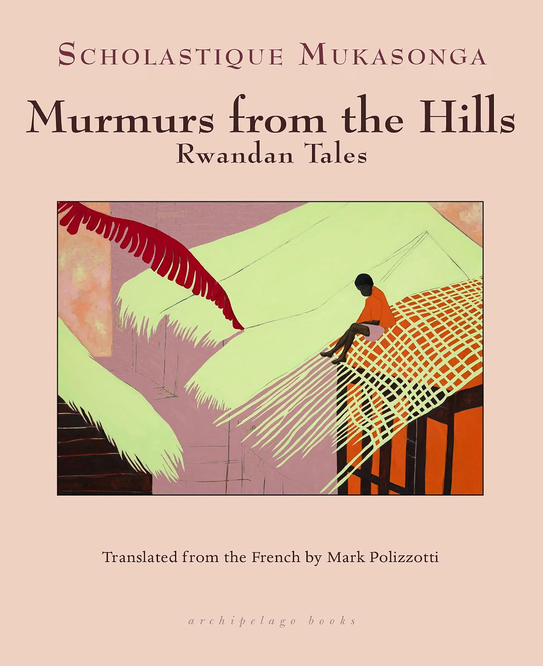
In Murmurs from the Hills, a beautifully constructed collection of loosely interwoven stories, Rwandan writer Scholastique Mukasonga draws on collective memories, folktales, and myth to evoke a world that colonialism and civil war nearly obliterated.
Alluded to rather than described in detail, the German and Belgian occupations of Rwanda provide the backdrop for these tales. European authorities radically altered Rwanda’s political and economic structure, and Catholic missionaries assumed control of education and healthcare, ignoring ancient cultural traditions. As anti-colonial movements swept Africa in the 1950s, Belgian officials shifted their support from the Tutsi elite to Hutu political leaders, triggering mass violence against Mukasonga’s people, the Tutsis.
Her stories are imbued with longing for a Rwanda uncontaminated by colonial influence and internecine violence, a nostalgia rooted in the landscape of her country — its hills, rivers, and sacred trees. The old Rwanda was a community-based society in which every member had a voice and women played prominent roles.
The opening story, “The Rukarara,” is a rumination on the sacred river on whose banks Scholastique, the narrator, was born but knows only through her mother’s accounts, as the family was uprooted and relocated during the political violence. Years later, she becomes interested in the river’s history and discovers that the Rukarara was once celebrated as the headwater of the Nile. It drew many European explorers for whom Rwanda’s Watusi giants became a “funhouse-mirror image” of the country’s inhabitants. It is a great misfortune for Rwandans, she concludes, to live at the source of the Nile.
In “The Wood of the Cross,” Mukasonga brilliantly captures the tension between Christian teachings and traditional Tutsi beliefs. Viviane, a young Tutsi girl studying in a missionary school, is thoroughly bewildered by her teacher’s exposition of Bible stories. In a hilarious scene reminiscent of David Sedaris’ Me Talk Pretty One Day, Viviane tries to make sense of the story of Adam and Eve, in which “Eve is giving her husband a mango, the kind that grows in Europe.” Viviane understands the concept of not eating forbidden food, but she has no context for “apple.” The teacher terrorizes the children with images of hell, but gluttony and sloth are hard notions to convey to youngsters who hardly have enough to eat.
Near Viviane’s home stands a church built from a grove the missionaries destroyed; its great cross was carved from a giant tree the Europeans associated with the devil, but which the community believed to have protective powers. For Viviane’s mother and the other Tutsi women, the wood retains those attributes. Before Viviane leaves Rwanda, her mother secretly cuts a slice from the cross and fashions an amulet, which Viviane always wears at her waist. “Do you think it will replace the pill?” her perplexed European lover asks cynically.
“Titicarabi” is the story of a beautiful dog that wanders into the community. When he begins to speak, he so entrances the villagers that they neglect their chores and crops. The village falls into ruin, and “Titicarabi” becomes a cautionary tale on the seductive power of empty speech: In Rwanda, to speak like Titicarabi is to ramble on without saying anything of consequence.
(Years later, in France, Mukasonga’s son tells her that Titicarabi is actually a children’s song, and the internet proves him right. Myths, the story reminds us, travel across cultures and are constantly transformed.)
“Yampaye inka Musinga — O Musinga, you who have given me a cow!” begins “King Musinga’s Cow,” a heart-wrenching story of the bond between the narrator’s grandfather and King Yuhi Musinga, whom the Belgian administration deposed in 1931 for resisting colonial rule and Catholic evangelization, and who died in exile in the Congo in 1944.
For Rwandans, cows were more than property; they represented wealth, honor, and social status. “To swear by the name of someone who had given you a cow and had thereby become your patron, your protector, and to whom you in return owed respect and service, was a common occurrence in the old Rwanda,” explains the narrator.
The grandfather once had a herd, but European diseases killed livestock and children, and the Hutus slaughtered many cows to feast on. Now, the old man has only this one cow, which he grooms “tenderly smoothing her coat,” sacrificing his own food for a ball of rancid butter with which to rub her legs.
The grandfather’s care for the animal illustrates the devotion of many Rwandans to bygone values and traditions; it is an act of defiance, an expression of loyalty to the ousted king, and a sacred duty.
“Misfortune” is a meditation on the origin of adversity. In traditional Rwandan culture, misfortune is never random: Crop failures, monkey invasions of granaries, miscarriages, the deaths of children — all are caused by malevolent spirits, the ill will of another, a broken social bond, or even the act of an ancestor.
When Anonciata loses her fifth child, the village women gather to determine the cause of this spate of misfortunes they fear could contaminate them all. The oldest opines that Anonciata’s family, arriving as the Belgians drove out the Germans, brought misfortune with it; the youngest, that the cause lies in the village itself: Anonciata’s father married her to a man whose rival cast a spell on her. The problem is finally solved when Anonciata moves away.
Through telling Anonciata’s story, Mukasonga illustrates the Rwandan belief in the interconnectedness of all things and all periods of time.
Although most of the author’s stories revolve around Tutsis, “Cyprien the Mutwa” focuses on another of Rwanda’s three population sectors, the Batwa (Mutwa in the singular), a small, marginalized group of Indigenous forest dwellers largely forgotten by the Belgian colonizers.
The protagonist, a young Mutwa, is allowed to enroll in the local school but is seated apart and ignored by the teachers. Three girls eventually defy convention and befriend him, lending him the schoolbook the teacher denied him. Cyprien turns out to be a stellar student but never gains acceptance by the school authorities. Through his story, Mukasonga provides a more complete portrait of Rwandan society than is usually presented.
Rather than dwelling on the Rwandan Civil War (1990-1994), which culminated in the genocide against the Tutsi and resulted in an estimated 800,000 deaths, Murmurs from the Hills depicts the lives of everyday people — their values, traditions, beliefs, and customs. Writing in French (and beautifully translated by Mark Polizzotti), Mukasonga serves as a master interpreter of Rwandan culture for the non-African reader.
Bárbara Mujica is a novelist, essayist, short-story writer, and critic. Her latest novel, Miss del Río, based on the life of Mexican movie star Dolores del Río, was named one of the best books of 2022 by Library Journal and one of the five best recent historical novels by the Washington Post. It was optioned by John Black Productions, in Hollywood, for a film or miniseries. Mujica’s novel Frida, based on the tumultuous relationship between Frida Kahlo and Diego Rivera, was an international bestseller published in 18 languages. Sister Teresa, based on the life of the Spanish saint Teresa de Avila, was adapted for the stage by the Actors Studio in Los Angeles. I Am Venus revolves around the identity of the mysterious model for the Rokeby Venus, the only extant female nude by Spanish painter Diego Velázquez. Mujica’s story collections are Imagining Iraq, an Amazon bestseller, Far from My Mother’s Home, and Sanchez across the Street. Her Collateral Damage: Women Write about War is a compendium of writings by women on the trauma of war. In 2022, her study Women Religious and Epistolary Exchange in the Carmelite Reform won the GEMELA Prize for best book of the year on early modern Hispanic women.