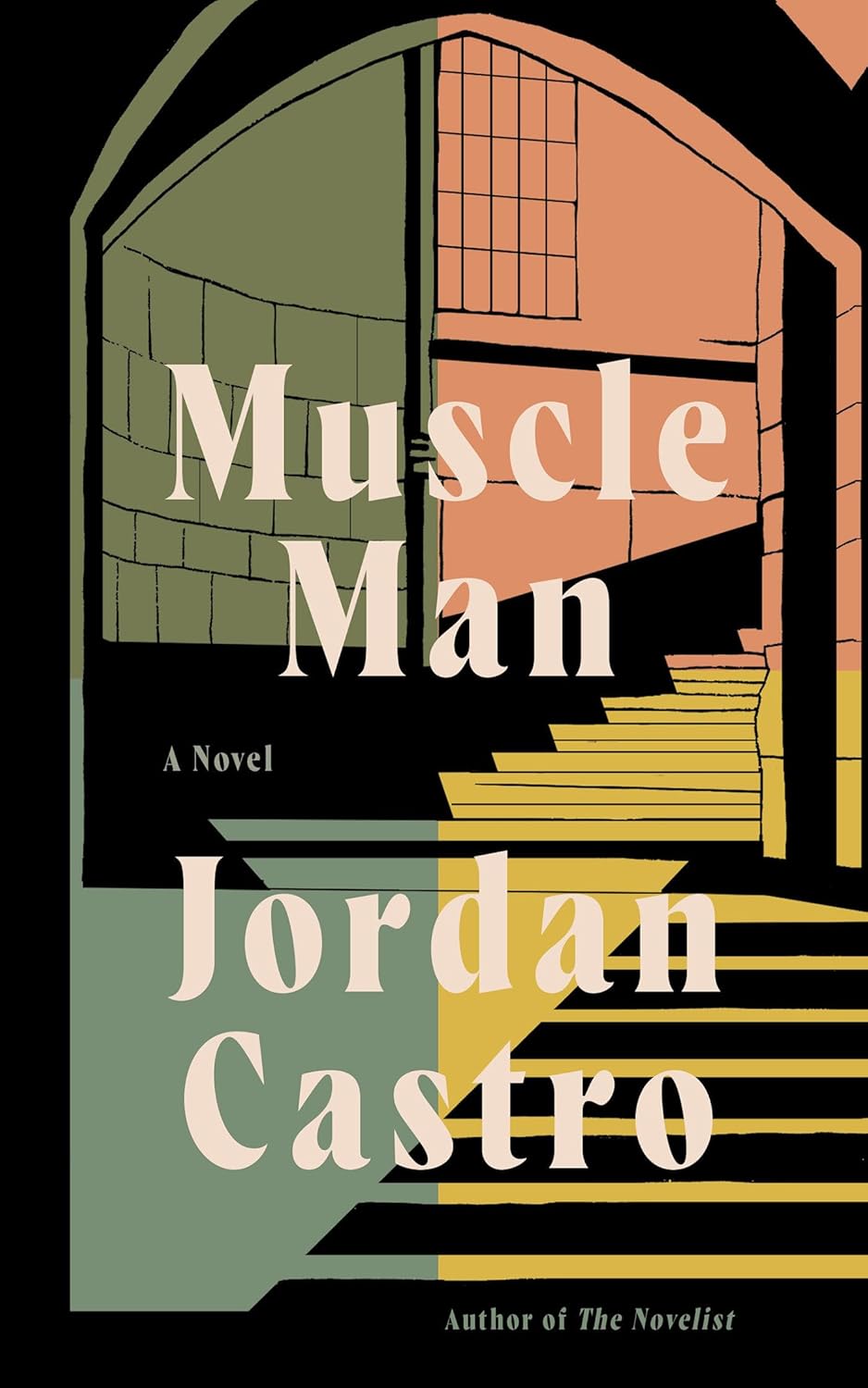
Muscle Man: A Novel
- By Jordan Castro
- Catapult
- 272 pp.
- Reviewed by Teddy Duncan Jr.
- October 7, 2025
A gym-rat professor scorns the disappointing humans around him.
Dualism, as the introductory philosophy course tells us, is the defining feature of Western thought; the body and the mind are unconditionally severed from each other. This leads to an obvious cultural conclusion: If the spheres are separate, then the activities of those spheres are discrete domains as well.
From there, stereotypes emerge — such as, for example, the mindless but muscular bodybuilder and the scrawny but (ostensibly) intelligent academic. For the bodybuilder, the mind is assumed to interfere with his task at hand; for the professor, the body interferes. The latter could be a brain in a jar equipped with a keyboard; the former could be a headless body wielding a dumbbell. Consider the compounding associations: vitality versus ethicality, immediacy versus reflection, and strength versus intelligence.
In Jordan Castro’s newest novel, Muscle Man, we see the interplay between these spheres and the impossibility of a partition between them. Muscle Man spans a late afternoon into an evening: Harold, an English professor, attends a meeting at his university, goes to the gym, and then returns to campus for a second meeting.
The novel’s two locations — the university and the gym —represent the binary training grounds for the mind and the body. We’re told Harold has recently been working out intensely, becoming “shredded, around seven or eight percent body fat.” He’s come to hate his job and live for the gym.
The book’s action, such as it is, would barely be enough for a five-page story. Its substance instead derives from Harold’s interiority, which the reader has unmediated access to. His is a bleak and alienated perspective, equally narcissistic, self-loathing, and misanthropic. Castro’s debut, The Novelist, possessed a similar second-by-second interiority. But if The Novelist was about addiction, impulsivity, and change, Muscle Man is about contempt and its attendant delusions.
The novel invokes Dostoevsky’s Notes from Underground, a book whose protagonist, too, displays a fatalistic disdain for others. There’s even a meta-textual layer at play, since both Harold’s fiction and his professional work (a somewhat odd, though not entirely implausible, combination for an academic) are considered “underground” scholarship. Muscle Man itself fits neatly into this designation.
As a character, Harold festers “underground,” hating his colleagues, viewing them as physically weak and pitiful conformists, as “cretinous, nosy, explanation-obsessed bugs.” He calls students “mentally defective.” To him, anyone who acts as if their body — the grounding for their very world — does not exist is disgusting.
Despite this nearly ubiquitous contempt for others, he is not a self-assured man who heroically confronts the world with resolve. Rather, Harold reduces the universe to a small point, collapsing on himself. He is unsure how to behave at departmental meetings, visibly anxious and awkward when encountering a woman at a water fountain, and unable to communicate with fellow gym-goers in the steam room.
There’s an implacable truth in Harold’s self-alienating disposition — an orientation that comically inflates the self while negating others. Through it, Castro calls out our worst impulses: The pretension to divide the world into us and them. For Harold, “us” is a hyper-narrow sliver (limited to a few fitness gurus, his professor-friend Casey, and fellow gym rats), while “them” is unlimited. As he tells himself, they are “self-evidently lesser,” unworthy as companions or even casual interlocuters.
But what we hate in others is often precisely what we refuse to see in ourselves. And we can’t totally disregard Harold as a crazed narcissist (though he surely is one), since he often aims his disdain — keenly felt but never spoken aloud —at deserving targets. For instance, when campus-wide alerts are sent out after violent crimes, the evil acts aren’t decried for their vileness but are instead cast as an opportunity for a “time of reflection.”
Harold is also correct in his insistence that we’re fully corporeal; there’s no platonic “non-body” to appeal to. Only by merging the physical with the mental can we be whole. Yet, Muscle Man confirms the limits of the individual: Even when perfectly synthesized, as Harold feels he is, there’s no such thing as a truly self-sufficient being. His rejection of others and assertion of his own primacy isn’t a strength. In fact, it’s what renders him weaker than weak.
By the end of the novel, Castro lays bare the truth behind Harold’s clandestine hatred and self-silencing. He is shown to embody the very weakness he rails against — but he is far from the only one.
Teddy Duncan Jr.’s freelance writing has appeared in publications such as the Observer, Document Journal, Compact Magazine, ASAP Journal, and others. His scholarly work is in Between the Species, Latin American Literary Review, the International Review of Zizek Studies, the Midwest Quarterly, and Journal of Excellence in College Teaching. His new book is Interpreting Meat: Theorizing the Commodification and Consumption of Animals. He can be reached at [email protected].