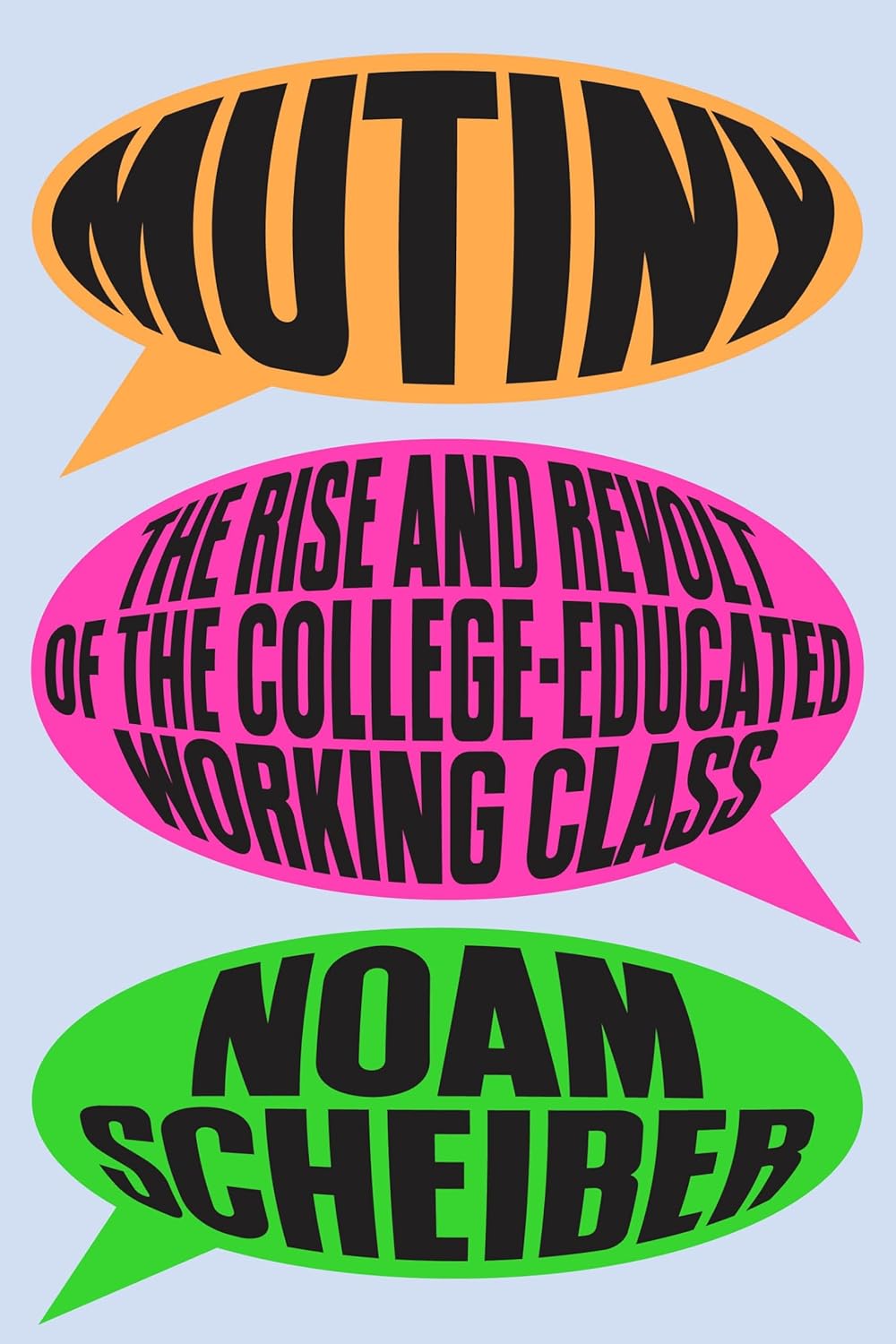
Mutiny: The Rise and Revolt of the College-Educated Working Class
- By Noam Scheiber
- Farrar, Straus and Giroux
- 384 pp.
- Reviewed by Tim Hirschel-Burns
- April 20, 2026
That bachelor’s degree doesn’t go as far as it used to.
When a post-pandemic surge of labor activity erupted — successful unionizations at Starbucks and Amazon, Hollywood writers and actors strikes, a defenestration of the UAW’s leadership — it was notable for two reasons.
First, it sparked a revival of the American labor movement after decades of decline. From a 1950s peak, when one-third of U.S. workers were in a union, the rate had dropped to single digits. But the post-covid years pushed that number upward, and Joe Biden even became the first president to walk a picket line.
There was something else notable about this labor surge: Many of its participants had gone to college. The confluence of these dynamics is the focus of Noam Scheiber’s Mutiny: The Rise and Revolt of the College-Educated Working Class. According to the New York Times reporter’s account, a growing class of downwardly mobile college graduates has adopted a “politics of the underdog.” People who might’ve aspired to become the boss a generation ago are now waging war against the bosses.
Mutiny is driven by deep reporting on some of these people. One of them is Teddy Hoffman, a Watson Scholarship winner who fell into working behind the counter at Starbucks as his theater dreams never quite materialized. He helped instigate unionization at his Chicago store, challenging a corporation whose long-serving CEO, Howard Schultz, resented the appearance that a union was needed to compel the company to respect its employees.
Chaya Barrett was raised seeing college as the ticket to a prosperous future, and she had long bought into Apple’s image as a futuristic pioneer. A job at a Maryland Apple Store seemed likely enough to fulfill these aspirations, but Chaya’s disillusionment grew amidst shift cuts, rent and student-debt pressures, and corporate policy shifts that envisioned her more as a retail worker than the IT professional she saw as befitting of her education. A union became the channel for her frustration.
The Starbucks and Apple union drives provide the heart of the narrative, but Mutiny also makes extended detours to the Amazon Labor Union, Hollywood strikes, the UAW, and more. In each case study, Scheiber introduces a vivid set of personalities at is center. The author is an effective storyteller, and the case studies are deeply reported, providing a workplace-level view of how labor struggles actually play out: the spreadsheets sorting employees based on their likely warmth toward a union; the obstinance of C-Suite executives determined to show that unionized workers don’t win better terms; and the sense of purpose unionization efforts give to workers who see their lives drifting.
While Scheiber is skilled at weaving his narrative, Mutiny’s content sometimes seems to diverge from its headline subject. Set up as a book about the malaise and anger of the college-educated working class, it is — at least in terms of word count — largely a granular account of labor struggles at a few big-name corporations. It’s notable that many of the protagonists in those struggles are college grads, but Scheiber devotes more attention to Steve Jobs’ legacy at Apple and baristas’ stress over increasingly elaborate Starbucks orders than he does to electoral politics or the other domains where “the rise and revolt of the college-educated working class” might play out.
Still, if Mutiny gives a somewhat sparse rendition of its broader argument, it is nonetheless a compelling one. The skyrocketing wealth of the super-rich leaves most college grads’ socioeconomic position much closer to those without a degree than to the elite subset of their fellow graduates. Scheiber also notes that recent AI breakthroughs have meant that “knowledge work suddenly looked vulnerable to the automation that had cannibalized blue-collar jobs for generations.”
For all the post-2024-election commentary arguing that possession of a bachelor’s degree now constitutes the primary political dividing line, Mutiny’s epilogue makes a convincing case that graduates and nongraduates have actually been growing closer when it comes to economics.
Historically, the best predictor of revolutions has not been absolute deprivation. Rather, it is relative decline that’s far more likely to spark the collapse of a political order, when a critical mass of people feels the system has lost its ability to deliver the future they were taught to expect. From the Russian Revolution to the Arab Spring, disillusioned college grads have often been at the heart of these movements. If the United States does undergo a political revolution like the one Bernie Sanders famously called for, what Mutiny deems “the college-educated working class” won’t be far from the center of the action.
Tim Hirschel-Burns is a policy advocate and writer based in Washington, DC. He holds a J.D. from Yale Law School and has written for publications including the Los Angeles Review of Books, Foreign Policy, and African Arguments. Find him on Bluesky at timhirschelburns.bsky.social.