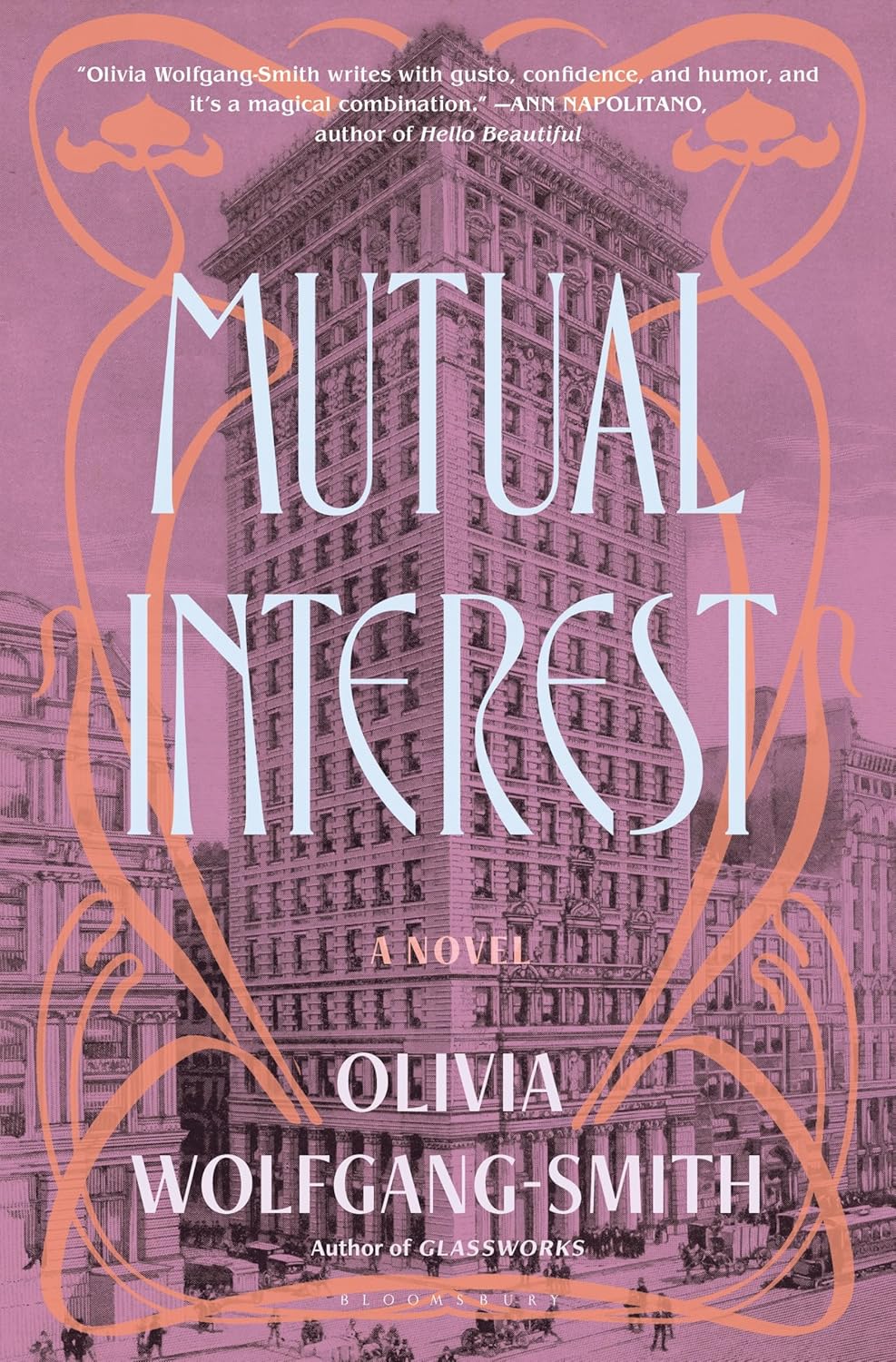
Mutual Interest: A Novel
- By Olivia Wolfgang-Smith
- Bloomsbury Publishing
- 336 pp.
- Reviewed by Carrie Callaghan
- February 19, 2025
An apparent story of manners digs much deeper, hitting philosophical bedrock.
In 1898, a 17-year-old girl is hurtling along a winding Upstate New York road on a bicycle. Drunk. She does so 83 years after a volcano on the other side of the world erupted and set in motion a transportation shortage that would (we’re told) lead to the creation of this liberating wheeled contraption. Vivian, our cyclist, knows nothing of that. But she is certain she wants out of her stifling home in Utica. With that beginning, Olivia Wolfgang-Smith’s second novel, Mutual Interest, casts a gimlet — yet affectionate — eye on Vivian’s launch into life.
With her body leaning back against another girl, the one actually doing the pedaling, Vivian feels both the exhilaration of speed-induced freedom and some inklings of pleasure. For she has no interest in the marriage-and-babies future her parents have in mind for her. Those parents, “devoted curators of vast and inarticulate pain,” are only too happy to let Vivian follow her wealthy friend to New York City, in what purports to be a short trip but which Vivian sees as her escape hatch.
Vivian proves adept at ingratiating herself both into wealthy salons and the beds of first one young woman and then another. But time and patriarchy take their toll, and soon the handle of her parasol is looking decidedly worn. Her stomach is empty, her future bleak — until she sets her sights on an eminently eligible bachelor, about whom rumors swirl. But not the good kind.
Oscar Schmidt is in the personal-care business. He oversees a regional soap operation, which was his own escape hatch from his dismal and guilt-ridden childhood in central Ohio. There, he inherited his family’s self-hatred by developing a crush on the local (male) store clerk. In spite of Oscar’s tall stature and aptitude with various farm implements, he can’t feel at home in his body. He moves to the city, where he alternately tortures and pleasures himself in back alleys and a rotating circuit of tawdry bars, where men wink at one another and disappear into the washroom together. But rumors gather like malevolent spirits and threaten to tear his reputation to shreds.
Oscar’s reputation matters because his commercial success, his only entrée into society and assurance of a refuge from the Midwest, is now under assault: An eccentric (would we say neurodivergent?) and wealthy dilettante with a passion for candles is elbowing his way into Oscar’s supply chain. Squire Clancey, with a name as haughty as his old-money pedigree, is also fleeing an uncomfortable home life, though his parents try harder than Vivian’s to find a way to love him.
Vivian is a puppet master extraordinaire, manipulating others’ emotions and finances to serve her needs. But the omniscient voice of this wry novel doesn’t spare her from its analysis: We see her weaknesses, too, even when she does not. Such insight turns what might otherwise be a manipulative woman into a sympathetic one, as we know Vivian’s wounds and blind spots.
The author excels at balancing mirth and menace here. Her characters find — or redefine — success while New York’s Gilded Age swirls around them in beautiful color. Her writing sparkles with the glitter and edge of Art Deco beveled mirrors.
Still, as the characters twirl and wind around one another as in the best novels of manners, a reader might be left to wonder what, beneath the enameled lacquer, it all means. Is the story about a strange love triangle and the accommodations we can force, if we try hard enough, upon our own circumstances? That seems too narrow. Instead, “there are no stakes but the global; there is no timeline but the infinite,” the book tells us both at the beginning and end. We are aiming beyond a love triangle.
Wolfgang-Smith has audaciously combined the clear-cut features of a realist novel with a couple of random explosions — literally. If the question of every human narrative is “destiny or choice,” she seems to come down squarely in the middle. Vivian, Oscar, and Squire are buffeted by the winds of chance, but they also have the fortitude to pilot their own lives.
Or do they?
“There is no threat so unbearable as randomness,” our invisible narrator tells us. Mutual Interest takes the randomness of chaos theory and mixes it with characters who bend their lives to their wills. Such courage might have been — and will again be — particularly necessary for gay, lesbian, queer, and other marginalized people, who once had little help from the world in building their happy endings. But for those among us who find companions loving enough to hold our hand as we leap across the crevasse, away from certainty and toward something like happiness, courage might not be as elusive as it seems.
Carrie Callaghan is the author of the historical novels A Light of Her Own and Salt the Snow. She lives in Maryland with her family and four ridiculous cats.