A slim, surprisingly reassuring treatise about censoring the shelves.
Stanford University linguist Arnold M. Zwicky describes the recency illusion as one of those cognitive distortions in which people understand things in the world solely on the basis of their personal experience with them. More specifically, he defines it as a cognitive bias in which one thinks a thing originated recently simply because that person only noticed it recently.
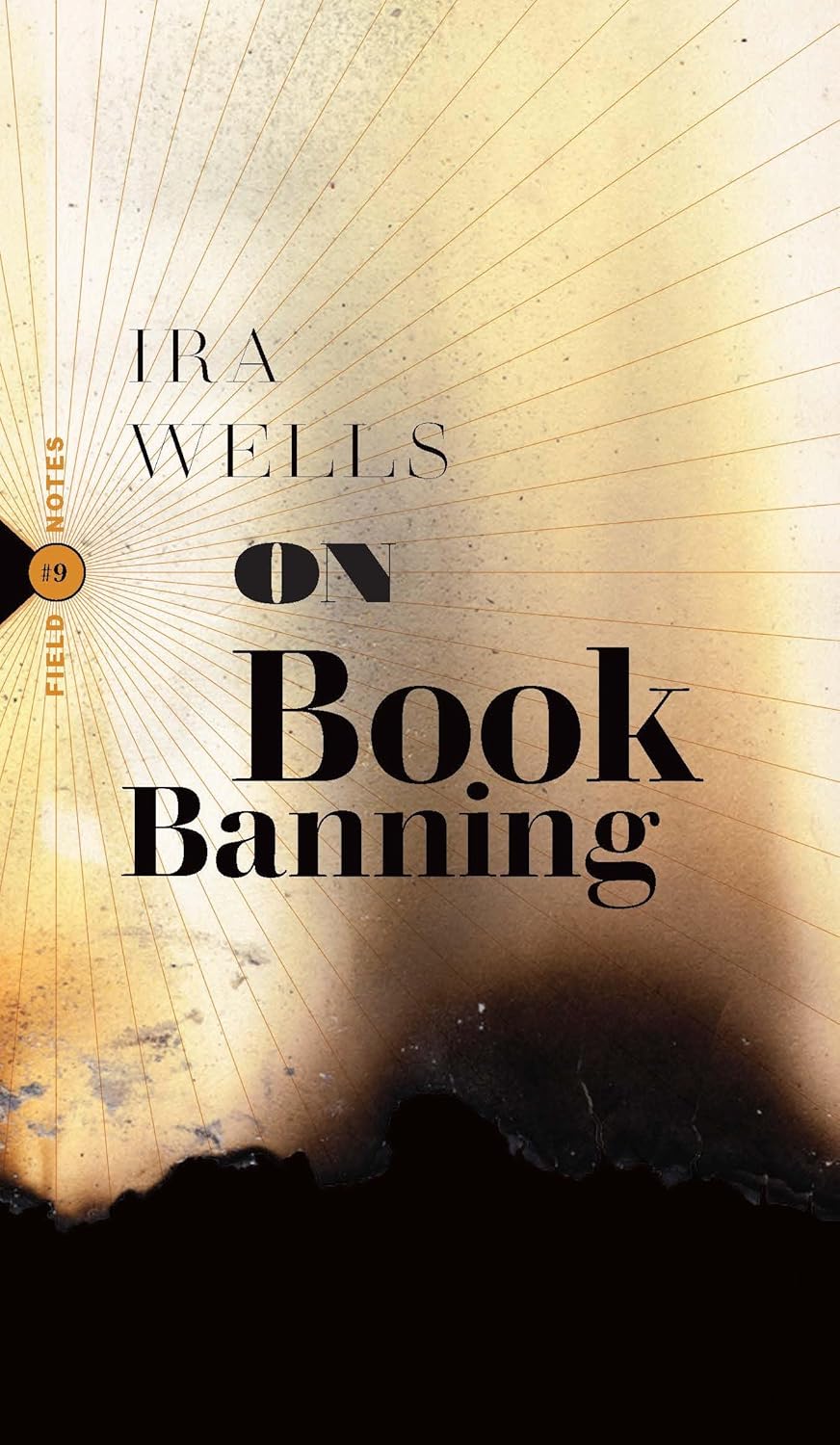
North Americans’ fully warranted alarm over politically motivated gag efforts like book-banning may be similar. We are accustomed to certain liberties and, perhaps, have taken them for granted. Now that they’re threatened, we point to one person, one group of politicians, one time in history (this one) and perceive it as newly problematic or specific to this milieu. In On Book Banning, University of Toronto literature and humanities professor Ira Wells clarifies: We have always sought to silence those whose views make us uncomfortable.
Wells’ pamphlet-like book — the ninth in Biblioasis’ “Field Notes” series — explores the nature and history of book-banning. Its strongest chapters take readers back through much of Western history to campaigns for and against book-banning on “moral” (read: sexually repressive) grounds. There are wonderfully engaging explorations of the contributions of John Milton, John Stuart Mill, and Andrew Carnegie to the West’s commitment to the free sharing of ideas. There’s also a fascinating — if a little creepy — account of a lesser-known figure named Anthony Comstock. (Spoiler alert: He was a chronic masturbator who founded the Society for Suppressing Vice. Go figure.)
The scope of this book is broad. Fortunately, Wells excels at that writerly skill of toggling easily between good storytelling and helpful summative assessments. For example, after telling us about Comstock and engaging in some Freudian theorizing about “psychic censorship,” Wells gives us well-researched theory of his own:
“Thinking back over the history of censorship, we see how the impulse to censor conforms to certain broad types. The paranoid censor silences others to consolidate power or safeguard his own ego…The righteous censor sincerely believes that if people were permitted to publish or speak as they please, the social order would collapse…The perverse censor takes pleasure from his daily rubbings with the taboo, and thrills at explaining the vices of others.”
On Book Banning is fine public scholarship, although I don’t see it as centrally concerned with how censorship “trivializes art” or “undermines democracy,” as its subtitle announces. Those ideas are in there framing the work, but it’s the historical, psychological, and philosophical explorations that really characterize the narrative and distinguish it from the other volumes on the topic.
Wells expertly teases out the philosophical and ethical positions of free-speech advocates and opponents alike, the latter of whom “are fighting for control of our collective past.” His position is clear. The book’s emphasis on human history and our tendency to oppress by suppressing, however, is fascinating. Taken as a whole, I think Wells is saying that “libricide” and “literary treason” are as old as time. This is who we are and have always been. What will we do about it now?
If the book contains flaws, they show up in later sections on critical race theory (CRT). In chapter four, he describes a disturbing incident in a Canadian school and connects it to CRT in a manner that I’m not sure those CRT theorists deserve. The incident — the 2023 “mass purging” of older books from K-12 libraries in a large district in suburban Toronto — is indeed troubling. Libraries there threw out thousands of books published before 2008 in an attempt to weed out old, Eurocentric (and lots of classic) literature.
Wells rightly criticizes the event and names the harm done. But his analysis juxtaposes those unfathomable actions with excerpts from Matsuda et al.’s 1993 Words that Wound: Critical Race Theory, Assaultive Speech, and the First Amendment. It wasn’t entirely clear, but it seemed to me that Wells was suggesting this 22-year-old, lawyer-authored volume on litigating hate speech somehow informed the Peel District’s actions. I skimmed both the district’s guidelines for what they call “anti-racist weeding” and my copy of Words that Wound but couldn’t really make sense of the connection Wells drew between Peel’s actions and the much-maligned, commonsense legal theory. It seems that Wells’ link between CRT, “CRT-inspired ideas,” “CRT-adjacent” work, and the book-purging is his own.
I wish he’d read more recent and more relevant work on CRT in education. (Please see this article of mine for clarification on what CRT in education actually is.) Wells seemed not to be demonizing CRT by misdescribing it — as so many politicians and politicized racists are doing here in the U.S. — and may only have been seeking balance between critiques of the Right and the Left. But he veered a bit out of his lane.
Despite this, On Book Banning is just the kind of work I like these days: one in which an author studies a matter deeply and then boils it all down into something readers can digest. The book has dozens of footnoted sources but is a concise and focused five chapters, and Wells is a respected academic who writes in accessible, engaging prose. It’s good reading for a weekend.
As we commit to lifting society out of its current draconian mood, we’ll do well to keep simple truths like Wells’ beautifully expressed maxims in mind:
“Libraries cannot uphold intellectual freedom while aggressively weeding ‘problematic’ resources and limiting all new acquisitions to material that supports a single, totalizing ideological program…Literature isn’t reducible…[but] reducing literature is precisely what censorship does: With its ideological checklists or puritanical frameworks, it reduces literature to a shrunken, misshapen parody of itself. A novel teeming with voice and perspectives becomes a single ‘message,’ or a wicked idea, a naughty image, or even a single, abominable word.”
Despite its unsettling topic, On Book Banning is oddly soothing. With the exception of its unfortunate overreach into CRT, the book feels like a reassurance from someone with expertise that we might end up okay. Wells doesn’t say this directly, but his strong subtext is we’ve been here before, which reminds me that we’ll move past it again. Readers who value the written word, democracy, and art will be inspired to work toward that day.
Sarah Trembath is an Eagles fan from the suburbs of Philadelphia who currently lives in Baltimore with her family. She holds a master’s degree in African American literature and a doctorate in Education Policy and Leadership. She is also a writer on faculty at American University. She reviews books for the Independent, has written extensively for other publications, and, in 2019, was the recipient of the American Studies Association’s Gloria Anzaldúa Award for independent scholars for her social-justice writing and teaching. Her collection of essays is currently in press at Lazuli Literary Group.
.png)