On Fire for God: Fear, Shame, Poverty, and the Making of the Christian Right — a Personal History
- By Josiah Hesse
- Pantheon
- 368 pp.
- Reviewed by Arthur Ivan Bravo
- March 17, 2026
A man reflects on becoming an “exvangelical.”
“I am surrounded by hundreds of other preteens…The boys beat their chests, rip at their hair, and scream like they are being dragged through barbed wire…we’ve been instructed to give every last dollar in our wallets to tonight’s offering…We are sinners, and, try as we might, we will never feel clean.”
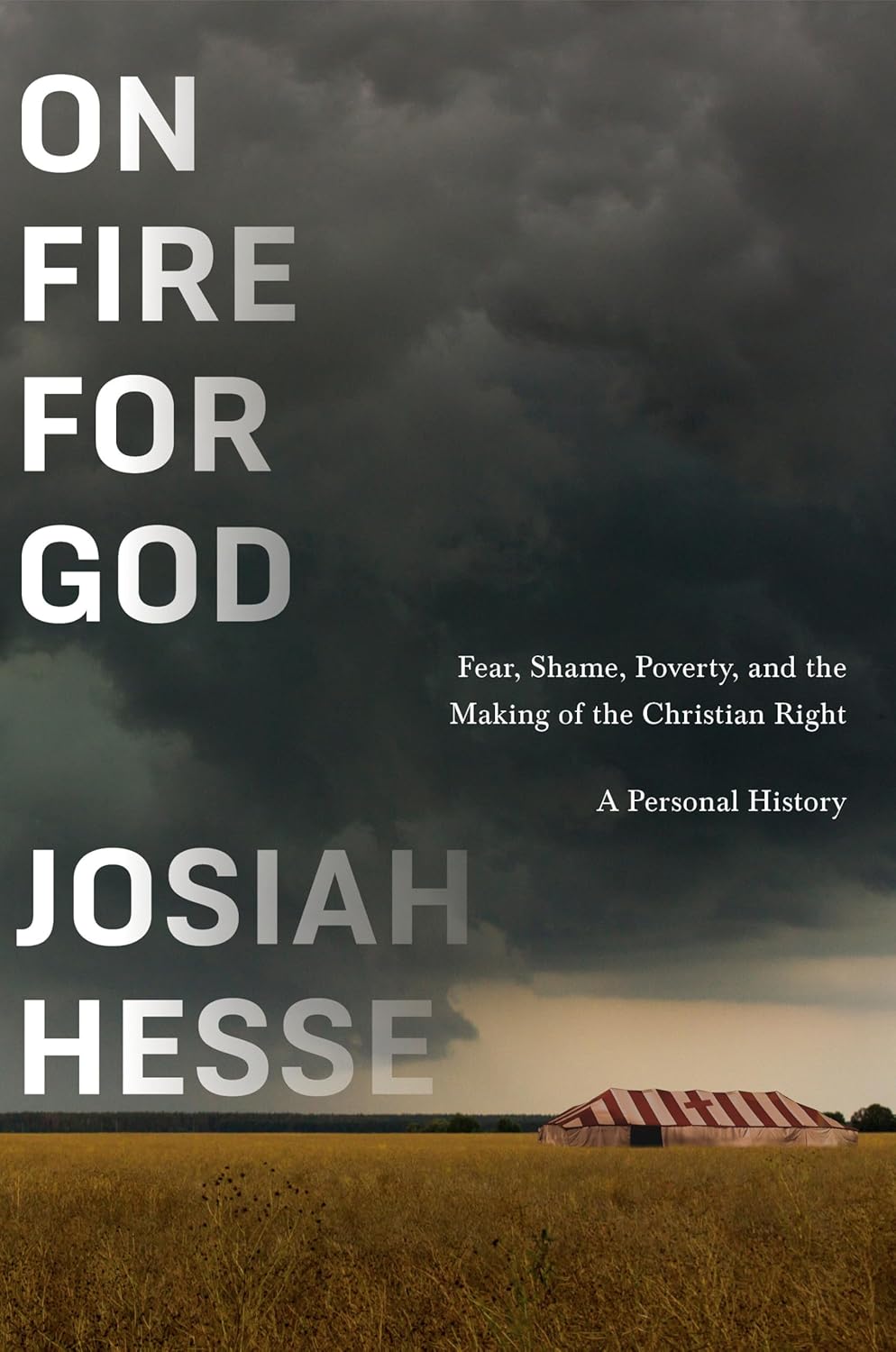
So begins On Fire for God, Josiah Hesse’s searing memoir of “exvangelization,” his journey away from the evangelical Christianity into which he was born. As topical as it can get, the book fearlessly confronts many of the cultural and political issues raging in America today, while remaining — to its credit — a distinctly personal and intimate account.
The story follows Hesse, now a Denver-based freelance journalist, from his 1990s childhood in semi-rural Iowa through the highs and lows of his self-discovering adulthood in the 21st century. From the vantage point of a mature, secular lifestyle (which includes an openness to alternative spiritual practices), he reflects not only on the trajectory of his life, but also on evangelical Christianity’s influence in recent American history.
By placing his own story amid the experiences of flyover country’s white working class, Hesse tell us as much about them as himself. These communities — filled, in the mid-20th-century, with people who felt left behind in a rapidly modernizing and globalizing postwar world — succumbed to the lofty but false promises of conmen who contorted Christianity’s hopeful message, with the intent to swindle. The relentless epidemic of poverty, depression, and substance abuse in these places isn’t your fault, the people were assured. It’s their fault. Hence, the xenophobic blaming of others that continues to poison a large swath of the American electorate.
After setting the stage with brief forays into the historical relationships among those faux-Christian evangelical grifters, right-wing factions, and corporate interests, Hesse offers a painful account of his own ancestors, who sought salvation by pouring their meager resources into the church while contending with infidelity, domestic violence, substance abuse, and scarcity at home. By the time Hesse was born, little had changed. “My parents gave an estimated $125,000 to our church in less than a decade,” he writes, “while we ate burnt tater tots bought with food stamps.”
The memoir makes several shifts in perspective and jumps in time, and it’s all rendered vibrant by the author’s many you-had-to-be-there-to-know-about-it pop-culture references. Here, he recalls finally indulging a longtime secret interest in secular music:
“…flipping through CDs at Walmart…my breath quickened, my heartbeat doubled, and my hormones pulsed as my fingers caressed the faces of Ricky Martin, Sugar Ray, and the Goo Goo Dolls’ Johnny Rzeznik.”
Hesse’s voyage toward a different kind of life is gradual and subtle, as is his loss of faith. Along the way, he struggles with feelings of inferiority, develops a temporary habit of self-mutilation, and grapples with the dawning realization of his bisexuality. As a young adult, he finds himself in the same situation as so many around him: lacking an education and a purpose, and indifferently moving from one low-paying job to another.
It’s in recalling this period that Hesse offers his most pointed critique of what has befallen his community and others like it. Interestingly, it’s through the writing of these harsh reflections — which required a return to Iowa to interview family and friends — that he is ultimately heartened, finding some of the closure he’d been looking for. After reading On Fire for God, others might, too.
Arthur Ivan Bravo is a teacher, writer, and Ph.D. student in anthropology at SUNY Albany. He lives in New York City.