One Aladdin Two Lamps
- By Jeanette Winterson
- Grove Press
- 272 pp.
- Reviewed by Nicole Schrag
- February 2, 2026
A mesmerizing treatise on better living inspired by an ancient Arabic tale.
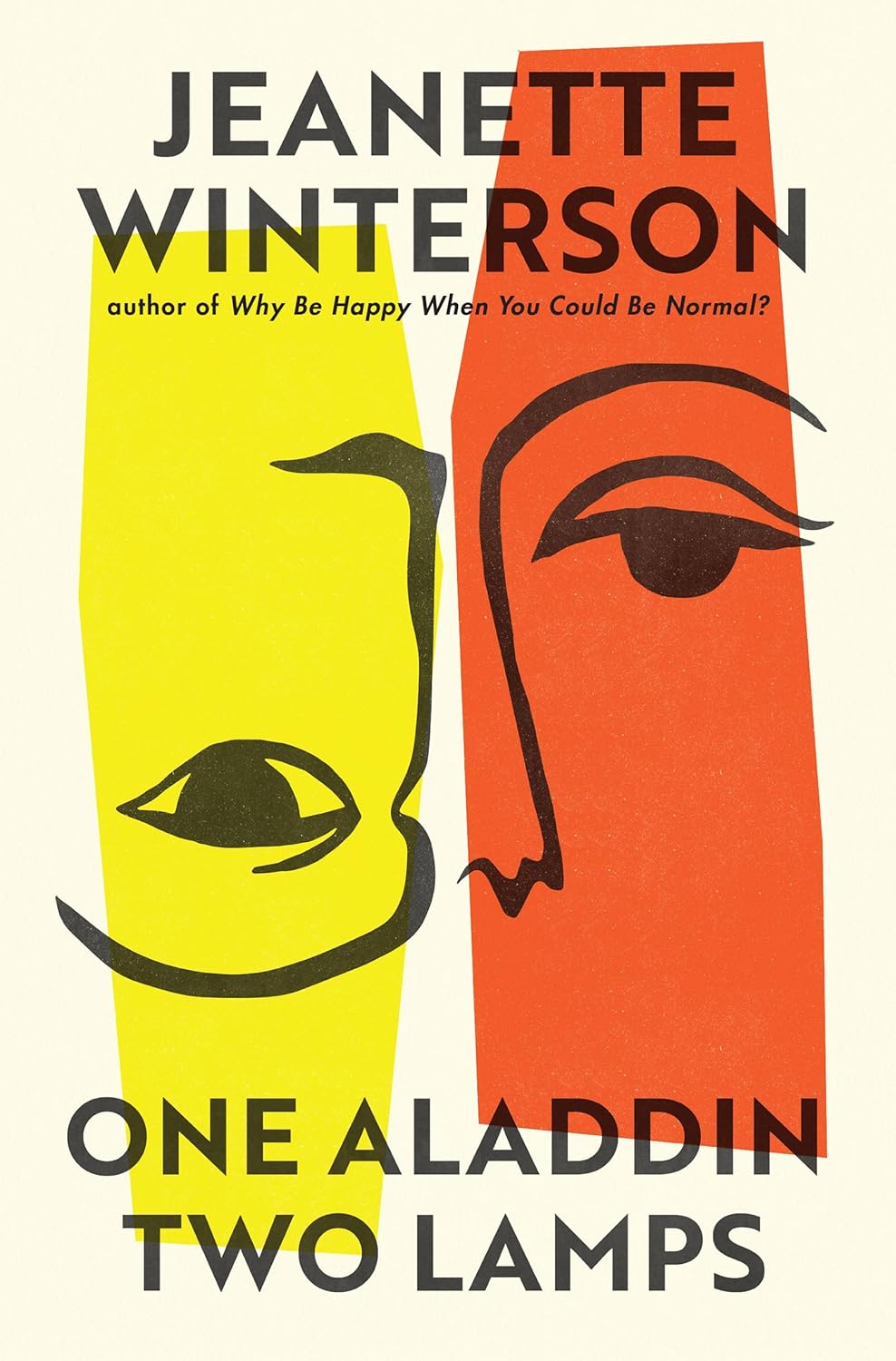
One Aladdin Two Lamps delivers the formally inventive nonfiction that Jeanette Winterson is so good at, mashing up memoir, political commentary, and mini analyses of everything from Shakespeare’s A Winter’s Tale to Taylor Swift lyrics. But above all, it contains Winterson’s extended meditation on One Thousand and One Nights.
The book makes for such a smooth, funny, provocative reading experience that it’s easy to miss its breathtaking range. Winterson’s imaginative leaps are made possible by her Arabic source text, which is famous for its multilayered stories, twists of fate, and new beginnings. Her reading of the Nights is an argument for how storytelling — then and now — is crucial for survival and for sustaining the possibility that we might even thrive.
Yet to say One Aladdin Two Lamps is about the power of storytelling risks underselling it. Winterson offers a beautiful, book-length reading of the Nights that delights in the absurd tales, recounting them in her own hilarious voice to examine how their themes of gender oppression, sudden turns in fortune, justice, mercy, and forgiveness resonate today. Partly, it focuses on the power of Shahrazad, the storyteller, whose tales manage to keep her alive, buying her another night before Sultan Shahryar will behead her as he has scores of other women before her.
Winterson contrasts the Nights’ self-interrupting stories with the narrative tropes that dominate the Western imagination. While the West’s favorite hero plots rely on one “Lone Star figure” with a fixed trajectory, the Nights, she argues, centers “chance encounters” as “what matters most”: “Who you meet, how you meet them, whether they decide to help or to hinder, to notice, to ignore, whether you decide to engage or walk on by, makes all the difference to the outcome.” In the Nights, one really doesn’t know how the story is going to end. It all depends.
One Thousand and One Nights was an important book for Winterson as she tried to imagine herself out of a miserable girlhood as a queer child in a fundamentalist Pentecostal household. She describes how, though her adoptive mother prohibited most books, Winterson read a library copy of The Arabian Nights, and then, on the recommendation of a librarian, read the entire One Thousand and One Nights. Although “the stained glass window” at her local library “said Industry and Prudence Conquer,” Winterson understood that “a lifetime of hard work would never get me out of here.” The narrative multiplicity of the tales cracked open for her new possibilities for her own life, ultimately allowing her, in her words, to escape.
Throughout her retellings of the Nights, Winterson emphasizes how the stories we tell either preclude change or make it possible. We live in unforgiving times, and she is well familiar with the rigidity of much right-wing storytelling, which writes off immigrants, gays, or pick-your-group-of-choice as beyond the reach of mercy. She cites many such examples from both personal experience and political rhetoric.
But she also draws our attention to the stalemate between trans-inclusive and trans-exclusionary radical feminists, arguing there must be “a way to find a story that is not based on rejection and recrimination” and that allows “a way through” the impasse. She additionally cautions against throwing out the work of “writers/artists whose personal views, in their own time, are troubling to us now,” because art from the past lets us see the now in important ways. We aren’t “marrying” such works, Winterson points out, we are reading them, and the distance they afford us has the potential to help us cultivate powerful imaginations that can do the work of transforming “What is” to “What if?”
Further, “We can imagine other lives — including our own. More importantly, I think, we can imagine other outcomes.” Aspirational passages like this occasionally made me feel like I was reading a self-help book. Yet Winterson emphatically rejects the neoliberal framing that dominates, say, The 7 Habits of Highly Effective People or Atomic Habits. When trying to cast a vision for what’s possible, she hopes for her readers to be able, for instance, “to find satisfaction in the beat by beat of ordinary time.”
If we read this from a framework that values personal ambition, such a modest vision for a well-lived life might seem uninspiring. Read another way, though, it’s radical. To think that we all (all!) might be able to live lives where we have — and enjoy — enough.
In this book, Winterson uses her imagination to offer us a world better than our own. Its hopefulness may, I suspect, put some readers off. But One Aladdin Two Lamps stretches our imagination in the way the Nights has long done for Winterson, and I commend it to anyone eager to glimpse possibilities for change.
Nicole Schrag is a freelance writer based in Tampa, Florida. You can find more of her work at nicoleschrag.com.