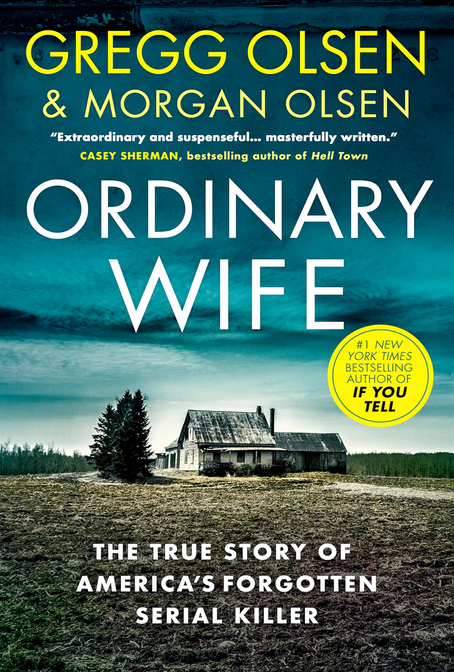
Ordinary Wife: The True Story of America’s Forgotten Serial Killer
- By Gregg Olsen and Morgan Olsen
- Notorious Press
- 264 pp.
- Reviewed by Diane Kiesel
- November 13, 2026
This less-than-titillating tale is short on authorial insight.
Public fascination with serial killers never wanes. Amazon lists some two dozen titles about the so-called “Dating Game Killer,” Rodney Alcala, linked to at least nine murders before he died of a heart attack on California’s death row in 2021. And Ted Bundy, who confessed to killing 20 women, merited twice as many books before and after the state of Florida executed him in 1989. This obsession is hardly new; in 1947, even Charlie Chaplin got in on the act when he made a black comedy about a serial-killing bigamist, “Monsieur Verdoux,” loosely based on the true story of Frenchman Henri Landru, nicknamed “Bluebeard.”
Now comes the father-daughter writing team of Gregg and Morgan Olsen with Ordinary Wife, the forgotten tale of a rare female serial killer once dubbed “Mrs. Bluebeard.” She’s Anna Elizabeth “Lyda” Trueblood Dooley McHaffie Lewis Meyer Southard Whitlock Shaw, who, between 1915 and 1920, sent four husbands, one brother-in-law, and perhaps her only child to early graves by exposing them to arsenic-laced flypaper or adding poison to their food. Convicted of killing one husband, she nonetheless escaped the hangman’s noose and died of natural causes an old woman in 1958 on a Salt Lake City sidewalk while clutching a Safeway shopping bag.
Despite the titillating subject matter, Lyda’s story is not that compelling, at least as presented by the Olsens. In fairness, when writing about century-old crimes, authors are limited in their source material to contemporary newspaper articles and, if they’re lucky (the Olsens were), trial transcripts and prison records buried in government archives. Unfortunately, the authors rarely place into context what they learned from these key sources. They write:
“Lyda had been painted as a cartoon villain, but as we peeled back the layers, we found a woman who was a real product of her time…[she] was fodder for newspapers in a way that few women were…Yes, others killed and were tried for it, but Lyda was held to a different standard. Her wiles. Her looks. Her charms. Whether true or not, all things attributed to her colored every breath she took. And who knows, maybe she wasn’t really any of those things?”
Wh-a-a-a-t?
Isn’t it the job of nonfiction authors to synthesize the research materials and use their literary skills to suggest a conclusion about their subject, or at least attempt to? Instead, the Olsens shirk that responsibility:
“We wanted to bring Lyda’s forgotten story to light and let you draw your own conclusion about this ordinary wife.”
The story that comes to light is this: She was born Anna Trueblood in Missouri in 1892 to a farming couple constantly on the move, although the authors’ bare-bones recounting of her childhood fails to explain what turned her into a monster. Ostensibly, she married to escape her hardscrabble prairie life, yet none of her many spouses was particularly prosperous. After five persons in her orbit died in quick succession, suspicious authorities exhumed the bodies, finding arsenic in all but the child’s. Her daughter’s cause of death was never determined, but there was speculation Lyda had starved the youngster; the body was small for a toddler.
Prior to killing her husbands, Lyda convinced them to take out life insurance policies naming her beneficiary. Afterward, she filled her homes with mountains of flypaper dipped in arsenic. At least one husband was recovering in the hospital from an apparent severe stomach ailment until Lyda finished the job by visiting with a home-cooked meal. Once it was determined the men were poisoned, Lyda was captured in Hawaii, where she was living with a new husband, Paul Southard, whose life she’d unsuccessfully attempted to insure for $10,000. (He survived by divorcing her.)
She was returned to Twin Falls, Idaho, in 1921 to face the music for the death of husband number four, Edward Meyer. The months-long trial that followed was standing-room-only, with most of the audience being curious women. Although it was clear the killing was premeditated, jurors convicted her of the lesser charge — second-degree murder — to avoid sending a woman to the gallows.
Lyda was sentenced to 10-years-to-life in the Idaho State Penitentiary in Boise, where few other women were housed and security was relatively lax. For nearly a decade, she was a model inmate who kept away from cooking or futzing with flypaper, channeling her inner Martha Stewart by decorating her cozy cell and planting roses in the prison yard. But fearing she’d never be paroled, Lyda used her so-called charms to convince lifetime jailbird Dave Minton, housed in the nearby men’s facility, to help her escape.
She remained on the lam more than a year, dumping Minton as soon as she could and racking up another husband. She was rearrested before the new guy could become victim number six. Back in custody, Lyda was not paroled again until October 3, 1941, when she was released from her homey cell — by then adorned with curtains and flowery wallpaper — and went to live with her sister.
A decade later, Lyda married for a seventh time, to widower Hal Shaw, in Elko, Nevada. By some miracle, he survived her.
Diane Kiesel is a retired judge. She is currently an adjunct professor of law and author. Her latest book, When Charlie Met Joan: The Tragedy of the Chaplin Trials and the Failings of American Law, was published in 2025 by University of Michigan Press.

