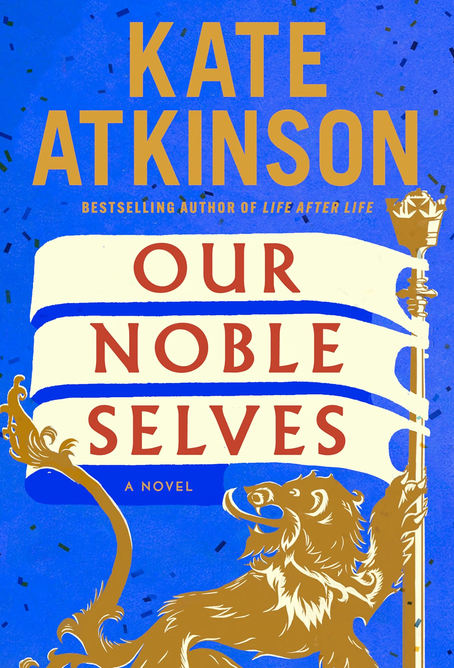
Our Noble Selves: A Novel
- By Kate Atkinson
- Doubleday
- 352 pp.
- Reviewed by Bob Duffy
- November 10, 2026
A poignant historical farce told by a genre-spanning master.
Our Noble Selves is a comic tour de force à la P.G. Wodehouse or Kingsley Amis. Kate Atkinson’s historical novel, set a few years after World War II, is humanely satirical, laugh-out-loud funny, and affectionately parodic of today’s standard pop-fiction tropes. It’s touching as well, tinged with a distant feel of lingering pain from the war, both in its protagonist and in many of the characters who surround him.
Gracefully weaving undertones of pain and bereavement into over-the-top spoofery calls for exceptional subtlety, and here the effect succeeds brilliantly. Atkinson is a proven whiz at mingling tonal elements: Her previous books range widely in setting and spirit — a clutch of detective yarns, along with a quartet of historical novels that blend strains of speculative fiction, magical realism, and social comedy.
Harry Flynn, this novel’s hero, is a mid-20th-century Everyman, an aimless sort who’s less can-do than done-to. As the story opens, Harry is recruited — in an outrageously serendipitous moment in a London park — to help mount a national “Festival of Britain.” (Atkinson bases her sprawling festival on an actual one that ran in the early 1950s, celebrating the history and culture of the U.K. as it emerged from the war.)
As the book’s title slyly hints, Atkinson’s fictional recasting of the event is shot through with witty hyperbole. Its organizers have designated singular breeds of “Festival Cow” and “Festival Duck,” the latter exclusively delegated to paddle in the festival lake. The planners have also anointed comely Restoration-attired “Nell Gwyns” (after Charles II’s notorious mistress). Among the criteria for selection: that they “be ‘well endowed,’ as their costumes relied on very low-cut, off-the-shoulder bodices.” The Nells are to wander the grounds, intoning “Who will sample my wares?” as they peddle their period-appropriate oranges.
Former journalist Flynn has lately returned from the war in Southeast Asia, where he was interned for three years as a forced laborer — along with 30,000 other Allied POWs — constructing the Burma-Siam railroad. Nearly half of his fellow captives died there, and he himself is bedeviled with unbidden memories of eating a live mouse and a fist-sized cockroach to sate his continual hunger. Flynn’s stark flashbacks come and go throughout the novel, poking through the droll veneer.
There’s a sliver of backstory in Harry’s life since his return from captivity. He had drifted into “an ill-considered marriage to a smartly dressed war widow called Ivy Shears…With her tight blond curls, not to mention her grandstanding bust, she represented the epitome of womanhood to a man who had barely set eyes on a member of the female sex in over three years.”
The war-widow bride has a tween daughter named Veronica and a listless pooch. Harry, soon disillusioned with domesticity, has fled the scene, leaving no forwarding address.
In his festival role, Harry works with an incongruous crew of officemates young and old, a circle that Atkinson deftly mines for humor. And the windup plot rolls on. The morning after an innocent meet for drinks with a female coworker, Harry wakes up battered and bruised, unable to recall much about the previous evening, including how he got home. His companion is missing from work. Rumors fly. In predictable crime-fiction fashion, a pair of suspicious coppers begins to dog him relentlessly. His life turns into a tangle of coincidences, absurd misunderstandings, and unlucky missteps that crop up with a frequency that defies probability.
In a parallel development, Harry accompanies another colleague to a ceremony naming the winning recipe for the Festival Cake, one devised by a female TV chef with ties to the festival’s senior leadership. She also has a dodgy husband and a checkered past. Meeting this shady pair thrusts Flynn into a welter of dubious connections and exposes him to a blackmail attempt involving a talismanic bloody scarf.
To complicate matters — just as Harry is struggling to shake off suspicion like a guy trapped in a room carpeted with flypaper — his ex tracks him down, dumping daughter and dog on him, and decamps for Europe with her lowlife boyfriend. Veronica turns out to be a provident sidekick for Harry. Although shockingly obtuse about school subjects, she’s uncannily precocious when it comes to street smarts and, yes, is expertly familiar with the formulaic conventions of trashy thrillers. She draws on this superpower — in moments of suspenseful high comedy — to extricate Harry from tight spots.
Atkinson orchestrates all these shenanigans with a tumble-forward burlesque of pop-thriller plot gymnastics and tongue-in-cheek nonchalance. This relentless farcical pacing carries right on through the thrill-ride climax. Calling it a thrill ride is not just reviewer shtick; the finale comprises a grippingly formulaic sequence, a murderous chase of dad and stepdaughter, by a wholly unexpected nemesis, on a careening rollercoaster.
Again, Atkinson seeds the narrative with hints at the disruption and heartache caused by the war. Most of the characters have lost spouses, parents, sons, daughters, lovers, or friends in the fight. It’s a quiet but incessant backbeat under the surface rhythms of the narrative, and attentive readers will respond empathically to its hushed omnipresence.
How does all this turn out? Harry’s snug return to normalcy would be a safe guess, considering the genre’s conventions, but readers will need to discover for themselves how Atkinson decides to tinker with the standard love-wins-out formula.
Bob Duffy reviews regularly for the Independent.