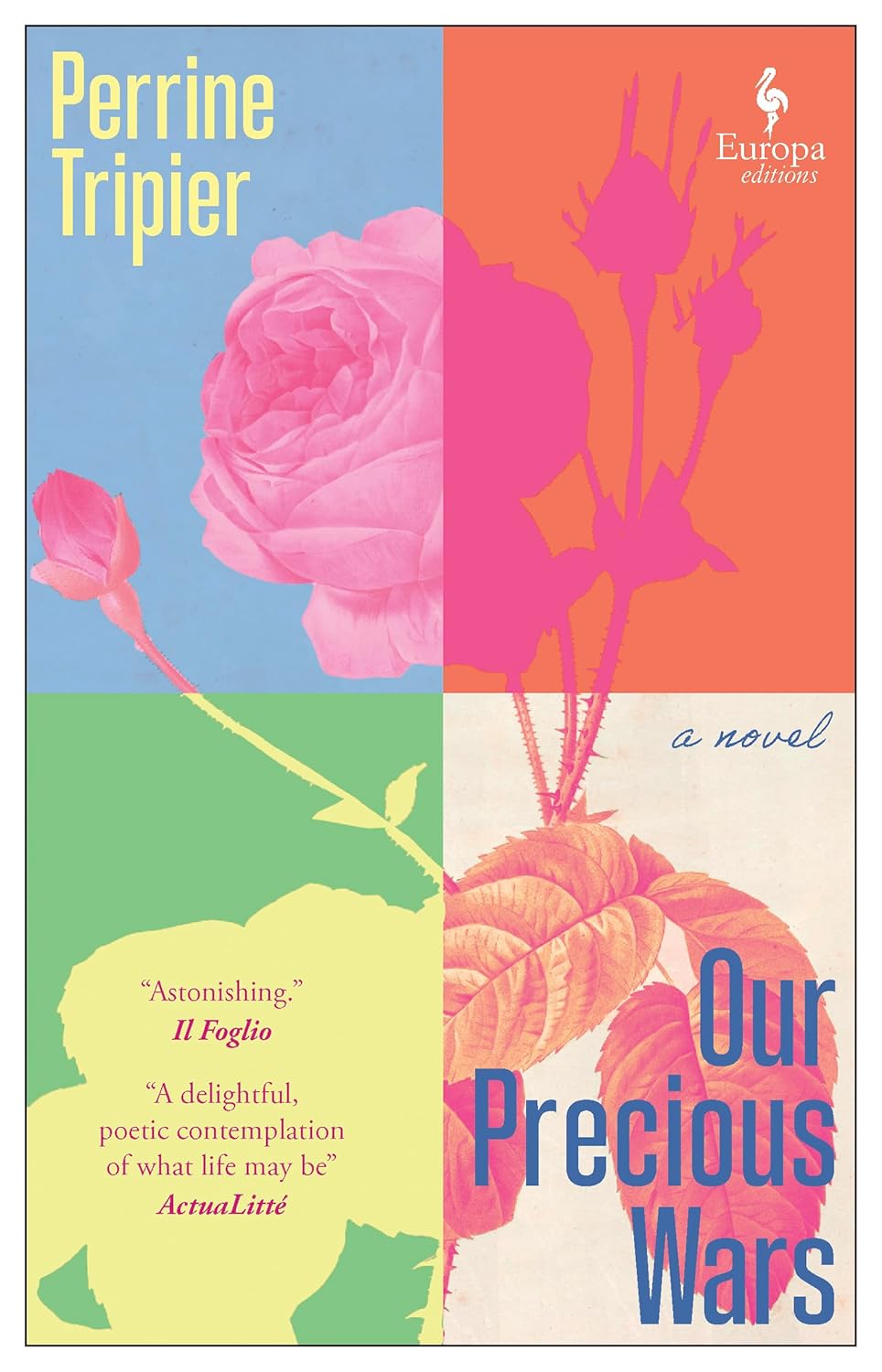
Our Precious Wars: A Novel
- By Perrine Tripier; translated by Alison Anderson
- Europa Editions
- 160 pp.
- Reviewed by Frances Thomas
- December 3, 2025
An elderly woman reflects on her purposely constricted life.
There are books that demand to be devoured, enrapturing readers with fast-burning bacchanalias of drama and conflict. And there are those that can only be savored — slowly, languorously, and with sweeping submission to the long, latent arc of quotidian pleasure. Our Precious Wars, the debut novel of French writer Perrine Tripier, pours plot and atmosphere into the diamantine drop of a lozenge, releasing its sweetness to those who wait.
Waiting is necessary because of the story’s resolutely durational structure. Voiced in the first person by one Isadora Aberfletch, an elderly Frenchwoman passing her final days in a nursing home, the narrative is a meandering stream of flashbacks spanning her long life. Aberfletch’s reminiscent gaze fixes less on the classic milestones of aging — graduations and marriages, births and passings — than the microscopic sensory data of their time and place.
Recalling the early death of her younger sister, she conjures grief via pointillist scenic description: “the leaves sodden with dirty rain, the slippery road winding between two slopes of soggy grass, the bare trees, mineral monoliths of dead life.” The season and geography of watershed moments — whether tragic, as in first grief, or blissful, as in first love — are not incidental but integral to their enduring grip on her psyche.
This grip is made urgent and specific by the swelling poetry of synesthetic details: the sticky drench of summer’s “resin-scented shade,” the sparkling white of snowfall that “pierces eardrums, burns retinas.” Such densely figurative reminiscences are never wholly romantic; there is always something prickly, some filament of friction, to texture the idyll and render it real.
Yet reality, with all its roping networks of contingency — the responsibilities of kinship, the pervasive compulsion to participate in commerce, the interlocking drudgeries of bodily maintenance and care — is magically, at times distractingly, absent from these pages. The narrator, who is white, wealthy, and able-bodied, never appears to hold a job, suffer a heartbreak, or cook a meal (for sustenance, she heats up cans of food delivered to her doorstep by unseen, unnamed workers).
Aberfletch lives out her adulthood in the house she grew up in, a sprawling country estate that she inherits when her father dies and where she keeps mostly to herself. On a rare summer holiday when she opens her door to relatives, one of the youngsters — or, in her words, “childish brats” — tries to play with a wooden doll that was her late sister’s. Upon discovering his innocent game, she flies into a violent rage, screaming, crying, and reaching to strike him. It is, unsurprisingly, the last visit she receives from family.
No matter. Her one true beloved is not a person but a place: her home. Capitalized throughout the book as if it were a person, “the House” is the instigator, in the narrator’s eyes, of all action and consequence: the singularly salient point from which life radiates meaning. It breathes, gazes, stretches, and yawns among a host of other anthropomorphic gestures, embracing — or entrapping — its inhabitants with visceral force.
Even when Aberfletch is physically removed from the place, she is consumed by granular evocations of it: “I cling to details,” she says from her generically furnished room in hospice care, “to the shape of the light switches, the sound of the door handles as they are pressed, the fine film of dust on yellow lightbulbs.” This constant rush of remembrance is both blessing and curse, a balm of familiarity that stings as it soothes.
If the house is the novel’s indestructible stage, pre-adolescence is its interminable age, the pocket of time in which the narrator’s capacity to desire, dream, and create ossifies. She spends the siesta hours of her childhood reading and re-reading a fairytale about a princess who refuses to marry in the interest of “keeping her kingdom whole and to herself alone.” Solitude is the plot’s engine and endgame: all the princess does is run from one castle tower to another, perpetually in flight from would-be suitors.
“I think my entire character was formed by reading these pages,” Aberfletch opines from the perch of her dotage, affixing a totalizing qualifier — entire — to something as malleable as one’s character.
This reflection comes early in the book, and at first encounter, it might seem reductive. But there is wisdom to the statement, a perspicacity of self-regard. Aberfletch has spent her whole life running — from intimacy and otherness, strangers she might have loved and novelties she might have acclimated to — and now, near the end of the effort, she is not triumphant; she is searching.
It takes a lot to give so little, and the elegant feat of this slim work is that it illuminates the wideness of the world through the peephole of one woman’s voluntary confinement.
Frances Thomas is a writer based in Brooklyn and an MFA in Nonfiction Writing candidate at Columbia University. Her work has appeared in Slate, Dazed, American Literary Review, Longridge Review, the Maine Review, and elsewhere. She writes to build safe spaces for hard conversations. You can find more of her work on her website.