Oxford Soju Club: A Novel
- By Jinwoo Park
- Dundurn Press
- 232 pp.
- Reviewed by Alice Stephens
- October 28, 2025
Rival spies collide at the only Korean restaurant in an English town.
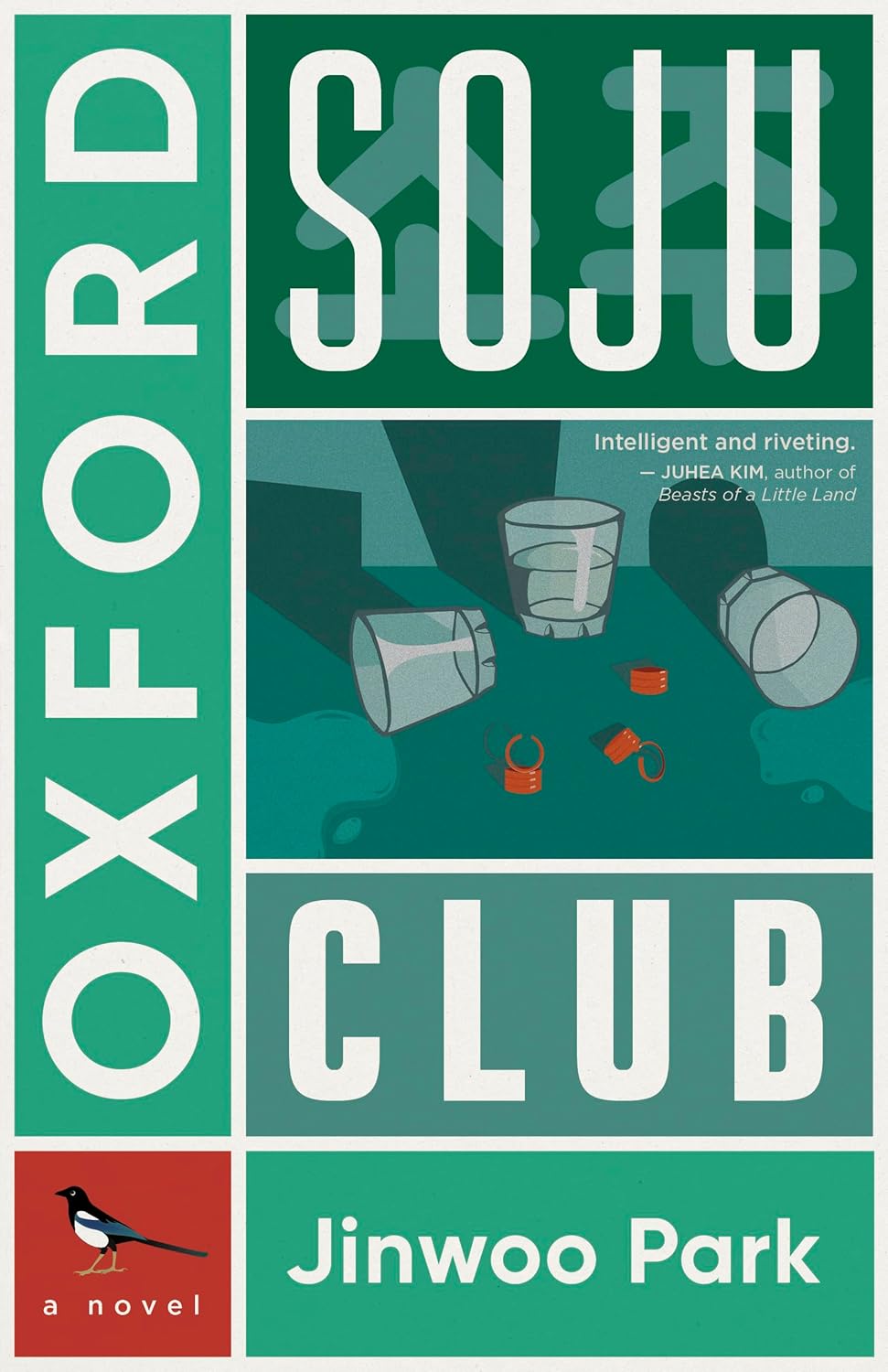
In the aftermath of Kim Jong-Il’s death, North Korean secret agents in Europe are being eradicated by the new regime, which wants to rule with a “clean slate.” A legendary spymaster, Kim Doha (Korean names are surname first, reflecting the emphasis on family origins), is stabbed to death in an Oxford alleyway. Discovered in his dying throes by Yohan, his faithful protégé, Doha orders Yohan to meet secret agent Dr. Ryu at their hangout, the Soju Club. His last words are, “Live. Yohan-a. Live.”
Thus begins Jinwoo Park’s dizzying, hyperkinetic debut novel, Oxford Soju Club, which crisscrosses voices, timelines, and names. Each chapter is narrated by a main player; subheads — “The Northerner,” “The Southerner,” “The American” — indicate which one. Each narrator first relays the action-packed aftermath of Doha’s death, and then flashes back to fill in their own backstories. Like a secret agent, the reader must be ever alert in order to follow the plot’s twisty structure.
The book’s tagline is “The natural enemy of a Korean is another Korean.” The main characters are all ethnically Korean but from very different backgrounds. “The Northerner” is the rookie spy, Yohan, saved from a North Korean orphanage by Dr. Ryu; “The Southerner” is the expat owner of the Soju Club, Jihoon; and “The American” is a CIA agent, Yunah. Later, these identifiers change; the Northerner becomes “The Nameless,” and the American “The Rejected.” As for the Southerner, well, you’ll have to read the book for details, but his voice is replaced by “The Exiled,” who is, intriguingly (pun intended), the only first-person narrator.
Once a monocultural, homogenous people, Koreans have become fragmented not just by the fateful split into North and South, but also by vast economic inequality (on both sides of the border) and emigration. Jihoon and Yunah, separated from their Korean origins by geographic distance, nonetheless live under the shadow of their parents’ homeland.
After his mother’s death, Jihoon flees Korea only to open a Korean restaurant in England that attracts every Korean in the vicinity. Even with a Harvard education and a good job, Yunah fails her parents — who sacrificed everything to give her an American life — by still being single as she approaches 30. Her CIA superiors see her ethnicity as an asset in their surveillance of the North Korean spy cell, until they see it as a liability, questioning her loyalty to the U.S.
But even when from the same country, the characters experience very different realities, as with Doha, protected by his family status, and Yohan, condemned by his, the difference a mere tick of fate. Class, geography, generations, and family all conspire to separate Koreans so that they’re eternally at loggerheads with each other: elite and lumpen, North and South, parents and children, heirs and bastards. The only one at peace is Jihoon, who seems to control his own destiny…right up until the moment he doesn’t.
The touchy question of what it means to be Korean hangs over the narrative. Though Korea is a highly patriarchal society, three of the main characters were raised without fathers. And Yunah never sees her parents, who ceaselessly toil at the family bagel shop. One character claims, “All Koreans, no matter how far we go, no matter how much we forget or ignore it, we all miss home.” But in the next breath, he adds, “[T]hose second-generation kids who don’t speak a lick of the language. They’re not Korean.”
Ah. And then there’s another unfortunate symbol of Korea, the orphan, a common trope in novels about Korea, including Chang-rae Lee’s The Surrendered and Adam Johnson’s The Orphan Master’s Son. Author Park suggests that the orphan is free from the Korean concept of hyo, “the loyalty a child has for a parent.” Without family ties and obligation, an orphan “can go anywhere, be anyone. It’s freedom.” As someone who was once labeled a Korean orphan, I’m here to say that not knowing your parents is not freedom but a whole different kind of life sentence.
In the end, though, the question of what it means to be Korean has nothing to do with returning to the homeland, or love of family, or blindly obeying your elders, or faithfully serving Dear Leader. To be Korean is simply to survive; to live to see another day, smoke another THIS cigarette, and drink another bottle of soju. As a mixed-race Korean who was part of South Korea’s ethnic cleansing via intercountry adoption, I say “geonbae” to that.
Alice Stephens is the author of the novel Famous Adopted People.

.png)