Palaver: A Novel
- By Bryan Washington
- Farrar, Straus and Giroux
- 336 pp.
- Reviewed by Ellwood Johnson
- November 13, 2025
A mother and her estranged queer son attempt to talk it out.
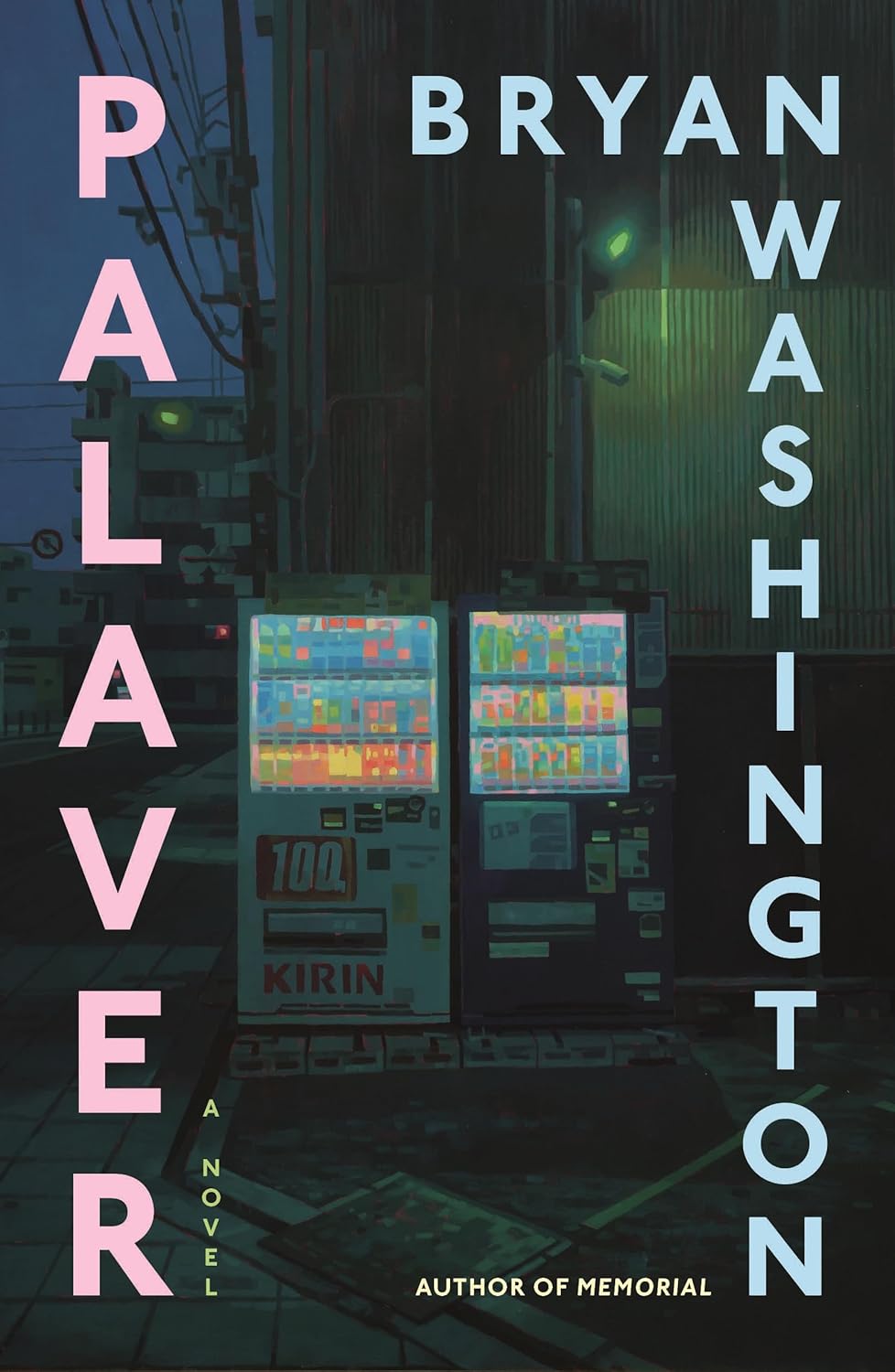
Bryan Washington’s new novel, Palaver, asks us to consider how we make room for others in our lives. It’s a story about the things we carry and the things we abandon. It’s also the story of an unnamed mother and son trying to forge a new relationship out of the pain and hurt from their past.
What we cannot know at the outset is that both are already waging war against that past. Born and raised in Jamaica, the mother spends most of her childhood with her half-brother, Stefan, and her friend Cheryl. He is eight years older and sometimes feels more like a parent than a sibling. Even as an adult, she still feels both his influence and his absence:
“The mother’s earliest memories weren’t her own — they belonged to her brother. If the mother was honest, she couldn’t remember a single one of these things.”
Palaver insists that loss and grief shape us in complicated and unexpected ways. The mother grieves for the long-deceased Stefan for decades, and it manifests in her relationship with her son. Even as a young child, she knows her brother is gay and that life on the island will be difficult for him because of it. She knows, too, that she can do little to change anything, and so does he, which is why he encourages her to leave Jamaica:
“It’s opportunity…Those don’t come often. You know what life is here. Go and see what it is elsewhere. You can always come back.”
His advice is well-meaning but does little to reassure her. Whereas she’d once felt that “life-changing moments were momentous,” she now, as an adult, wonders “whether the big moment might actually be an accumulation of smaller moments, each of them irreversible, charting a path that becomes knotted and turned until it became distinctly itself.”
Many years and many miles later, her early experiences of love and loss have acquired new forms as she attempts to make peace with her estranged gay son, who left Houston for Japan a decade prior. Much of his contempt is rooted in her longtime rejection of him and her obvious preference for her older (and straight) son, Chris. When the mother abruptly shows up in Tokyo shortly before Christmas, the son tells her:
“You kicked the shit out of me when I lived with you. Made me feel worse than fucking dirt for being queer. Made me feel even worse when I came back home, the first time, and now you are asking me to make the same fucking mistake again? It’s fucking ridiculous.”
As readers, we never learn whether the son, who never met Stefan, knows — or even cares — why his mother has trouble accepting his sexuality; to him, it only matters that she does. But we can unravel the thread and trace the connection back to its source: her belated attempts to come to terms with her brother’s death and the sorrow left in its wake.
Family tension fuels much of the novel’s drama, including between the son and his homophobic sibling. “That’s the worst thing about him,” says Chris at one point, commenting on the son’s sexuality. “Baby boy’s perfect otherwise.” Every effort at brotherly love, it seems, is met with enmity.
Yet Washington reminds us that there’s still value in our relationships, however contentious they might be. For the mother, this hard-won insight is proffered by Ben, who owns a bistro near the son’s apartment. “Sometimes the moments we’re left with are enough for us to keep going,” he remarks. “They have to be enough. Because they are all that’s left.”
For the son, similar wisdom comes courtesy of his friend Alan. “We’re here and then we’re gone, but we can be here for each other,” Alan says to him. “It’s the least we can do, and also the hardest thing we can do.” In Washington’s world, relationships are no light matter; they’re treated with a delicate sensibility. Characters and readers alike aren’t given an easy escape. The only way out is to burrow deeper and emerge from the other side.
The mother’s trip to Japan is as challenging as it is unwelcome, and she spends most of her time there trying — and failing — to repair her bond with her son. Their journey back to each other takes time, and the route is circuitous. They quarrel and disagree and rarely see eye-to-eye; between them, the solipsistic folly of humans at their worst is on full display, but so is their unrelenting resilience.
“We don’t have to look any particular way. We just have to try,” the mother tells him near the end of the book. “To figure out what works for us. That’s all that matters to me.” Readers must discover for themselves if it’s all that matters to her son.
Ellwood Johnson is a freelance writer and editor who spends much of his spare time reading and writing fiction. He currently works full time as a special assistant at the Folger Shakespeare Library in Washington, DC.