Paradiso 17: A Novel
- By Hannah Lillith Assadi
- Knopf
- 320 pp.
- Reviewed by Mike Maggio
- April 1, 2026
A Palestinian refugee wanders through life searching for a homeland.
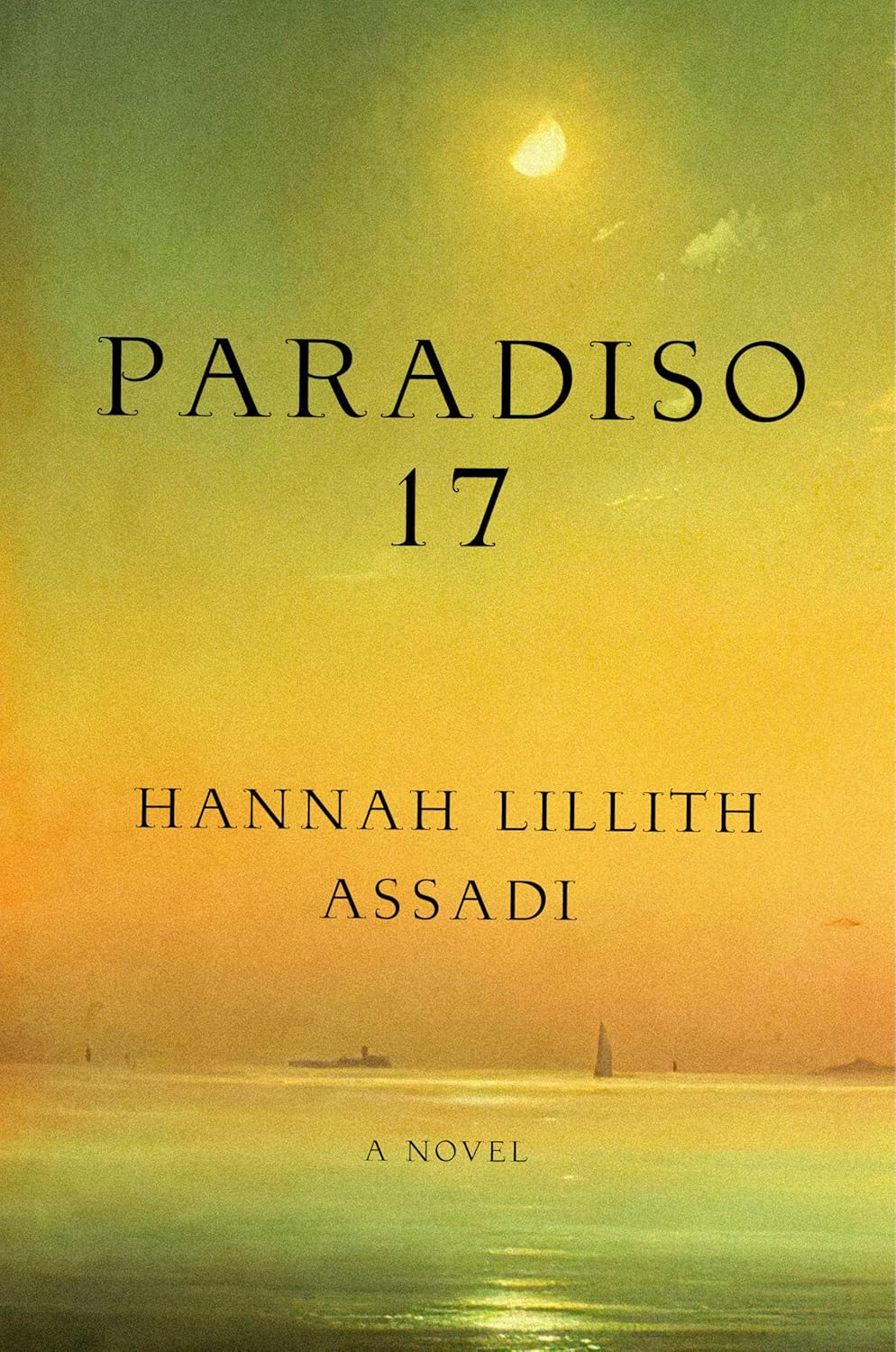
Hannah Lillith Assadi’s Paradiso 17 — the title comes from Dante’s Divine Comedy: Paradiso Canto 17 — is based on the life of her father, Sufien, a Palestinian refugee who, like many stateless individuals, wanders through life searching for roots. Unlike most Palestinians, however, Sufien ends up, after years of dissolution and disillusion, marrying an American Jew and settling down, precariously, into an existence that’s not quite the American Dream.
The novel begins in 1948 just before the Nakba — the “catastrophe,” as it is referred to in the Arab world — in which Palestinians were violently expelled from their land at the creation of the State of Israel. Sufien is barely 4 years old when his father, Abdul Jalil, announces he’s going off to fight the Zionists, leaving Sufien and his family to fend for themselves.
Like most Palestinians at the time, the Jalil family is forced out of their home and compelled to journey by foot in search of refuge, first ending up in Syria, where they build temporary lives, and, later, in Kuwait, where life becomes more stable but never permanent.
Eventually, Sufien is sent to Italy to study, but when his father can no longer afford to give him money, Sufien ends up working odd jobs, takes on a new identity as Frank Leone, and meets Bernardo, a well-to-do Jewish New Yorker who comes to help Sufien financially throughout much of his life. Bernardo convinces Sufien to move to New York, where Sufien alternately lives comfortably (thanks to his benefactor), becomes homeless, rebounds, and finds work as a taxi driver. In between, he gets involved with alcohol and women, attends classes at Columbia, and meets Sarah, an American Jew from a wealthy family, whom he marries despite protests from her relatives. Sufien’s wanderings don’t end there, though.
In many ways, the novel, while telling the story of the author’s father, relates the broader story of the Palestinian diaspora: the displacement, the state of being dispossessed, the sense of alienation, the absence of roots. It’s as if the plight of the Palestinians has been condensed into a single individual whose life mirrors the suffering of all his compatriots.
And, yet, Paradiso 17 is by no means an allegory, nor does it attempt to make a point. Rather, it follows a narrative construct that stands on its own with characters who are well developed and a plot that is keenly rendered. Additionally, Assadi’s prose is crisp and clean, and much of it borders on the poetic:
“Um Sufien [Sufien’s mother] knew better, she knew that loss begets loss. And that this was the beginning. Fortune begets fortune, and misfortune more misfortune. The curse warned of in nightmares of her mother and her mother’s mother had come for her. Now while all the other women in the camp rubbed their keys to their houses like talismans, Um Sufien accepted that she would never see her homeland again. Where had this awareness come from? She could almost hear the prophecy aloud, spoken very plainly, very distinctly. Who was speaking? Not her, not her children, and not even her children’s children. Palestine already belonged to another Earth.”
While the book is filled with tragedy, it is also packed with Palestinian humor, as when Um Sufien calls her young son ya majnun (“oh crazy one”), when Sufien names his cat Sharmuta (Arabic for whore), or when he refers to his son-in-law as tawilo ahbil (“the tall stupid one”).
Paradiso 17 tells the story of the Palestinians from a point-of-view rarely seen in the West. Assadi’s insights into the complexities of Palestinian life are unique, and her novel is a triumph both from a literary and a socio-historic perspective.
Mike Maggio’s novel, Woman in the Abbey, won the Literary Titan Gold Book Award and is available from his website or through Amazon and other book outlets.