Partita: A Novel
- By Barbara Kingsolver
- Harper
- 352 pp.
- Reviewed by Ryan Davison
- September 29, 2026
A tour-de-force exploration of music’s power to heal.
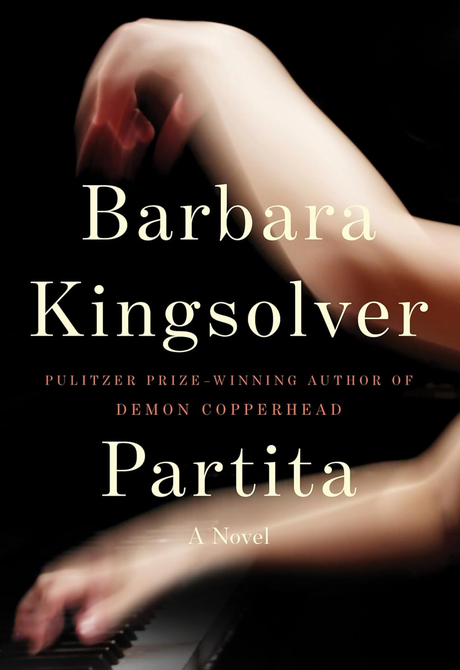
Early in Barbara Kingsolver’s electrifying new novel, it’s explained that a partita “is a musical composition made of many parts with different paces and moods. The contrast is the point. The parts are all different, and the artist’s work is to make them add up to something that feels whole.” For a work that hurls readers across jagged emotional landscapes while fusing themes of class, obsession, politics, and abandonment into a cohesive, compelling narrative, the title applies perfectly. Much of the power in Partita comes from its impressive literary variation.
Our narrator, Livia Cable, is a musical soul who has never fully achieved contentment. She is somewhere in later middle age at the novel’s opening, living with her kindhearted husband in a farmhouse next door to her childhood home. Her parents have died, as has her older brother, Cyrus, who stepped in front of a train when Livia was 11. A one-time prodigy, she carries musical mantras around as affirmations:
“Eight measures of statement, eight measures of response — that’s how a scrappy German orphan named John Bach got the whole world in his pocket a few hundred years ago and keeps a lot of us there still. He threads a promise in your ears, weaves it around through the soft brain folds and down to the needful heart where he delivers you this conclusion: Rest easy. This all comes out all right in the end.”
We hope Livia’s interpretation of Bach is correct but begin to wonder when a phone call from the past unleashes a flood of long-repressed memories and feelings. With the call, she is pushed back into the head and heart of the 20-year-old piano phenom she once was at the Indiana University School of Music.
Here, the story truly begins.
Younger Livia appears mostly content, living at the piano, mastering impossible pieces. Her brother’s suicide did little to slow her development or ambition but turned her mother into a hopelessly depressed hoarder. Livia dates a fellow student at the conservatory but meets strapping, idealistic Sigurd at a political rally. A relationship begins that bursts the firmament of her heart, igniting never-imagined passions. It’s that phone call from Sigurd 27 years after their breakup that forces her to examine events from earlier in her life.
The novel first traps our attention as a romantic, coming-of-age adventure; soon turns shockingly traumatic; then morphs into a gripping family drama; and finally erupts with revelations around deeply concealed secrets. Sections slide back and forth between the younger and older Livia, the transitions wonderfully smooth and effective. While cleaning out the overstuffed house of her recently deceased mother, she uncovers long-hidden secrets about herself and the death of her brother. These discoveries serve as flash points to the later story, and the final act detonates with the same ferocity of the beginning and middle.
Partita is a virtuoso storytelling achievement that’s packed with musical insights accessible to those with little musical knowledge. As Livia grapples with pieces from Chopin, Mozart, Ravel, Beethoven, and Bach, we can follow along with a complementary playlist that accompanies the text. A reader, for example, can plug “Ludwig van Beethoven, Seventh Symphony, second movement” into YouTube and listen to exactly what our protagonist struggles to perfect. Partita offers a ticket to the inner world of how musicians must fight through a work with their soul.
With words alone, Kingsolver conjures an incredible sensory experience; this is the rare book that will satisfy readers of all tastes. I highly recommend it to music fans, but even if you’re someone who doesn’t know pianos have pedals, none of its power will be lost on you. In fact, the force and intensity delivered by Partita surpasses Kingsolver’s 2023 Pulitzer Prize-winning Demon Copperhead.
Ryan Davison, Ph.D., is a regular contributor to the Independent, Open Letters Review, Edelweiss+, and NetGalley. His work has also recently appeared in the Chicago Reader and the Malahat Review, and his blurbs are often cited by LitHub’s Book Marks, the popular book-review aggregator. Along with literary criticism of traditional and independently published works, Ryan holds a doctorate in neuroscience and is an author of scientific papers.