Penelope’s Bones: A New History of Homer’s World through the Women Written Out of It
- By Emily Hauser
- University of Chicago Press
- 496 pp.
- Reviewed by Bob Duffy
- June 18, 2025
Antiquity’s ladies finally have their voices heard.
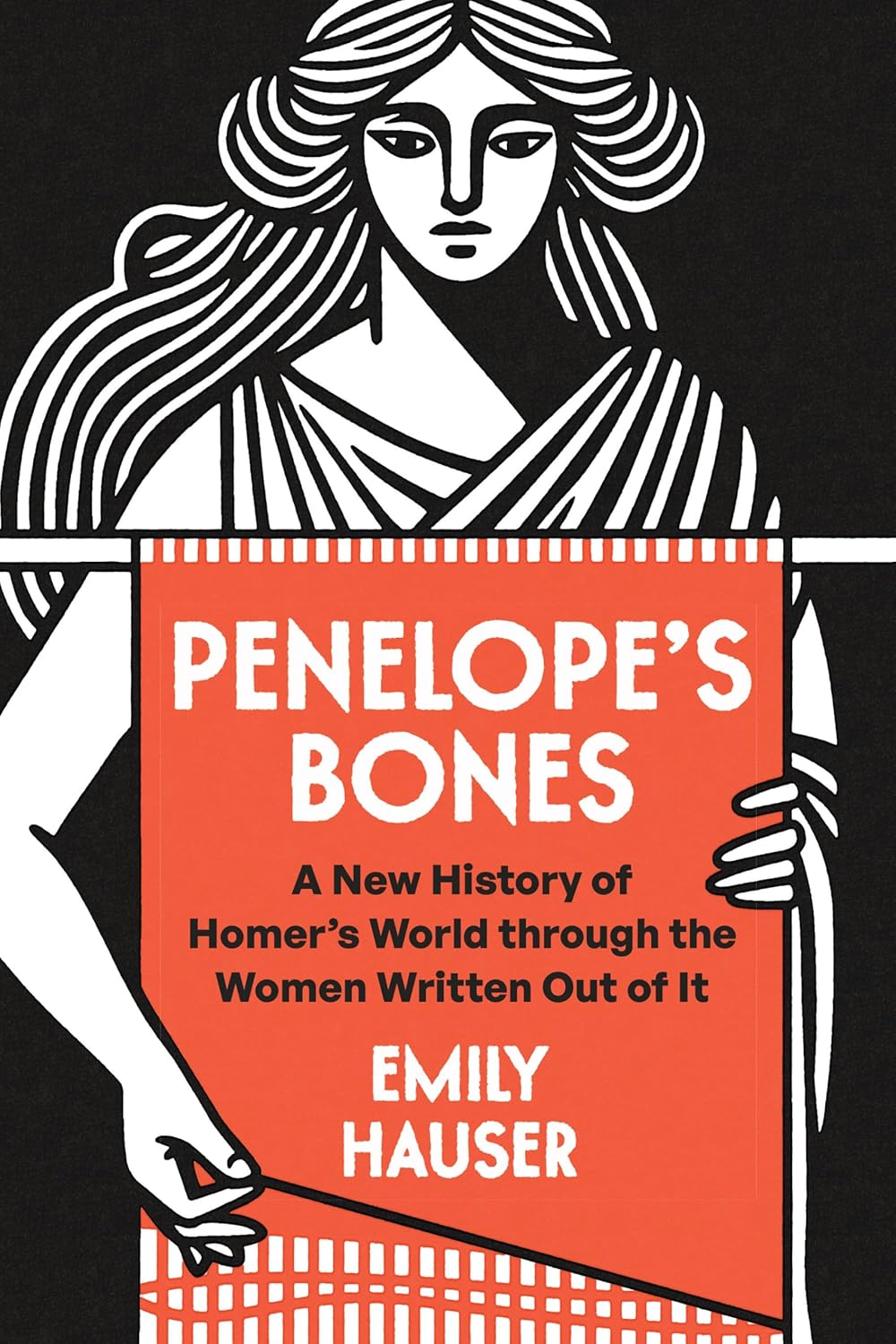
Like the song of the Sirens, Emily Hauser’s Penelope’s Bones tugs powerfully at its readers, an echoing summons from beyond the horizon. Hauser merges flawless aesthetic intuition about the Homeric epics with a superb command of scientific approaches to Bronze Age history from linguistics, genetics, cell biology, biophysics, and elsewhere.
Using existing archeological discoveries, she calls back from the grave a cadre of anonymous real-life women, most of whom died before 1200 BCE, the approximate time of the reputed fall of Troy, on which the succession of oral bards we’ve come to know as Homer based their depictions. Hauser’s interdisciplinary reportage, which anchors each of her chapters, supplies revealing scientific analysis of these long-dead women, whose social or familial roles markedly parallel those of female characters from Homer’s two epics.
Hauser’s insights underscore an overarching argument that’s thoroughly — and enlighteningly — feminist. The result for the reader: a fresh and exciting familiarity with Homeric epic owing entirely to this scholar’s groundbreaking explorations.
Penelope’s Bones homes in on 15 female figures who appear in The Iliad or The Odyssey. Typically, they play contrasting — though often brief and decidedly ancillary — roles in narratives steeped in harsh, male-centered tropes: conquest, bloody violence, prideful self-assertion, enslavement, and, yes, rape. For the bards we know as Homer, as well as the bulk of the epics’ audiences in Ancient Greece, today, and at all points between, these martial preoccupations are blithely enfolded in the accepted order of war-related practices.
But Homer’s women, for Hauser, stand out in moving counterpoint to the testosterone-addled rhythms of both epics. Although many of these female characters can seem like supernumeraries in the action, she underscores how they often provide subtle, resonantly ironic grace notes in the central thrust of the epics.
Penelope’s Bones considers mortal queens, sorceresses, Amazons, prophetesses, nymphs, and goddesses. Ten appear in The Iliad and five in The Odyssey, among them Helen (whose seduction and flight with Paris starts the war depicted in The Iliad), Briseis (the captive whose seizure by Agamemnon ignites the stubborn wrath of Achilleus), Andromache (the wife of Trojan hero Hector), and Olympian goddesses Hera, Athena, and Aphrodite. She treats each as an archetype, or at least as an embodiment of a social role or pursuit associated then and now with female agency: daughter, wife, queen, seducer, matriarch, mother, bride, and so on.
For instance, touching on Helen’s reputed beauty, Hauser describes the computerized facial reconstruction from the unearthed skull of a Mycenean contemporary of the legendary queen. In another, she recounts the DNA analysis of 95 Bronze Age skeletons recovered from a single site. Her aim: to illustrate the typical kinship bonds (and consanguinity) of aristocratic married couples. She parallels these patterns with the royal marriage of Trojan King Priam and his queen, Hecuba.
On the topic of Amazons and warriors, Hauser cites a dig at a Black Sea location where, upon skeletal analysis, a Bronze Age warrior buried with great honors turns out to have been female. Another Asia Minor find: a warrior whose tomb items, which customarily reflect the occupant’s most significant and prized possessions, included a comb and makeshift mirror, which, in comparison with similar ancient discoveries, suggests the decedent was something of a dandy (or perhaps a different sort of Bronze Age queen).
This reviewer can offer only one minor quibble with this otherwise marvelous study. Hauser also writes accomplished historical fiction based on Homeric tale, and she leads off each chapter here with a brief excerpt, presumably from her creative work. In themselves, they’re evocative pieces, reflective of considerable novelistic talent. But in the context of Penelope’s Bones, they come across as self-serving and out of place. Still, they’re quite good and are likely to set some readers off in search of their originals (which may be the point — and the problem).
That cavil aside, there’s much in this book to intrigue anyone interested in Homer and the epics ascribed thereto. Check it out if that includes you.
Bob Duffy, a retired academic and advertising executive/brand consultant, reviews frequently for the Independent.