Persecuted: Why We Need Scapegoats
- By Jack Lule
- Johns Hopkins University Press
- 264 pp.
- Reviewed by William Rice
- November 9, 2026
Humans sure love blaming each other for society’s ills.
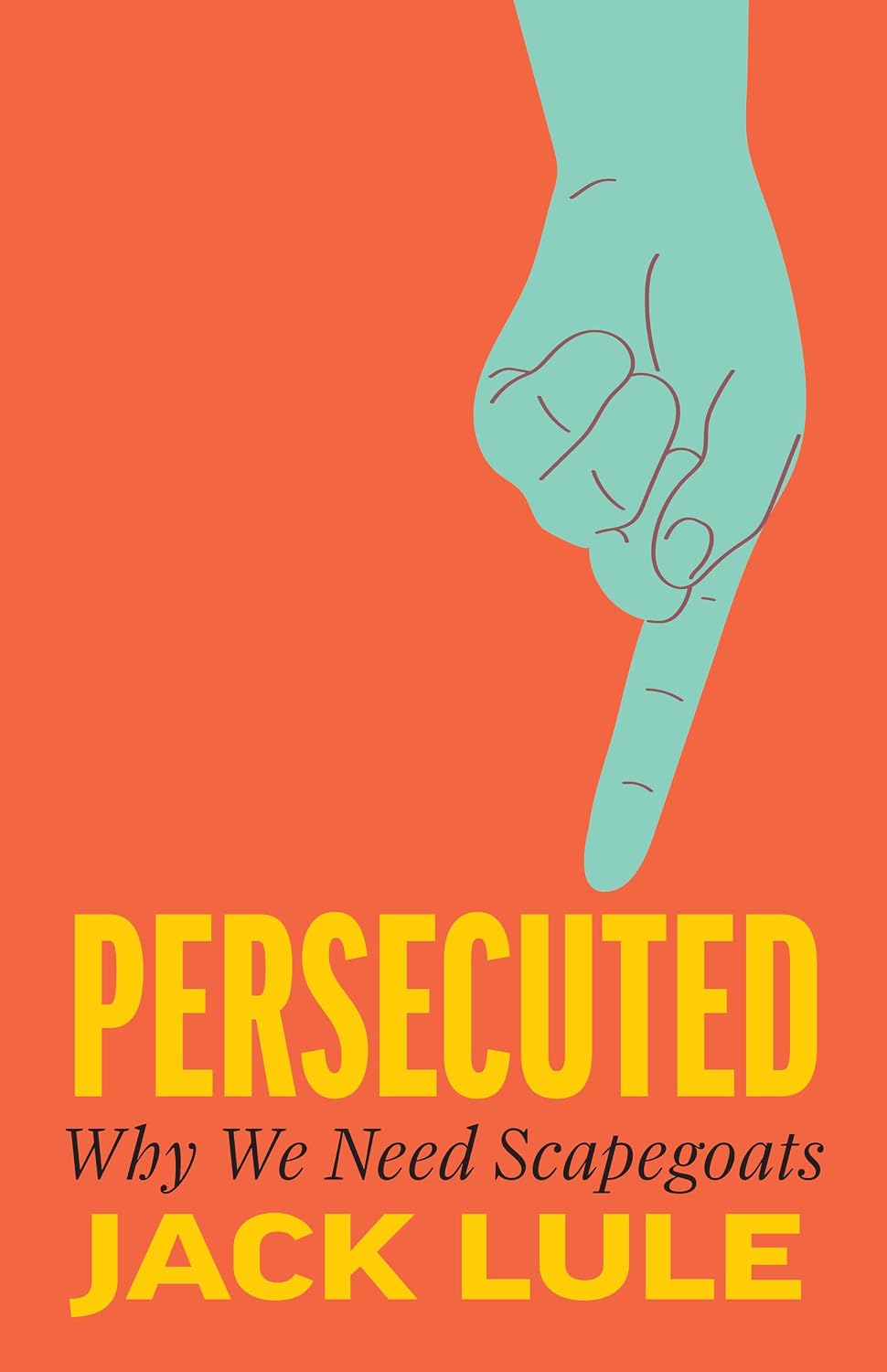
Persecuted: Why We Need Scapegoats is a brief, oddly written summary of what political philosophers have said over the last century or so about the process and motive for punishing the blameless for society’s ills. The sad consensus is that, far from being a frightening aberration, scapegoating seems to be a necessary component for groups to, in the words of author Jack Lule, “bring themselves together and keep themselves together.”
Lule acknowledges up front that this is a depressing thesis. Despite his attempts at the end of the book to introduce a note of hope that humankind can someday overcome its disturbing habit, the chances seem slim.
The word “scapegoat” comes from an ancient ritual in which two goats were brought to the temple. One was slaughtered in sacrifice, the other was metaphorically loaded up with all of the society’s sins and sent into the wilderness. This second goat was the scapegoat.
The two 20th-century thinkers the author is most in debt to for their ideas are the American Kenneth Burke and the Frenchman René Girard. Burke, according to Lule’s paraphrase, speculated that scapegoating is not “a problem that arises when people come together. Scapegoating is at the very [center] of how people come together.” Burke further believed that this moral scourge is a natural product of language: In defining what is and is not, who belongs and who doesn’t, we inevitably create outsiders who are prime targets for scapegoating.
Girard came to his perspective on scapegoating as part of a theory that humans determine their desires from the desires of others, what he called “mimesis.” Such a follow-the-herd tendency would lend itself to the sort of mobs that often prey on the scapegoat. Girard argues that rivalry is contained and social order upheld through the process of scapegoating.
The principal original argument Lule contributes to his book is that the media play a central role in the awful human tendency to blame the innocent for our troubles. He particularly notes the sinister organizing and encouraging part played by radio in the massacre of Tutsis and moderate Hutus by extremist Hutus in Rwanda in 1994. Maybe because he’s faulting his own field (Lule is a former journalist and journalism professor), he pulls no punches:
“…Modern media expertly support the entire scapegoat process. In fact, modern media have become something like scapegoat networks.”
But Lule is particularly concerned by social media, which, he says, “produce, reward, encourage, amplify and extend hate.”
Lule adopts a broad definition of scapegoating, extending from lone-gunman mass shootings, in which racial or ethnic minorities are the intended victims, to the Holocaust. Sometimes, he finds the scapegoating urge in feelings that could reasonably be assigned different origins. For instance, while it’s clear that anti-Latino bias and generalized xenophobia are among the motivations for those demanding tighter immigration control, some are principally stirred by a desire to uphold the law. And though Israel can be accused of a disproportionate response in Gaza, one that’s caused far too many Palestinian deaths, it was not scapegoating to blame Hamas for the October 7th massacre that touched off the war.
The writing style is one I have never encountered before in a book intended for adults. It employs the short, declarative sentences of a primer for children. Here’s an example:
“‘Machiavellian’ has become a common word. Niccolo Machiavelli wrote a book called The Prince. The book said that rulers should do whatever is necessary to maintain power, even it if means being cruel, deceptive, or manipulative. That’s where we get the term ‘Machiavellian.’”
While there’s nothing wrong with clear, simple writing, this kind of storybook cadence detracts from the sophisticated points being made. And if anyone reading the book is unfamiliar with Machiavelli, it’s up to them to inform themselves; the rest of us shouldn’t have to sit through an explanatory pit stop.
That excerpt is also an example of another textual distraction: The author periodically interrupts the flow of argument to discuss a particularly pleasing, irritating, or otherwise interesting word or phrase. Everyone involved in the literary arts loves words and likes to talk about them, but there’s a time and a place. (Despite Lule’s careful style, at least one factual error has snuck in: The author confuses the 1066 Norman Conquest of Britain with the arrival on the island hundreds of years earlier of Angles, Saxons, and other Germanic-speaking peoples.)
The one path Lule suggests can lead us out of the scapegoating jungle is self-awareness. Because those persecuting others generally believe they are behaving righteously, if more people become aware of the human inclination to scapegoat — and include themselves among those susceptible to the despicable practice — the tendency may weaken. He is encouraged by the fact that we have a word to describe the process and evidence that love can unite us as well as hate.
As can happen when an author devotes a book to describing a single phenomenon, unfortunately, he begins to see it everywhere. Lule asks in Persecuted if criticizing those who scapegoat is not an act of scapegoating in itself. Well, no, because they are actually guilty.
William Rice is a writer for political and policy-advocacy organizations.

