Planning Miracles: How to Prevent Future Pandemics
- By Jon Cohen
- Knopf
- 448 pp.
- Reviewed by Elizabeth McGowan
- November 14, 2025
You know the next superbug is out there somewhere.
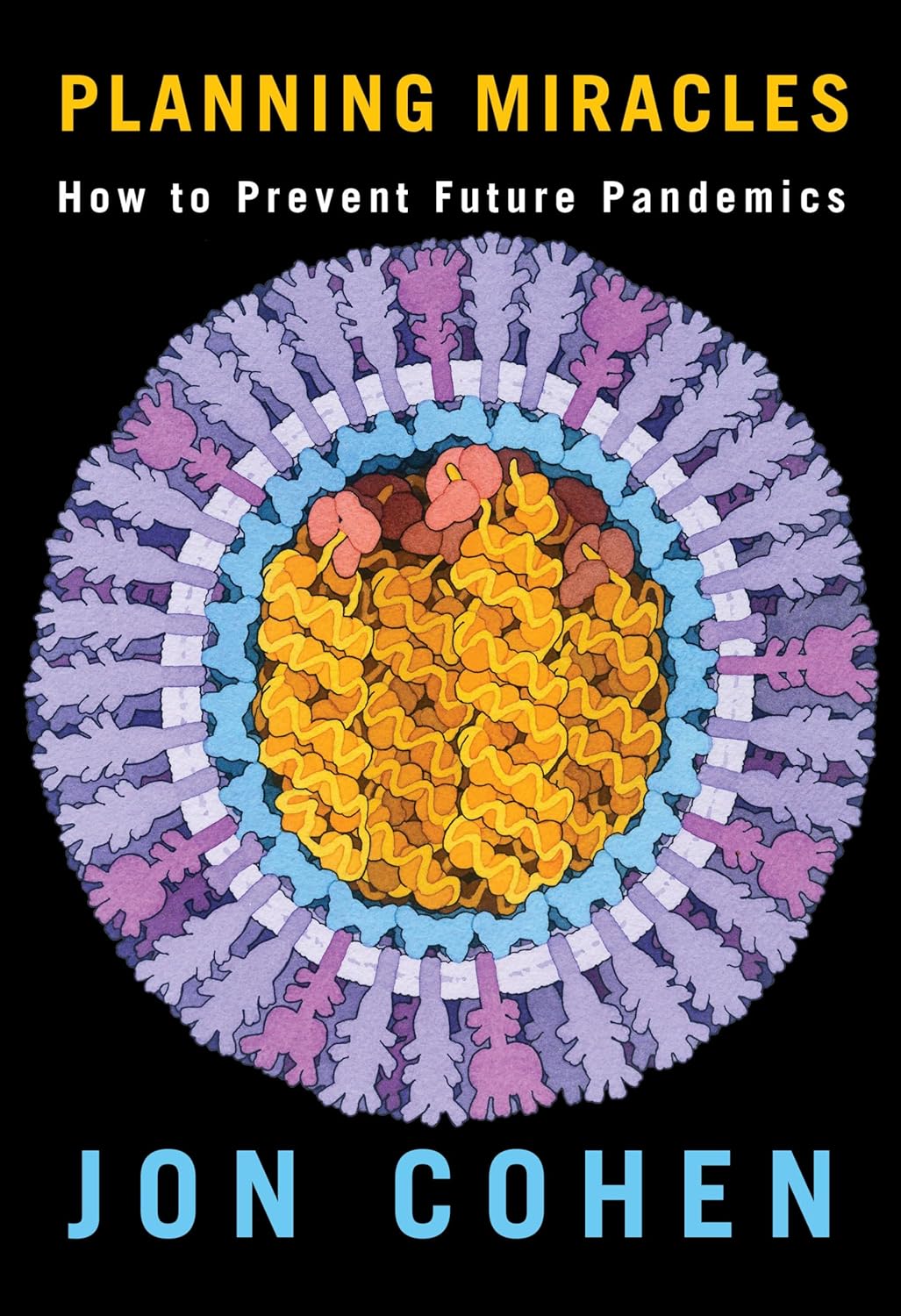
Planning Miracles would’ve been vastly more compelling — and welcomingly shorter — if Jon Cohen hadn’t buried the lede. Deep. It’s not until the halfway point of this 448-pager that the Science magazine correspondent delivers the goods promised in his book’s subhead: How to Prevent Future Pandemics.
And deliver he does.
Cohen shines when steering readers along absorbing journeys to the rainforests of the Amazon, the mountains of Vietnam, and “wet” markets in Cambodia to draw portraits of the intrepid and innovative scientists persevering to hunt down and halt potential sources of the next global scourge. More on that later.
But first, the jumping-off point for his book is, of course, covid-19. While those initial vaccines were created with astonishing alacrity due to unprecedented global cooperation, that model is threatened by the Trump administration’s upending of the federal government’s health expertise, coupled with the proliferation of misinformation and distrust of science that has ballooned since 2020.
Cohen states in his introduction that his aim in focusing on viruses “is to present the possibilities for keeping dangerous pathogens at bay while highlighting the follies of our risk/benefit miscalculations and the panic/neglect cycle.” In tandem, he emphasizes that Planning Miracles isn’t about what former New York Times science reporter Donald G. McNeil Jr. labeled “the human factors that spread pandemics” in his 2024 book, The Wisdom of Plagues.
This criticism might sound harsh to some ears, but Cohen then spends much of his first 10 chapters rehashing McNeil’s conclusions about the inadequate response to covid because of denialism, rumors, political opportunism, poverty, bumbling public-health institutions, ill-informed media, and a host of other Homo sapiens-related deficiencies.
The diligent reader is rewarded, however, in part III, “Surveillance.” It’s here that Cohen embarks on a global tour of bat caves, live-poultry markets, insect-laden rainforests, bird observatories, pangolin rescue centers, and farm shows to delve into how colorful, courageous, and controversial scientists can uplift and undermine one another as they hunt for harmful new pathogens.
Much of the material is recycled from his magazine reporting, but the detailed stories are pertinent and well-told. One of the most fascinating zeroes in on comparatively mundane settings: U.S. fairgrounds. Teams of “swientists” have collected samples from at least 40,000 pigs, analyzing them for clues as to how novel flu viruses spread through the show circuit, shuttling between animals and people.
Fears about the next flu pandemic usually spotlight Asian live-animal markets, with their exotic species such as palm civets, raccoon dogs, and bamboo rats. While people think such settings are a foreign concept in America, they aren’t, says Ohio State University swine veterinarian Anthony Bowman. Show-hog handlers, usually children, pose a similar risk of becoming disease conduits when they tend, groom, and even sleep alongside their charges. “I mean, is it really that different?” Bowman asks.
Early on, Cohen notes that his book’s title is a nod to the two words Basil O’Connor, inaugural head of the March of Dimes, used to describe the 1955 development of the polio vaccine by Jonas Salk. O’Connor was a former law partner of Franklin Delano Roosevelt, a president who spawned the foundation after being crippled by polio from the waist down.
“None of us dared to believe, 17 years ago, that this would happen in less than a century,” O’Connor wrote in 1955. “And yet, when it happened, it took everyone’s breath away.”
But innovation alone isn’t enough to derail outbreaks, Cohen emphasizes. It must be combined with the financial and political backing to transform the most promising ideas into action. “If we are going to plan miracles, we have to do it together,” he writes. “Viruses do not care about borders…But humans, when it comes to protecting their own communities from pandemics, care about them too much.”
One go-getter intent on ignoring those boundaries — and a character probably worthy of his own chapter — is virus-hunter Dennis Carroll, who drilled down on emerging threats before retiring from the now-dismantled U.S. Agency for International Development. Carroll was one of the visionaries behind the Global Virome Project, conceived at a 2016 meeting in Belgium.
Briefly, the ambitious endeavor, modeled after the Human Genome Project, was presented as an international partnership to construct systems and capacities to detect future viral threats circulating in the wild. Organizers estimated that between 631,000 and 827,000 such viruses have the potential to infect humans. Ironically, the resource-consuming covid-19 pandemic put the kibosh on that endeavor.
Planning Miracles is being released as the Trump administration doubles down on squelching real science while platforming charlatans, which makes Colin Carlson an especially compelling character in Cohen’s book. A study led by the Georgetown University biologist forecast how a warming Earth will upset animal habitats. The resultant mingling of more and more critters on the move boosts the likelihood of viral exchanges among wildlife, leading to new disease outbreaks.
To mitigate the risk to humans, Carlson recommends intensifying surveillance when a species is found far from its original home. For instance, long-haul travelers like Brazilian free-tailed bats merit attention because their range has expanded into the Southeastern United States over the last 10 years. “Plan long term around a world where we can’t put this back in the box,” says Carlson about climate change and potential pandemics. “Wishful thinking is our enemy.”
Sage advice, indeed.
Elizabeth McGowan is a Washington, DC-based energy and environment reporter who writes for the Virginia Center for Investigative Journalism. She has won numerous awards, including a Pulitzer Prize for “The Dilbit Disaster: Inside the Biggest Oil Spill You Never Heard Of” as a staff correspondent for InsideClimate News. Bancroft Press in Baltimore published her memoir, Outpedaling ‘The Big C’: My Healing Cycle Across America, in 2020.