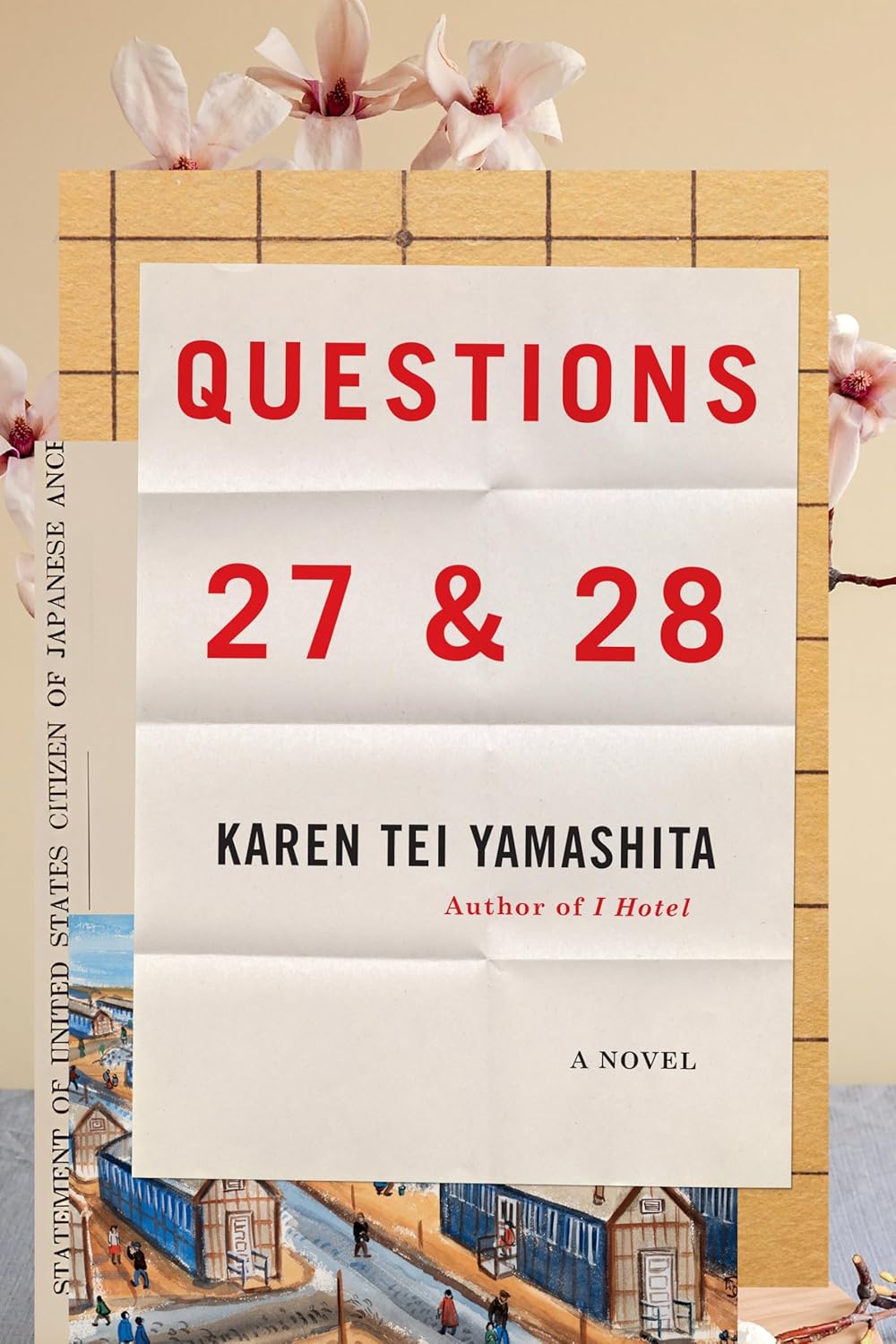
Questions 27 & 28: A Novel
- By Karen Tei Yamashita
- Graywolf Press
- 464 pp.
- Reviewed by David A. Taylor
- June 12, 2026
The fallout from Japanese internment camps ripples across decades.
Across a full career, Karen Tei Yamashita has written plays, stories, and novels. Her 2010 work, I Hotel, a National Book Award finalist, comprises 10 linked novellas. In her new book, the novel form takes on a fresh shape, reflecting patterns of history and the ways an archive can encompass and reveal a community, an era, and a country’s values.
The narrative in Questions 27 & 28 centers on the period from 1942 through 1945, after President Franklin D. Roosevelt signed a WWII executive order authorizing the uprooting of roughly 120,000 Japanese Americans from their homes on the West Coast and detention in an archipelago of hastily built camps. (For generations, these were called “internment camps”; many now consider “concentration camps” more accurate.) The story reaches backward and forward across decades, but to call it a novel about the camps is like saying Ulysses is a novel about a day in British-held Dublin.
An author’s note nods to Lane Hirabashi, the writer who introduced Yamashita to hundreds of boxes in the camps’ vast archive. The novel’s title refers to two queries on the form detainees needed to fill out in order to get released. The first asks if they — who have lost their freedom —are willing to serve in the U.S. military. The second asks if they renounce all allegiance to Japan (where most of them had never been). The answers cause generational faultlines that reverberate violently inside the barbed wire and beyond.
Characters roll through the narrative like files on carts, connected more by adjacent experiences than by direct interaction. Many passages reference true accounts; the author then shapes fact into fiction for dramatic coherence. (The book includes a bibliography for each section so that readers can pursue those threads.)
Near the midpoint, for example, in a chapter titled “Miné: Citizen,” we meet a young artist, Miné, in conversation with a photographer. As they walk through the desert examining petroglyphs, she sketches him. The real-life Miné Okubo was in her 20s when she and her family were sent to the Topaz camp in the Utah desert. Detainees were rarely allowed to photograph their inhumane conditions, but she drew hundreds of vivid sketches that bore witness. After the war, she pulled them together and published an early graphic memoir before that genre existed. She called it Citizen 13660, the inmate number the government had assigned her. It was later republished and entered as testimony in California’s hearings on reparations.
Miné is fascinating, and I watched for her to reappear beyond her initial few pages. Unfortunately, she never did (except in the book’s endnotes). Yamashita’s range of characters is as rich as James Joyce’s in Ulysses, but in a novel that seems determined to build emotional momentum, the decision to pull some of the liveliest characters off stage so quickly felt like a shame.
Still, I dog-eared many pages so that I could return to them. Some include chilling exchanges, like one involving an arrest after a false accusation. The detained man asks the police to tell his family where they’re taking him. “No, Harry, where you are going, nobody knows where you are going,” the officer responds. “I won’t tell nobody, and you will be there for a long time.” A footnote points to the quote’s presence in the Online Archive of California.
That archive may also hold the seeds of rapprochement. In an amazing scene, two dogged researchers from the present witness (as “future ghosts”) a 1942 gathering in which federal officials debate the legality of detainment. The subsequent internal wrangling at the Supreme Court, which ultimately approved the policy, might sound dry in lesser hands, but Yamashita fills it with tragic weight. As the researchers look on, Justice Robert Jackson utters his enduring — and damning — dissent:
“The Court for all time has validated the principle of racial discrimination in criminal procedure and of transplanting American citizens. The principle then lies about like a loaded weapon ready for the hand of any authority that can bring forward a plausible claim…”
In Questions 27 & 28, Karen Tei Yamashita has created a stunning indictment of the fallout from two loaded queries on an obscure, long-ago bureaucratic questionnaire. In the process, she brings the historical archive, in all its messiness, to life.
David A. Taylor’s books include Soul of a People, about the WPA writers, and Cork Wars: Intrigue and Industry in World War II, which received an Independent Publishers Book Award for world history. He teaches writing at Johns Hopkins University and produces a history/culture podcast, “The People’s Recorder,” which received a 2025 Signal Award.