Railsong: A Novel
- By Rahul Bhattacharya
- Bloomsbury Publishing
- 416 pp.
- Reviewed by Ananya Bhattacharyya
- March 27, 2026
An unusually determined young woman pursues a career in Mumbai.
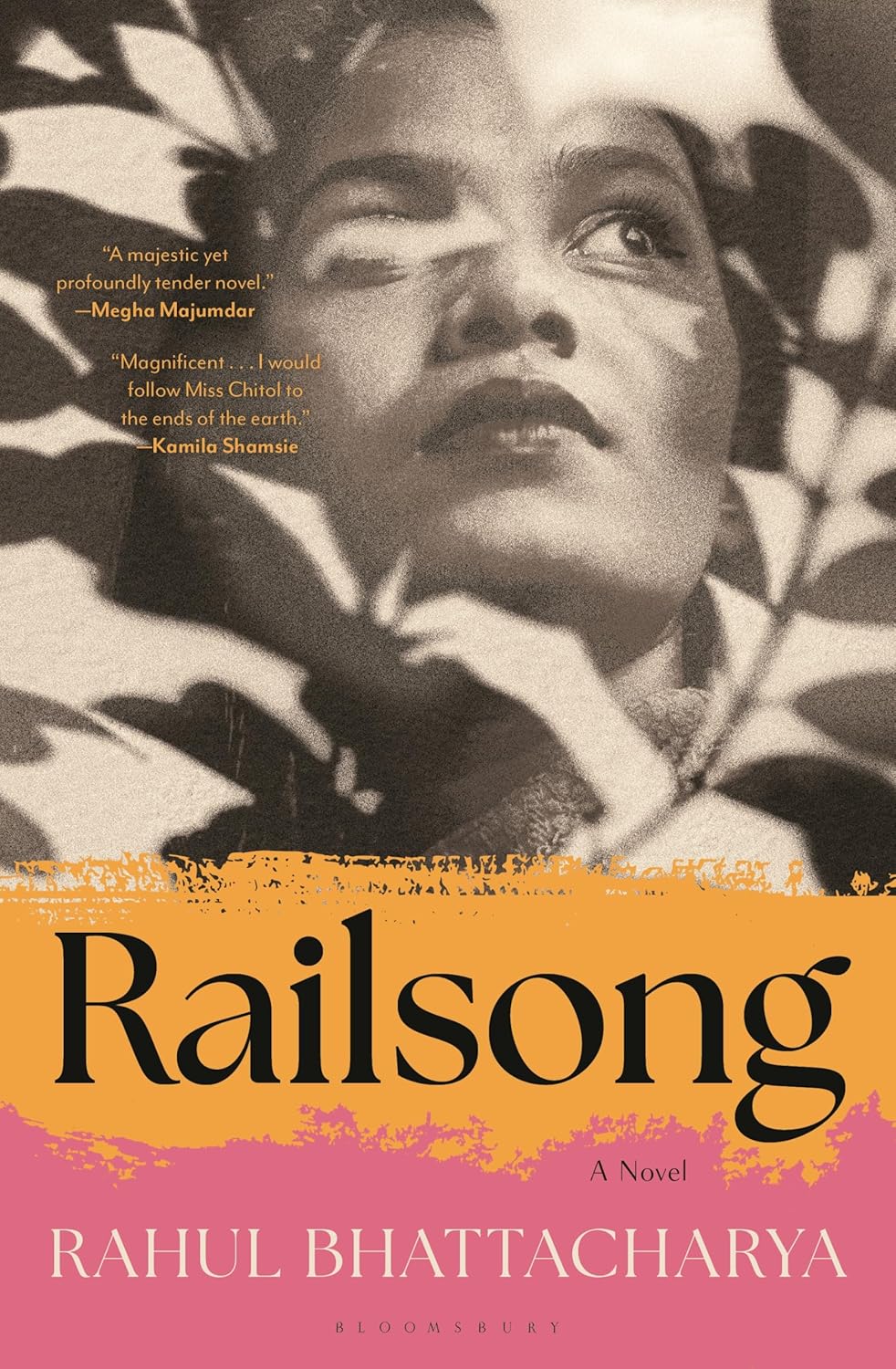
Rahul Bhattacharya’s Railsong attempts to capture the complexity of India — a staggeringly ambitious goal — by telling the story of Charulata “Charu” Chitol and her lifelong relationship with the Indian National Railways, a system that helps bind the nation together.
Charu grows up sheltered in a fictional small town, where she and her two brothers are raised by her widower father, who is a railway worker, and two elderly ladies, one of whom is her grandmother. Charu dislikes the misogyny she’s subjected to, especially at home, but finds solace in friendships and in books.
When she’s old enough to be somewhat autonomous, she runs away to Mumbai. Life is even harder there, but she has what it takes to survive in the huge metropolis: persistence. Charu first works at a shoe store and eventually gets a job with the railways as a clerk. And she endures numerous non-ideal living arrangements: first staying with relatives, then in women’s hostels, and finally with the man she marries and his parents.
What I admire most about this novel is Charu’s strength and attitude. She exchanges a sheltered life for one in which she struggles. Through sheer persistence, she gets the job she has always wanted, as well as subsequent promotions. The advice she receives after her wedding is to become like sugar that dissolves in milk — blend well into your new family and don’t stand out too much.
Yet she does something more interesting with her life. She goes after what she wants and gets it time after time. In fact, she is self-possessed in a way women aren’t typically socialized to be — not in India, and probably not in many places in the world.
Another thing I appreciate about Railsong is its language. Here’s a description of the Chitol family garden:
“The lime tree drooped with fruit, the spinach square was thick with green, the red hibiscus pistils flickered in the breeze. The entire township was proof of the resilience, the perpetuation of things. The winged seeds of sal helicoptered their way down with propagatory grace.”
And while some of Bhattacharya’s stylistic choices work well — such not translating certain Bangla words, which makes the prose evocative and adds to its poetry — others are less successful. The author makes the decision to call Charu “Miss Chitol” when she becomes a young woman and “Smt Chitol” after her marriage. (Smt is short for Shrimati, or roughly, “Mrs.”) Thus, for three-quarters of the book, every single reference to her has an honorific attached, creating unnecessary distance between the reader and the protagonist.
Another distracting choice is that all of Charu’s romantic interests are referred to only by their initials: B, P, etc., perhaps to show readers how inconsequential they are to Charu. This device needlessly draws attention to itself and away from the story.
While these are relatively small quibbles, a more serious shortcoming is that the narrative could’ve done with some tightening. Margaret Atwood bade writers to “hold the readers’ attention,” but Railsong falters in that regard. For instance, I understand the importance of showing readers how a person ends up getting a government job in India. They must pay respect to a whole bunch of bureaucrats, showing up day after day, month after month, until someone breaks down and gives the seeker a job. But there must’ve been a way to portray all this without taking us along on the plodding journey with Miss Chitol.
There’s much to admire in this novel, like how it creates a vivid portrait of both smalltown India and mammoth Mumbai, but the characters seem to glide past each other without really connecting, so the book ends up feeling idea-driven. It weaves a rich tapestry of information about a time and a place, but it falters as a story about people whose actions and inner lives invite deeper engagement.
Ananya Bhattacharyya is a Washington-based editor and writer. Her work has been published in the New York Times, the Guardian, LitHub, the Baltimore Sun, Al Jazeera America, Reuters, Vice, Washingtonian, and other publications.