Rasputin: The Downfall of the Romanovs
- By Antony Beevor
- Viking
- 384 pp.
- Reviewed by Anne Eliot Feldman
- May 19, 2026
A richly researched history of the dubious mystic.
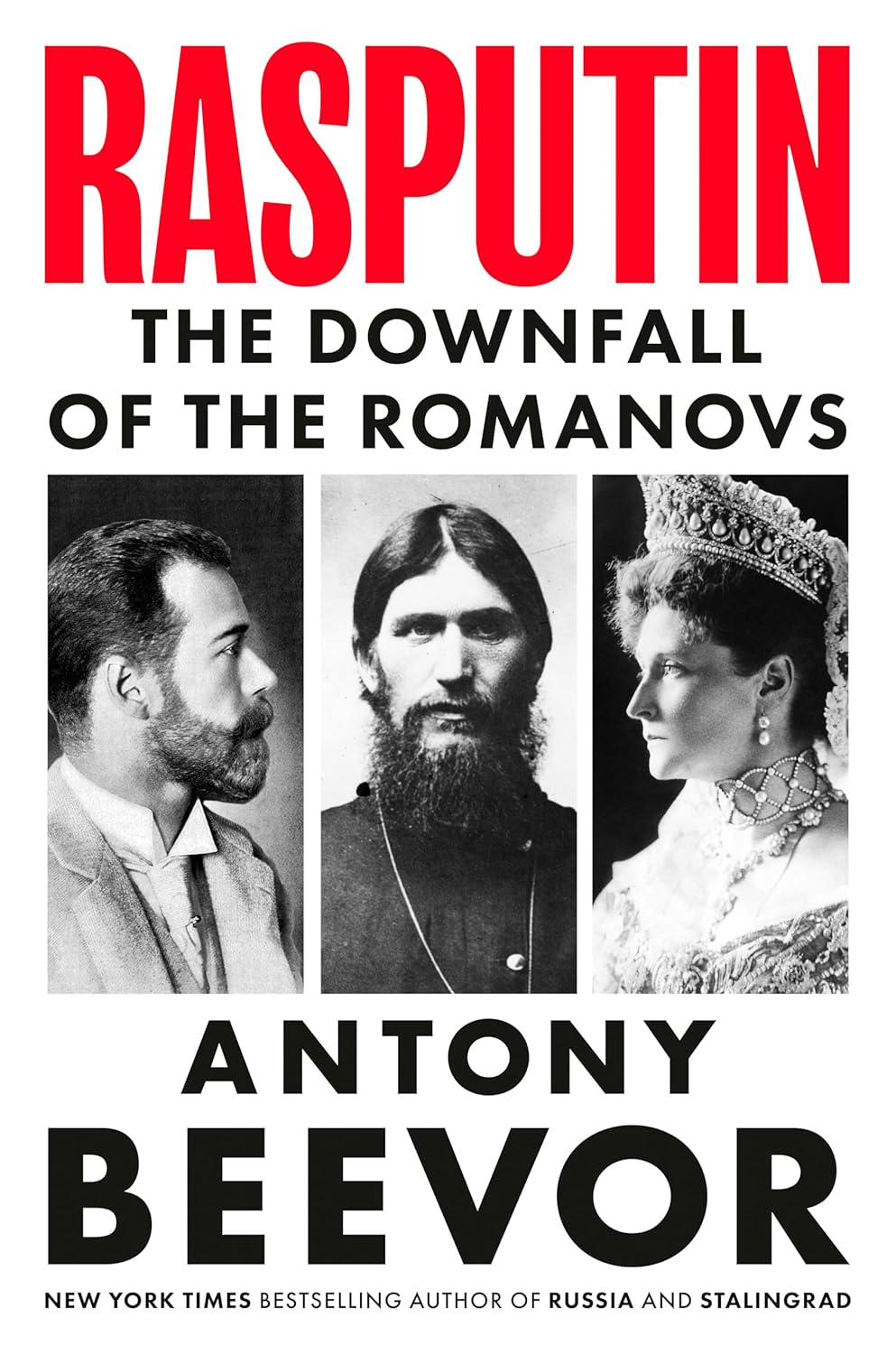
Rasputin: The Downfall of the Romanovs by acclaimed British historian Sir Antony Beevor is a vibrant biography that reads like a political thriller. Published more than a century after the titular Svengali’s death, the book features a meticulous yet fascinating account of the 11-year relationship (1905-1916) between Rasputin and the Romanov family, a relationship that led to his murder by “fervent monarchists” and the subsequent downfall of Nicholas II and Alexandra, the last tsar and tsarina of imperial Russia.
Beevor devotes the book’s first two chapters to Grigory Efimovich Rasputin’s Siberian roots. Unlike western Russia in those days, Siberia had no serfdom or large estates. Its vastness and punishing weather bred a self-reliant people who tended to be “more independent” than their countrymen, “even anarchic.” Born into a peasant family, a barely literate Rasputin marries at 18 and has three children before being drawn to the magical allure of the Russian Orthodox Church. By1897, he’s undergone enough spiritual training to become a wandering pilgrim, going from one monastery to another “in search of God and understanding.”
The next few chapters describe Nicholas II and Alexandra in their early reign. The introverted Nicholas is deeply religious, believing that “almost every event must be the will of God.” Small in stature for a Romanov, with a father (Tsar Alexander III) who considers him girlish, Nicholas lacks self-esteem. Having lost her mother at a young age, the German-born Alexandra (nee Alix of Hesse) is put off by the “unreal world of Romanov royalty,” with its “stupendous wealth and jewelry.” It takes the prodding of her English grandmother, Queen Victoria, for Alix to marry outside her faith and move to St. Petersburg despite not knowing a word of Russian.
A series of unfortunate events for the couple — the larger-than-life Alexander dies unexpectedly just before his son’s November 1894 wedding; their first child is a girl; and a stampede at their May 1896 coronation results in the trampling deaths of at least a thousand people — casts them in an unflattering light, magnified in time by a St. Petersburg society that leans into its independent press and democratic inklings. Writes Beevor:
“When a social and political order is about to disintegrate,’ the old academician Dmitriy Ovsianiko-Kulikovsky observed, ‘rulers always seek the support of the supernatural.’”
Thus, the charismatic Rasputin captivates the tsarina during their very first meeting in November 1905. Soon after, the tsar becomes equally smitten, happy that his wife is happy. The mystic’s apparent (though inexplicable) healing power over their hemophiliac son cements the bond.
The turbulent years that follow only fortify their connection. The tsarina increasingly relies on “Our Friend,” as she and Nicholas call Rasputin, for advice and consolation, and conversations with the holy man bring the tsar “a sense of relief and calm.” Yet, as salacious rumors and press reports of Rasputin’s incessantly atrocious behavior toward women run rampant and gain momentum, all anyone in elite circles can think of is how to get rid of him.
With the onset of World War I and the tsar gone to the front, the tsarina works to “refashion the ruling apparatus,” replacing anyone she suspects is disloyal to Rasputin. Her choices are disastrous, and Rasputin’s growing influence over the royals horrifies all. “People wanted to kill him,” writes Beevor, “and no one knew how.” But a grand duke and a prince finally figure it out, and the author’s rich account of the moments leading up to Rasputin’s murder and the killing itself — culled from a satisfyingly wide range of archival sources — makes for an engrossing set of chapters. Like icing on the cake, the book also includes over 50 photographs and an extensive bibliography.
As Beevor illustrates time and again, “When it came to Rasputin’s effect on the course of events, perception was far more powerful than reality.” In the tumultuous last years of tsarist rule in Russia, false stories were regularly embraced as true, while the truth was hidden or ignored, making it difficult to unravel the accurate history even now. (Fake news, you say?)
But finding truth is about more than just uncovering facts. His country’s history, said the great 19th-century Russian poet Fyodor Tyutchev, “cannot be understood with the mind alone. Neither can Rasputin.” This mystical man with “broken speech…short, almost unintelligible sentences, and…jumping around between subjects” also, as witnessed by those around him, possessed an infectious spiritual fervor, a “somewhat electrifying touch,” and “shining, steel-like eyes which seemed to read one’s innermost thoughts” and could transfix all types of women, vulnerable or not.
Rasputin casts a wide net and is an exciting show-and-tell of how one man’s “paradoxical character” and “astonishing story…defy conventional logic” and played a decisive role in the toppling of a dynasty.
With a B.A. from Colgate University, an M.A. from Georgetown University, both in Russian area studies, and a UCLA certificate in fiction writing, Anne Eliot Feldman has worked in the Library of Congress and the defense industry. She’s currently at work on a writing project of her own.