Refusenik’s Son: A Story of Spies, Bioweapons, and Cold War Survival
- By Alex Goldfarb
- Northern Illinois University Press
- 264 pp.
- Reviewed by Todd Kushner
- November 17, 2026
Life in the 1970 and 80s was grueling for Russia’s homegrown critics.
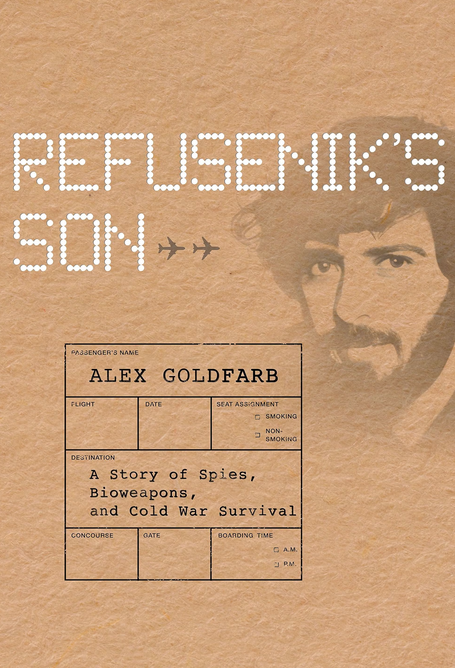
Alex Goldfarb was a Soviet dissident in the 1970s and wrote Refusenik’s Son to give his family a look beyond the public version of his life. In chronicling his observations, inner thoughts, and previously undisclosed details, he has crafted a suspenseful read, one replete with nettlesome Soviet officials, brave dissenters, energetic foreign correspondents, cat-and-mouse games with the KGB, and long-held secrets.
The book also serves as a stark reminder. Although the Western press extensively covered Soviet dissidents in the 1970s and 1980s, memories of their struggles are fading with the passage of time. These dissidents — often scientists, artists, writers, and other intellectuals — publicized Soviet repression and demanded that the USSR respect human rights. They faced consequences ranging from harassment to confinement in labor camps and/or psychiatric hospitals.
Goldfarb devotes the book’s first section to discussing his personal evolution. He started life indoctrinated to “love Comrade Stalin” but matured into a full-fledged activist and opponent of the Soviet regime. In these opening pages, he candidly lays out his “fears, suspicions, moral dilemmas, and ever-present awareness of the battle between good and evil.”
The author goes on to outline how dissidents leveraged U.S.-Soviet diplomacy and Western public opinion. In particular, he discusses how they influenced America’s Jackson-Vanik legislation (which tied expansion of U.S.-Soviet trade to increased Jewish emigration) and the outcome of the Helsinki Accords (in which 35 countries — including the U.S. and USSR — agreed to respect human rights and national sovereignty, to refrain from the use of force, and to cooperate in economic, scientific, and humanitarian issues). In fact, Goldfarb personally exploited anxiety over Soviet compliance with the Biological Weapons Convention to secure to his own emigration.
The book also digs into fissures within the dissident movement. Although members were unequivocally anti-Soviet, some wanted Russia to become more Western, while others sought a return to traditional Russian values. There were also tensions between dissidents who prioritized advocating for human rights and those with a primary interest in increased emigration.
The second part of Refusenik’s Son focuses on efforts to convince the USSR to allow Goldfarb’s father, prominent scientist David Goldfarb, to emigrate. The book details how the KGB framed and arrested U.S. reporter Nicholas Daniloff as a spy and accused Goldfarb’s father of passing classified information on the Soviets’ biological-weapons program through him.
Goldfarb unpacks his father’s story by drawing on the revelations of a shadowy defector from the KGB. He discovers betrayals by friends and family, outlines KGB subterfuge, and details allegations of CIA bungling. Ultimately, President Ronald Reagan and Secretary of State George Schultz successfully intervened to secure Daniloff’s release and David Goldfarb’s emigration.
The book’s chapters are short and suspenseful and reflect the author’s contemporaneous anxiety and uncertainty about how events will unfold. While some broader issues are discussed, the narrative focuses on Goldfarb’s personal experiences and is punctuated with extensive dialogue. He scrupulously documents the few paragraphs that are reconstructed from secondary sources.
Goldfarb incorporates vivid anecdotes about dissident life and also relays intensely personal episodes, such as the pain of leaving behind family in the USSR, divorcing his first wife because she will not emigrate, and the difficulties of adjusting to life in Israel as someone who speaks neither Hebrew nor Arabic. (Refusenik’s Son was originally published in Russian in 2023 and later translated into English by Goldfarb.)
Author Robert G. Kaiser once declared the importance of dissidents “leav[ing] a record of what really happened in [this] period of Russian history to tell the future what it felt like to live in the past.” Alex Goldfarb’s excellent Refusenik’s Son embodies that importance and deserves a place on the bookshelf of anyone seeking an empathetic understanding of those opposing the Soviet regime.
Todd Kushner is a retired U.S. Foreign Service Officer. The views expressed are his alone and do not represent the views of the U.S. government.

