Rehab: An American Scandal
- By Shoshana Walter
- Simon & Schuster
- 320 pp.
- Reviewed by William Rice
- August 15, 2025
Addiction is only part of our national drug-abuse tragedy.
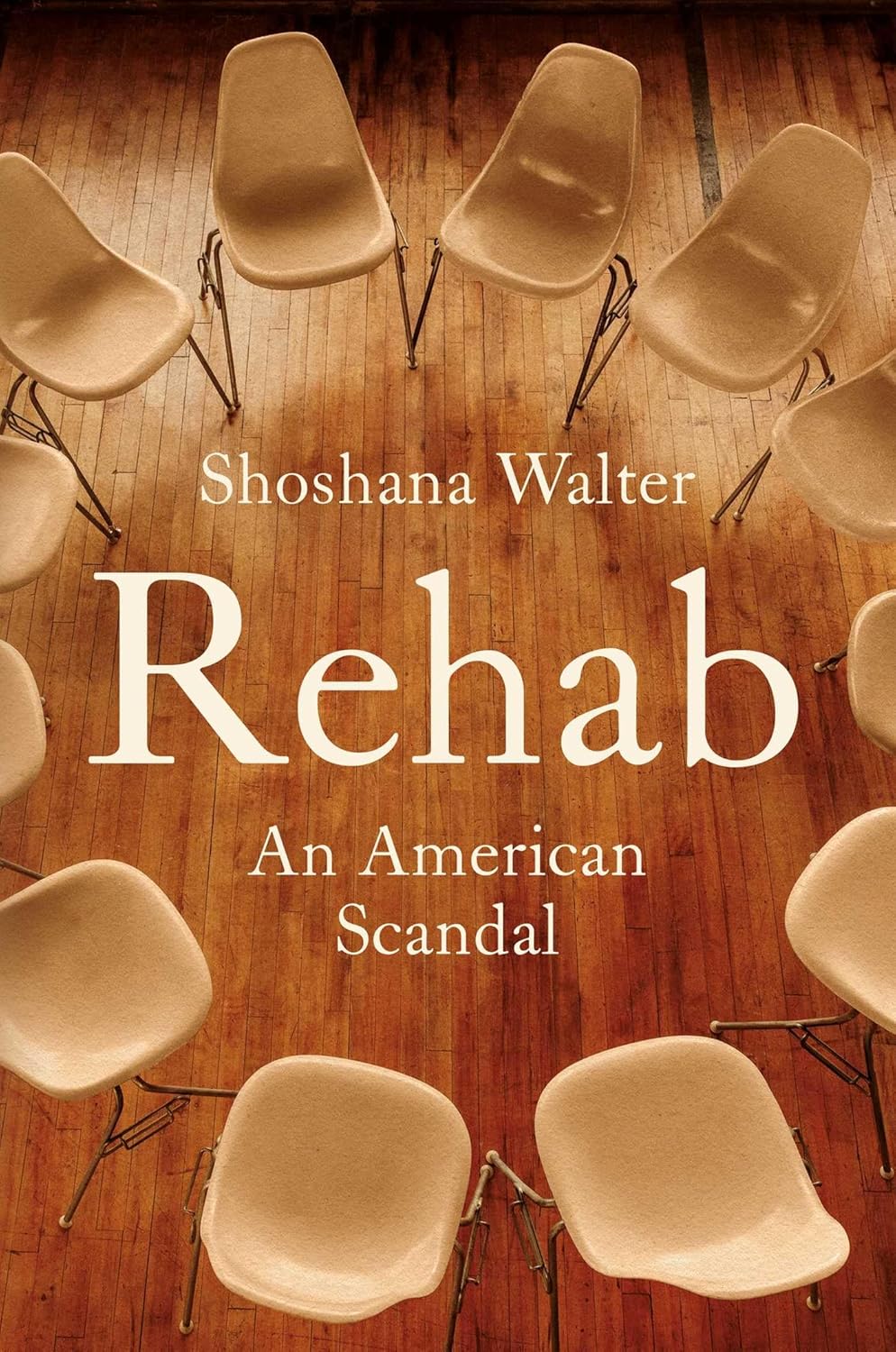
Vulnerable people are often abused, not because their abusers are necessarily evil but because it’s easy to ignore their needs when pursuing selfish ends. So it has been with drug addicts seeking treatment in recent years, as described in Shoshana Walter’s important new book, Rehab: An American Scandal.
The pursuit of profit has overridden the duty to provide humane and effective care in too many cases, Walter finds. And lethargic or nonexistent government regulation — by bureaucrats with an interest in not being bothered — has let it happen. Her answer is an old and simple one: generate enough public pressure through work like hers to force legislators and regulators to do their jobs and make rehabilitation programs the boons to private and public health they’re supposed to be. The author has a track record of bringing scandals to light.
This one involves supposed rehabs that give unnecessary drugs to residents to increase insurance reimbursements; fail to watch over potential suicides; refuse medical attention for severe injuries; and essentially rent residents out for onerous and dangerous labor in a 21st-century version of contract slavery presented as the therapeutic application of hard work.
Walter weaves the stories of four Americans from different corners of the nation into a single narrative of a rehab system gone very wrong: a young white man in Louisiana; a low-income Black mother in Philadelphia; a crusader against rehab abuse in California; and a physician with his own addiction who dedicated his professional life to treating others similarly afflicted — though he doesn’t come across as noble as that description may sound.
Actually, none of these figures is presented as a caricature, either good or bad. The often chaotic lives of substance abusers are presented with sensitivity and tact but never sentimentalized. The possibility of love and even fun in the midst of disabling disease is made credible through reporting that draws out the recognizably human in situations that, for most people, are otherwise not recognizable at all.
Walter shares some alarming statistics, including: “Studies show that patients are more likely to overdose and die after a 30-day stint in rehab than before it.” She explains this shocking phenomenon as a deadly combination of the tendency of patients to relapse after too-short a rehabilitation (a month is standard because that’s what insurance will pay for) and the lowered tolerance that comes with even an insufficient period of abstinence.
Race is central to the story, as it is to America’s response to addiction. Walter notes that when drug abuse is perceived as a Black and Latino problem — as it was in the last third of the 20th century — the public-policy emphasis is on law enforcement and punishment. When it is perceived that white people are becoming addicted to and dying from the abuse of drugs — as in recent decades — the efficacy of humane treatment suddenly takes precedence. The unavoidable conclusion: Addicts of color are dangerous criminals to be curbed; white ones are pitiable victims to be helped.
Even though she says that being arrested is sometimes the jolt substance abusers need to change their life, Walter in general holds that the puritanical and punitive approach to combating drug addiction is the wrong one. She notes that “hitting rock bottom” — the oft-cited necessary starting point for recovery — also poses serious risks:
“…[T]he possibilities are devastating and endless. Is hitting rock bottom losing your apartment, your job, your kids?...As the bottom grows deeper and deeper, it becomes harder to find a way out.”
As would seem to be obvious but is not reflected in public policy, many substance abusers need a lot of help to recover — help that extends beyond a short stay in an often subpar clinic. (Though Walter does mention the prevalence of “natural” recovery in the absence of outside intervention, often ascribed to physical maturation: Most addicts are young.) As with so many social problems, widespread addiction is, in part, a consequence of other failings, mostly tied to intergenerational poverty. It’s hard to “Just say no” when you don’t have a decent job, a decent place to live, or relatives in any better shape to help you.
In fact, Walter persuasively argues, seeking escape from a grim life via alcohol or drugs is a rational act. Not regularly getting high in those circumstances requires a leap of faith, one that’s hard to perform consistently. She explains:
“It’s not that addicts are physically incapable of stopping; it’s that many simply don’t have better alternatives, and the pathways to attaining those alternatives are less than clear.”
In addition to the need for socio-economic transformation, Walter offers more immediate prescriptions for the addiction epidemic, including the wider availability of the treatment drug Suboxone (which blunts the craving for heroin and other opioids) and rehabilitation services that not only avoid abuse but focus on the needs and goals of each individual.
Detracting somewhat from the vital message of the book is its lazy editing; ideas and even precise text frequently repeat in different chapters. But those errors can be excused if Walter’s work succeeds in pushing what she describes as a $53 billion rehab industry toward long-overdue reform.
William Rice is a writer for political and policy-advocacy organizations.