Roam: Wild Animals and the Race to Repair Our Fractured World
- By Hillary Rosner
- Patagonia
- 352 pp.
- Reviewed by Jennifer Bort Yacovissi
- April 10, 2026
After reading this, you’ll never look at a fence the same way again.
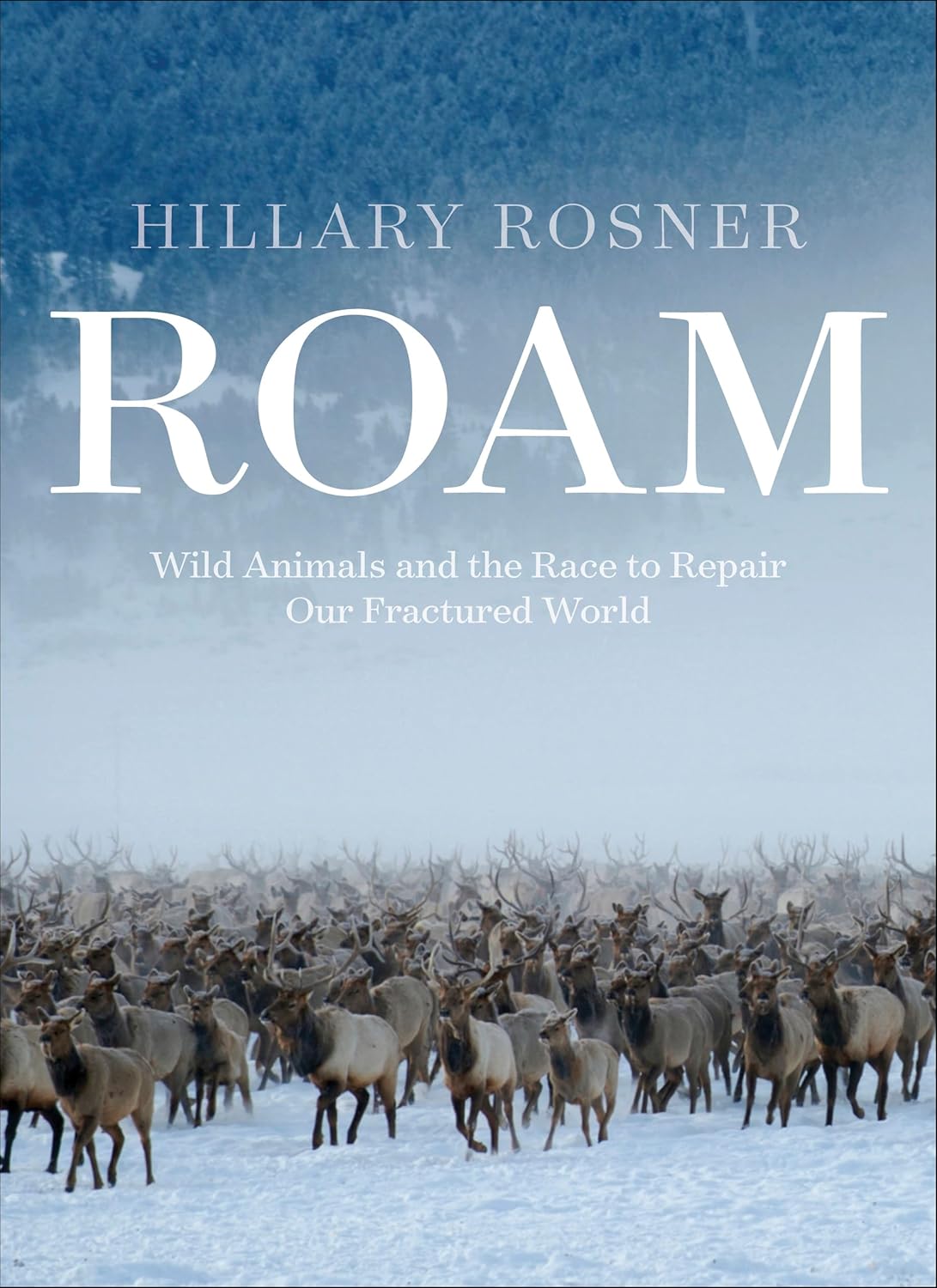
Patagonia, the clothing company, publishes “a select list of titles on wilderness, wildlife, and outdoor sports that inspire and restore a connection to the natural world and encourage action to combat climate chaos.” (Who knew?) One of these titles is Hillary Rosner’s Roam, which churns up the reader’s desire to do something, though it’s not immediately evident what that something could be.
Her target audience is almost certainly the cohort that already understands climate change is real and is primed to grasp the need for connected, uninterrupted corridors through which wildlife can move. (It’s possible not a single one of her readers was excited at the 2016 prospect of building a big, beautiful wall along the U.S.-Mexico border that blocked wildlife migration and only questionably stemmed the human kind.)
Walls, fences, and highways present barriers to wildlife in ways we rarely consider. We celebrate when a patch of land is saved from development, when some acreage is purchased for preservation. But if that bit of land is disconnected from other bits of open land, the plants and animals in it are basically marooned on an island; biodiversity decreases and extinction rates grow. When corridors are established that allow wildlife to move freely across greenspace, populations go up, diversity increases, and extinction rates fall.
Rosner takes herself and us on a globe-spanning research trip into the various efforts governments and organizations have undertaken to expand and reconnect the wildlife corridors that support the migration of animals and plants across the landscape and often across national borders, as with Monarch butterflies, which travel 3,000 miles across Canada, the U.S., and Mexico. Adds the author:
“Think of Arctic terns, with the world’s longest migration — somewhere between 25,000 and 50,000 miles — traveling between Antarctica and Greenland. What do they need to do to get to their ‘other side’?”
We visit Kenya, Italy, Costa Rica, Montreal, and many hotspots in the U.S. where efforts are underway to reconnect greenways. In just one example, the Yellowstone to Yukon Conservation Initiative connects 2,000 miles across the U.S.-Canada border to give big animals like grizzlies and wolves room to move.
Though Rosner sometimes dreamily harks back to an Eden when man and nature happily coexisted (I sense our earliest forebears would take exception), she does acknowledge the need to, say, separate hungry elephants from planted crops. Happily, pachyderms apparently don’t like bees; thus, there are “bee fences” in which hives are incorporated into otherwise slender fencing. Not only do the elephants stay away, the resulting honey is an additional cash crop for Kenyan farmers.
On the other hand, Rosner’s foreword, written just ahead of the book’s publication, undercuts some of her optimism. Wherever she mentions a federal program in the U.S. that had been successfully maintaining corridors or addressing climate change, readers can safely assume it no longer exists under the current administration. In fact, the agencies involved are likely working to pollute and develop even more, all the better to own the Libs:
“Today, if you pull up virtually any Interior Department announcement from the Biden Administration — for example, one from September 2024 touting $92 million in funds for river and aquatic habitat restoration — you will see a giant banner across the page informing you that the content is ‘ARCHIVED’ and that links no longer work.”
Elections have consequences that extend beyond the price of eggs.
The U.S. certainly isn’t the only culprit; China’s Belt and Road Initiative, in which China is paying for major infrastructure in developing (and developed) countries, takes an international approach to ignoring the ecologically catastrophic outcomes of its projects. But Americans love to take our entitlement wherever we go. “Driving the road to Piro [in Costa Rica],” writes Rosner, “we’d passed a giant mansion built by a Californian who illegally cut down seventy trees and then built a fence that looked to be more than ten feet high, forming a barrier to wildlife movement.”
She also introduces us to bleak terminology. The reality that “habitat loss now will lead to extinction in the future, though there may be a time delay between cause and effect” is called “extinction debt.” Climate change pushes animals to higher elevations to find an ecosystem to which they are adapted, but sometimes there’s no higher to go. This is termed the “escalator to extinction.”
In the chapter “Corridors of Injustice: How We Treat Each Other Is How We Treat the World,” we learn about the “luxury effect,” in which richer areas have more greenspace, more tree cover, and therefore more plant and animal density and diversity. It was the New Deal, oddly, that established the concept of redlining — identifying residential areas assessed to be riskier investments for the federal government — that continues to affect not just people but wildlife. “Just like a wall or fence or a highway, systemic racism creates a barrier to wildlife movement.” For instance, data analysis is a huge driver in making conservation decisions, but little data — such as annual bird counts — is collected in poorer neighborhoods, thereby reinforcing historical blind spots.
Still, there are elements of surprise pushing in the other direction, too. In the Everglades, which used to extend from Orlando to the Keys, previous and current projects to drain its water negatively affect every element of the ecosystem. This is a fact to which many Floridians have awakened. Even in deep-red Collier County, residents have voted twice in big margins to raise their own taxes to fund the purchase and preservation of land surrounding the Corkscrew Swamp Sanctuary.
In Roam, Rosner has produced a well-researched, thought-provoking book filled with photos that are at turns gorgeous and gut-wrenching (see the guanaco cadaver caught in a fence). What, as the publisher intended, does it inspire in the reader? Well, I’m ready to sign up for a summer in Montana cutting down old barbed-wire fencing. Hot, slow, exhausting work that probably involves cuts and scrapes, biting flies and ticks. Who’s with me?
Jennifer Bort Yacovissi’s novel, Up the Hill to Home, tells the story of four generations of a family in Washington, DC, from the Civil War to the Great Depression. She reviews regularly for the Independent and serves on its board of directors as president. Follow Jenny on Bluesky at @jbywrites.bsky.social.