Rooted
- By Leopoldo Goût
- Tor Nightfire
- 272 pp.
- Reviewed by Philip Zozzaro
- November 25, 2026
Has an ancient Aztec demon reawakened in Mexico City?
In 19th-century Spain, Anna Maria finds herself unable to stifle the whispering voices that emanate from a statue in her home. The antique repulses her, yet her husband, Alfonso, is obsessed with it. Despite her increasing loathing of Alfonso, Anna Maria longs for the day when she can give him a child.
That child is eventually born, but with a skin infirmity that horribly scars him — and that Anna Maria believes was caused by Alfonso’s adoration of the cursed statue. One day, she receives a vision that leads her to murder her husband in a bid to save her son. Instead, the drastic action merely seals her fate as hope turns to abject terror.
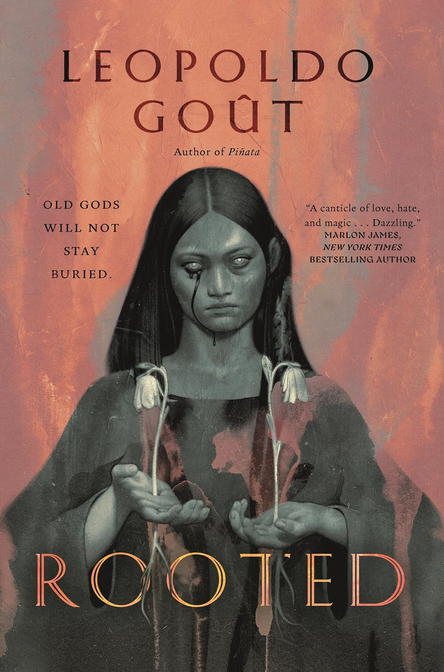
Thus begins Leopoldo Goût’s macabre Rooted, a horror story steeped in Aztec mythology.
Fast-forward to today. The repatriation of artifacts to their rightful home has brought Aurora Marino back to Mexico City. She is an art lawyer, and she and her friend Ociel are overseeing the successful restoration of various antiques to the Museo Nacional de Antropología. The trip marks Aurora’s first return to Mexico since she was a girl and is a poignant moment for the young woman.
When Aurora reunites with her mother, Maria, she sees her childhood home almost exactly as she left it. This frozen-in-time tableau serves as a disquieting reminder of the past she has tried to forget, one filled with tragedy and nightmares that refuse to leave her.
The longer Aurora remains in Mexico City, the more unsettled she becomes. Whether it be the odd sinking of the city or encounters with deranged people on the street, something truly feels off. Aurora self-medicates to thwart her dreaming but quickly realizes the nightmares persist while she’s awake.
An earthquake strikes the city, and when Aurora and Ociel check on the artifacts, they notice the horror concealed within a statue known as “The Flayed One”: a dead child. Meanwhile, Maria has developed a worrisome cough, and Aurora eyes an acute rash on the woman that appears to be spreading. The symptoms remind her of the circumstances surrounding her grandmother’s death decades earlier; she believes the past may be repeating itself.
Aurora is already emotionally vulnerable when she begins to hear the same whispers that once plagued Anna Maria. Her concern over her mother’s health, coupled with revelations from her childhood, leaves her adrift and questioning everything. The troubling moment when Ociel discovers Aurora cradling a desiccated infant may only be the start of a ghastly breakdown.
Rooted shines as a riveting psychological thriller suffused with generational trauma. Its disturbing prologue embraces horror-story imagery, yet the plight of Aurora and her connection to the relic draw the reader deeper into what is really a narrative about a woman confronting the past and coming to doubt her own thoughts and experiences.
The relationship between Aurora and her mother is a crucial part of the storyline, as is the ancient past, which is what has allowed mother and daughter to reunite and possibly reconnect. But a shared — and painful — family history, combined with the emergence of long-concealed secrets, threatens the women’s fragile détente.
The deep-seated distress that grips Aurora is palpable, and her return to her birth country only exacerbates it. At the heart of this tale is loss and the terror that comes from experiencing (or anticipating) it. While there is some gore in the novel, author Goût doesn’t revel in it so much as utilize the visceral to propel the emotional. Aurora’s tenuous grasp on reality and the possibility that she is self-gaslighting make for a terrific and mind-bending plot, one that elevates Rooted beyond genre fiction and turns it into a noteworthy read.
Philip Zozzaro, a married father of three, enjoys reading as much as possible, particularly history, biographies, mysteries, and horror. His reviews have appeared in the San Francisco Book Review, Booklist, the U.S. Book Review, and elsewhere.

