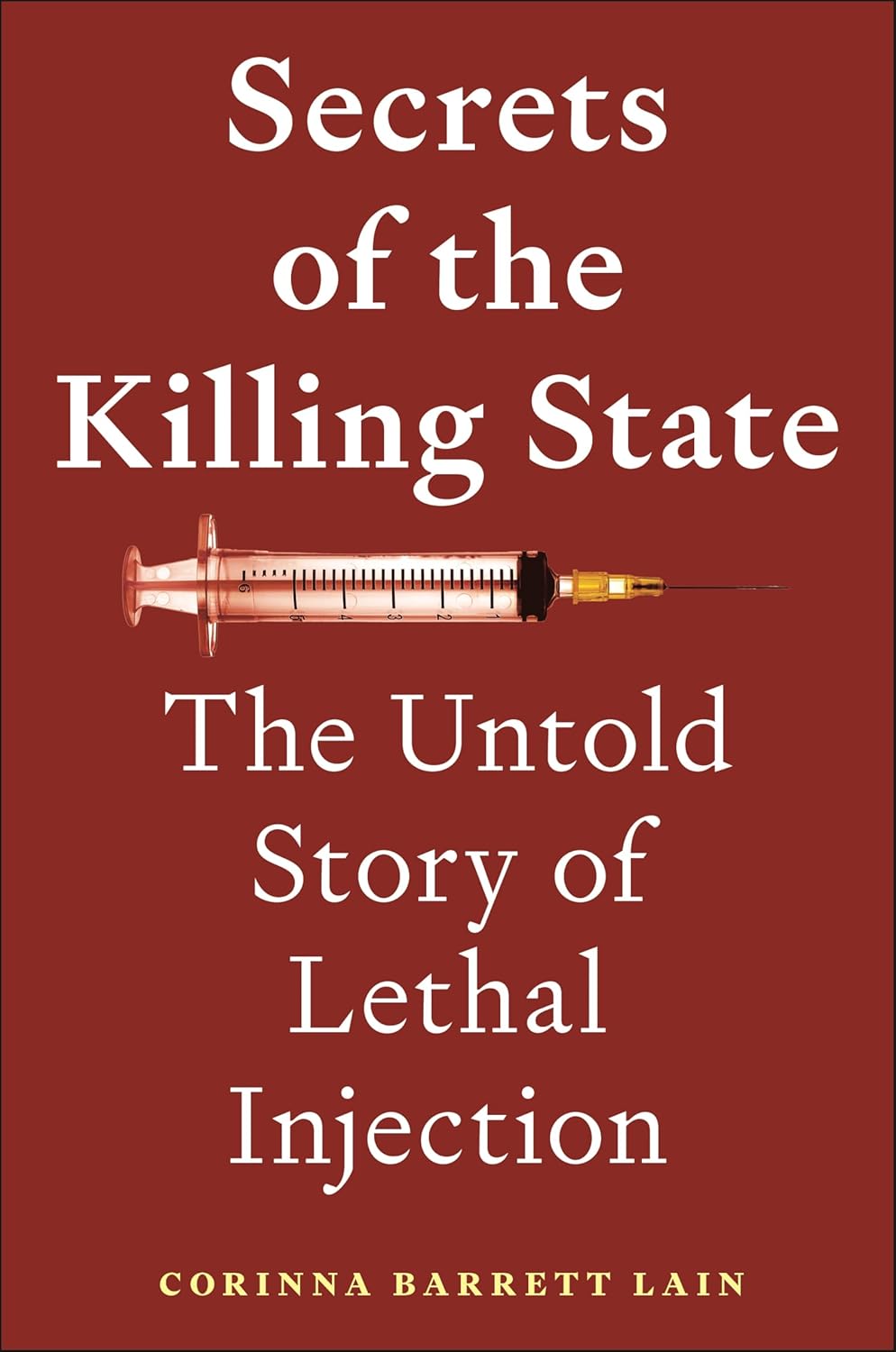
Secrets of the Killing State: The Untold Story of Lethal Injection
- By Corinna Barrett Lain
- NYU Press
- 384 pp.
- Reviewed by Tim Hirschel-Burns
- May 7, 2025
There’s no such thing as humane executions.
Each year, the United States euthanizes several million pets. The Netherlands has carried out assisted suicides for decades. It is not that it’s impossible to induce a peaceful demise. It’s just that American states don’t grant it to many of the people they condemn to death.
Corinna Barrett Lain’s Secrets of the Killing State: The Untold Story of Lethal Injection is full of such stories: The Oklahoma man who woke up during his own execution and tried to get off the gurney. How Arkansas executioners applied concealer to a dead man’s neck to cover up the five puncture wounds where they’d tried and failed to place an IV. Executioners having so much trouble pulling off the injection that the condemned prisoner offered suggestions for how they might succeed in killing him.
In a book that’s impressively readable for its terrifying and technical content, Lain explores how it is that states that have granted themselves the power to kill are so inept at carrying it out. One reason is that they simply don’t care. Death-row inmates are among the most disfavored groups in society, and if they suffer a torturous death, some will say, “So be it.”
But Lain shows that the attachment to lethal injection is not a story of simple inhumanity. Lethal injection is now used in 98 percent of U.S. executions, but methods such as electrocution, gas, firing squads, and hanging have all been employed, too. What marks out lethal injection is not its ability to kill but that it looks the least like killing. When an electric chair produces the smell of burning flesh, there’s no forgetting the state just executed someone. Lethal injection, in contrast, often looks like a medical procedure that makes a person drift off to sleep.
Lain emphasizes that looks can be deceiving. She presents extensive medical evidence that patients who do not appear to be feeling pain are, in fact, experiencing sensations like drowning or being burned alive. This understanding is shared by many on death row: In Tennessee, the only state that allows prisoners to choose the method of execution, five of the seven people executed since 2018 opted for the electric chair.
Still, given that lethal injection is peaceful for pets and assisted suicides, and that states are eager to conceal the brutality of capital punishment, why are executions by lethal injection so frequently torturous? The unique physical condition of the condemned is part of it. In a memorable phrase — albeit one that paints with a broad brush — Lain writes:
“It is hard to imagine a more ill-conceived way of executing a bunch of aging, ailing former drug users than a method that requires tapping into their veins.”
Lethal injections are also administered in the near-total absence of doctors, whose Hippocratic Oath bars them from participating in executions. Procuring the appropriate drugs presents another challenge. Many countries refuse to export them due to their opposition to the death penalty, while pharmaceutical companies don’t want to fall into a PR disaster, leading states to resort to secretive procurement methods and to the stockpiling of drugs (thereby limiting their availability for medical use).
In navigating these roadblocks, states also exude carelessness — demonstrated, in part, by their general reliance on a three-drug cocktail despite scant evidence of its superiority. Lain highlights a case that went to the Supreme Court in which two people sentenced to death sought to die instead by the one-drug protocol used for euthanizing pets. But in this case, as in others, she shows that courts have largely abdicated their responsibility to enforce the constitutional prohibition of cruel and unusual punishment.
The author mostly avoids discussing the broader morality of the death penalty, focusing squarely on lethal injection as a form of execution. For a semi-academic book about a particular method of inducing death, Secrets of the Killing State is spectacularly engaging: crisply written, full of moral clarity, and never preachy. But as the gruesome details pile up and the discussions of pentobarbital and sodium thiopental stretch on, one is reminded that this is a semi-academic book about a particular method of inducing death.
Right at the end, Secrets of the Killing State broadens its view. In the epilogue, Lain movingly recounts how the book led her to confront how different the people being executed are from who they were when they committed heinous acts decades earlier. And even if one could support the death penalty in certain circumstances, Lain concludes that “the story of lethal injection is a story about all the ways that states have proven themselves untrustworthy of the awesome power to kill.” After reading this important work, it’s hard to disagree.
Tim Hirschel-Burns is a policy advocate and writer based in Washington, DC. He holds a J.D. from Yale Law School and has written for publications including the Los Angeles Review of Books, Foreign Policy, and African Arguments. Find him on Bluesky at timhirschelburns.bsky.social.