Self-Help from the Middle Ages: What the Seven Deadly Sins Can Teach Us About Living
- By Peter Jones
- Doubleday
- 368 pp.
- Reviewed by Eliza McGraw
- May 11, 2026
We’ve long been trying (and failing) to vanquish our worse angels.
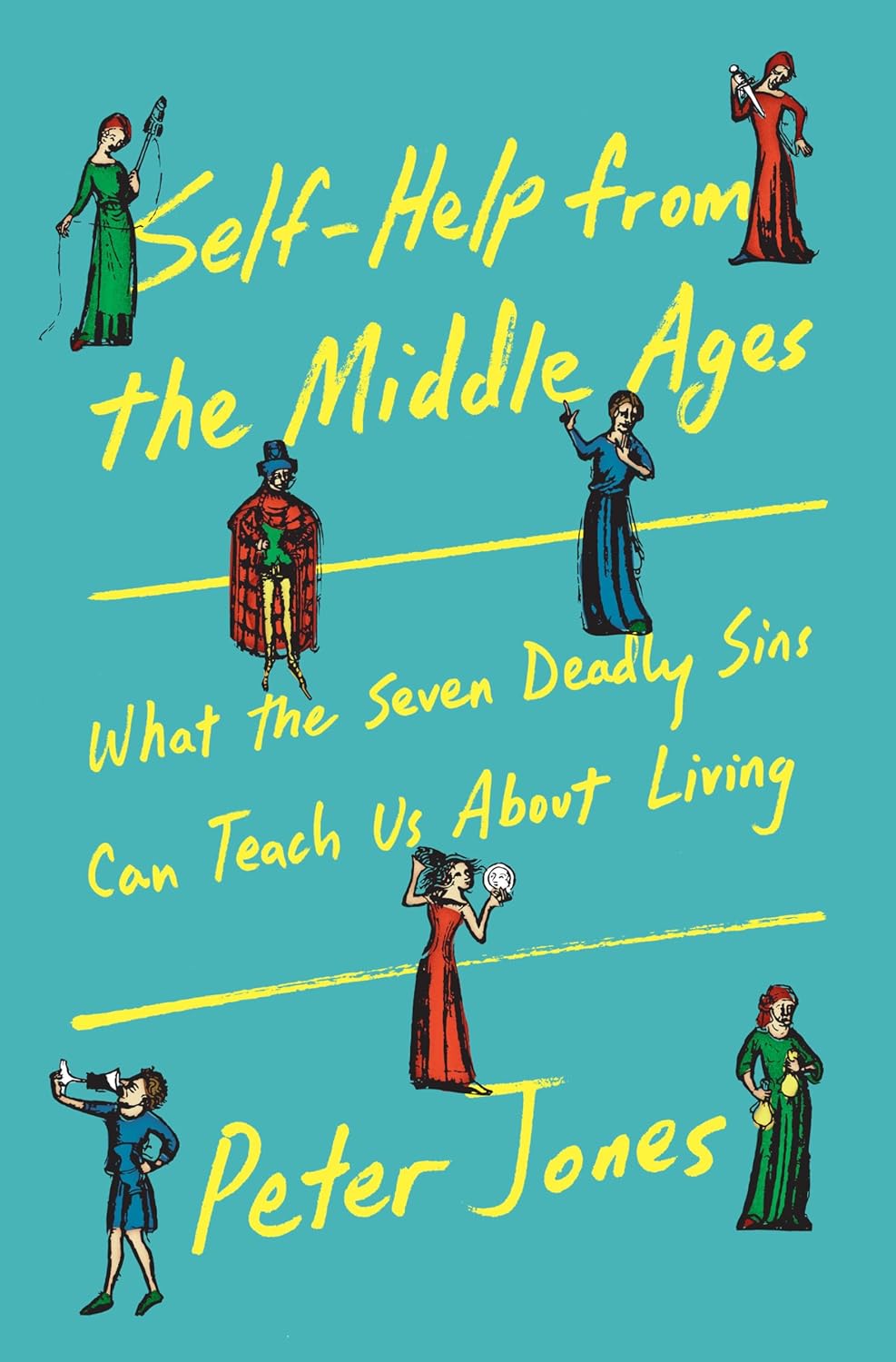
Peter Jones spends plenty of time in the Middle Ages. As a professor of medieval history, he teaches students how long-ago people comprehended the world and their place in it. Today, we consider psychology, pharmacology, and identity; back then, there were the seven deadly sins. Jones, whose own dark days working at a university in Siberia tipped him toward an examination of all seven, explores the connection between these old categories and our current lives in Self-Help from the Middle Ages: What the Seven Deadly Sins Can Teach Us About Living.
The title ably combines the back-and-forth between present and past that animates the book. Jones uses autobiographical anecdotes to explain how he came to focus on the deadly sins and deploys scholarship to keep readers grounded in their historical context. The 14th-century poet Francesco Petrarch, for example, reflected on how the sin of envy colors friendships. While being pleasant to his face, a group of Petrarch’s friends once gathered and ran him down because they envied his fame. Their “jealous hatred still feels fresh and alive,” Jones notes. “Isn’t this the experience many people go through today, in a life lived half online?”
The author uses such anecdotes from the past not only to demonstrate parallels, but also to show that there are remedies embedded in the sins, virtues beneath the surface. In the case of envy, the feeling of jealousy can be ameliorated by looking more closely at what we do have. And sloth — which, Jones points out, can also be interpreted as depression — might be helped by imagining larger perspectives or accepting compassion.
Nobody’s perfect, by the way. Even Thomas Aquinas had some issues with gluttony, we learn. He really liked a specific type of herring, and at least once, he over-fixated on it. At meals, the vaunted theologian would sit next to a friend who reminded him not to eat mindlessly. Aquinas delineated various forms of gluttony, including only eating rich food and eating too fast. As Jones writes, any of these can happen when “our relationship to eating slips beyond ‘reason.’” This chapter also gives Jones an opportunity to reveal that, in the Middle Ages, nobler foods existed on higher planes: Chicken trumped beef, and ham was more elite than lobster. Details like these keep the book lively.
In the chapter on anger, Jones chronicles the furious explosion that led to King Henry II ordering the murder of his friend Thomas Becket, the archbishop of Canterbury, in 1170. There are seven types of anger — listed by Hugh of Saint Victor in the 12th century — including furor, blasphemia, and luctus. Henry’s furies were famous, Jones writes. The monarch would get himself so fired up that, at least once, he rolled on the ground and crammed straw into his mouth while in a rage. This extreme example notwithstanding, the author notes that:
“A little anger can be a beacon, as Thomas of Perseigne said: it can magnify those problems in our lives that need more love or more effort to solve.”
Jones’ humility allows readers to identify with him even if they lack his extraordinary depth of understanding about antiquity. “If this is a self-help guide,” he writes, “it’s also a self-help journey.” One challenge facing the author is that people today might not be able to reel off the deadly sins. They seem archaic, or like a device for a horror movie. But Jones’ narrative, which keeps his own experiences close, enables him to balance deep dives into the Middle Ages with modern-day struggles. You start to see how the more things change, the more they stay the same. We humans are as flawed as ever; we just call our shortcomings by different names now.
Eliza McGraw is the author of Here Comes Exterminator!: The Longshot Horse, the Great War, and the Making of an American Hero and Astride: Women, Horses, and a Partnership that Shaped America. She lives in Washington, DC.