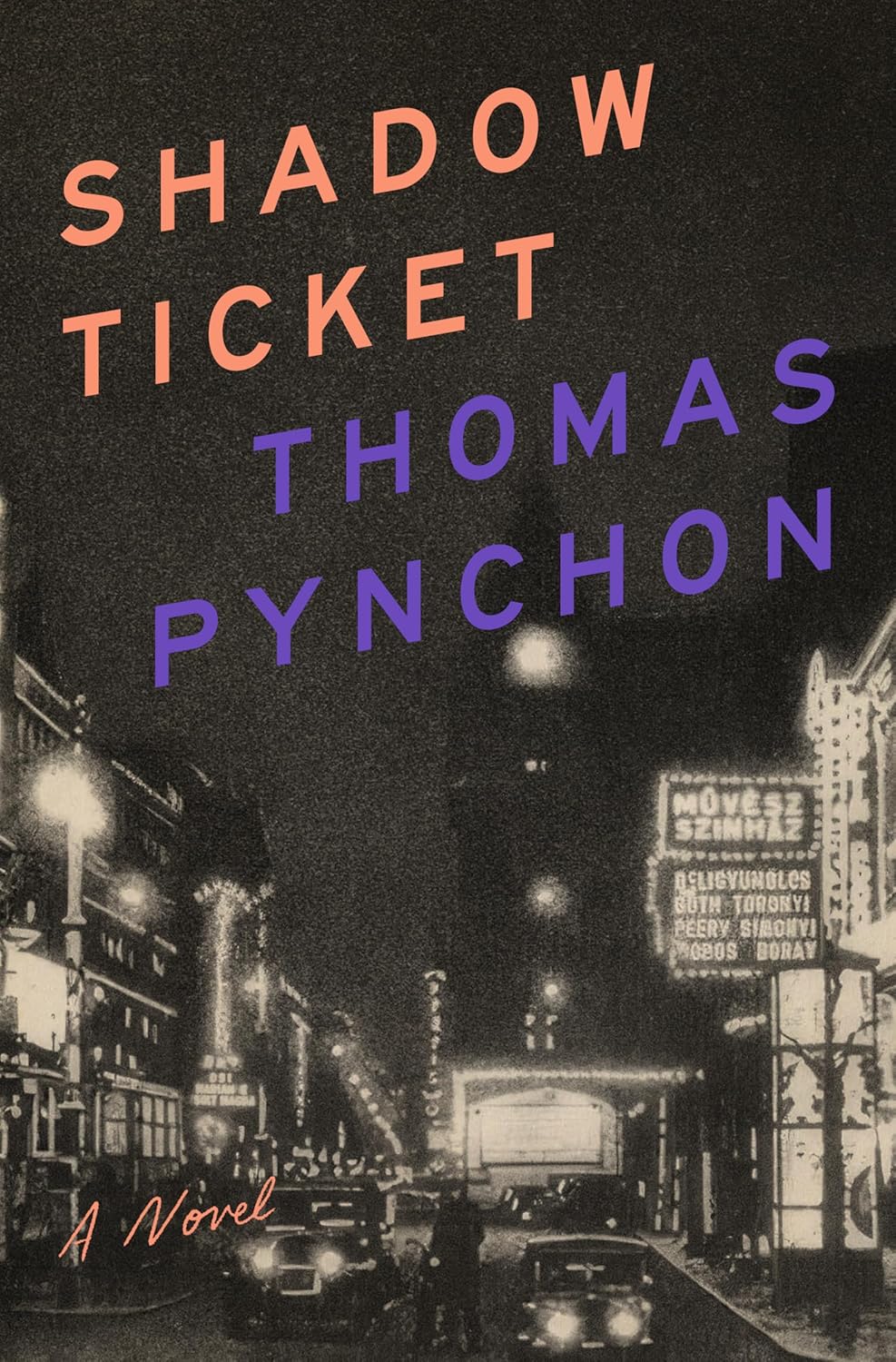
Shadow Ticket: A Novel
- By Thomas Pynchon
- Penguin Press
- 304 pp.
- Reviewed by Diane Kiesel
- November 25, 2025
Moments of brilliance brighten this otherwise overstuffed slog.
Twentieth-century college students studying post-World War II fiction were fed a steady diet of books by the usual male suspects (e.g., Philip Roth, Vladimir Nabokov, John Updike, Don DeLillo, and Thomas Pynchon). Among these, Pynchon’s work felt the least approachable, with plots that were convoluted, conspiratorial, and highly improbable. (Maybe not that improbable. After all, he wrote The Crying of Lot 49 in 1966, with its crazy backstory about an underground mail-delivery system that ran parallel to the U.S. Postal Service. And then, in 1971, what do you know? FedEx!)
Pynchon’s latest literary effort, Shadow Ticket, his first book in more than a decade, is more of the same — only shorter — with a dense plot about a violent union-buster-turned-private-eye who gets sidetracked from an assignment (to find the runaway heiress to a cheese fortune) by the explosion of a wagon transporting booze during Prohibition. Think “It Happened One Night” meets “The Untouchables.”
There’s no way to grasp the backstory of the many characters in this noir novel without re-reading each page three times and keeping copious margin notes. This is nothing new; Pynchon’s penchant for head-scratching plots famously came back to bite him in 1974 when the Pulitzer jury’s recommendation to award him the prize for Gravity’s Rainbow was overturned by the Pulitzer board because it believed the book was, among other things, “unreadable.”
Pynchon is as much of an icon as he is an author. The New York Times suggested that was the case in a recent article, “William Gibson, Lisa Simpson and More on Their Favorite Pinch of Pynchon.” The interviewees, some of them literary heavyweights, opined on why Pynchon is so revered. Perhaps the most (inadvertently) revealing quote came from DeLillo, who said, “Strong, surprising, long-lasting work. The American novelist times ten. This is Thomas Pynchon, book after book.” Curiously, DeLillo’s vague commentary didn’t include one substantive word about anything Pynchon has actually written. One wonders, does DeLillo find the “American novelist times ten” as unreadable as the Pulitzer board once did?
The answer for those who find reading Pynchon too much like slogging your way to an “A” in English 101 is to sit back and enjoy the man’s enormous talent for hitting the literary nail on the head through wordplay. Don’t worry about trying to understand the plot; instead, read Shadow Ticket to absorb and appreciate the beauty of the language.
For example, inside a greasy spoon, the main character, gumshoe Hicks McTaggart, takes stock of the place:
“Lunch dramas passing like storm fronts, pies in glass cases slowly losing their a.m. allure, grill artists taking care of various counterside chores while whatever they’re flipping is in midair rotating end over end. Fluorescent light through Today’s Special, a vivid green salad centerpiece the size and shape of a human brain, molded in lime Jello-O, versions of which have actually been observed to glow. ‘We used to dim down the lights before bringing it in to the table, but eating it in the dark made too many people uncomfortable.’”
Or, try Pynchon’s rumination about being struck by Cupid’s arrow:
“Call it obsession but it is in fact a duty, an all but sacred obligation to remain faithful to the moment of love at first sight, for who knows how many years to follow, keeping it uncorrupted, not allowing a day to pass without in some way returning to it — the Moment.”
But, if plot is your thing, think of Shadow Ticket like Mad Magazine’s “Spy vs. Spy” feature from childhood: The characters are either searching for or hiding from someone, and someone is searching for or hiding from them. Hicks walks away from his decreasingly satisfying career as a strikebreaker/management thug in Depression-era Milwaukee to sign on with the Unamalgamated Ops detective agency. “Private eyes of the 1930s are emerging from an area of labor unrest and entering one of spousal infidelity,” Pynchon writes, “encouraged if not enabled by Prohibition.”
Hicks’ “ticket” — in other words, his assignment — is to track down cheese heiress Daphne Airmont, who has skipped out on her fiancé and run off to Europe to stalk a clarinet player in a swing band. His agency has also been hired to get to the bottom of the aforementioned exploding booze wagon.
Very quickly, Hicks’ assignment morphs into something else — the shadow ticket. He heads to Europe, where the adventures pile up. He’s recruited to chase down Daphne’s errant father, Bruno, the Al Capone of Cheese, who has swindled everybody he’s ever met. Hicks locates Stuffy Keegan, the guy behind the wheel of the exploding booze wagon, who’s made his way to the Old Country aboard a rogue Austro-Hungarian U-boat that never surrendered after WWI. A pair of British espionage agents expect Hicks to join them on the trail of a Russian spy with the ability to disappear into thin air.
Hop Wingdale, the clarinet player of Daphne’s dreams, surfaces and vanishes again, and a den of Jew-hating fascist terrorists, the Vladboys, makes an unwelcome appearance here and there. Daphne wanders into a Hamburg beer garden, once a jazz haven, looking for Hop, only to find herself trapped by Hitler Youth practically shouting Nazi choir music. She’s rescued when Glow Tripforth del Vasto, piloting a flying machine called the “autogyro,” swoops in to save her.
Get the picture?
There is a serious, important story lurking in Shadow Ticket — cancerous antisemitism, anarchy, violence, and economic desperation metastasizing throughout Europe between the two world wars. Periodically, Pynchon brilliantly satirizes the coming apocalypse and demonstrates his meticulous research and fidelity to historical and cultural references. Unfortunately, those flashes of brilliance are dulled by an absurd cast of characters spinning their wheels and a cumbersome plot that leads nowhere.
Diane Kiesel is a former judge of the Supreme Court of New York. Her latest book, When Charlie Met Joan: The Tragedy of the Chaplin Trials and the Failings of American Law, was published in February by the University of Michigan Press.