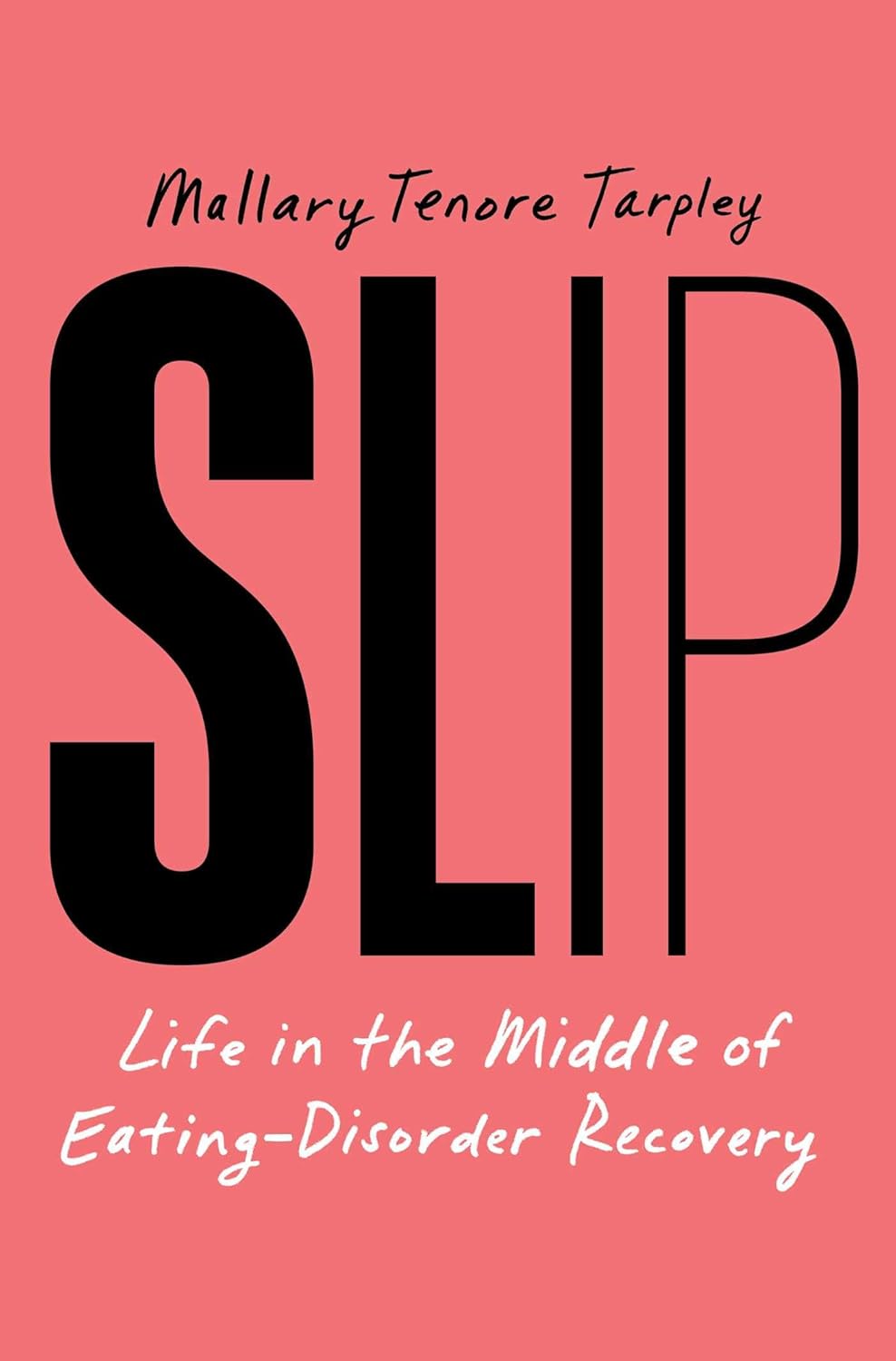
Slip: Life in the Middle of Eating-Disorder Recovery
- By Mallary Tenore Tarpley
- Simon Element
- 368 pp.
- Reviewed by Frances Thomas
- August 5, 2025
A smart, nuanced account of navigating fraught relationships with food.
Some illnesses — the merciful ones — can be traced like an Aristotelian plot: diagnosis (act I), treatment (act II), recovery (act III). Many others evade the stark rise and fall of classical Western narrative, refusing linearity and logic at every turn. Eating disorders are pervasive examples of the latter, with relapse rates as high as 70 percent. Despite the fact that 70 million people worldwide suffer from eating disorders — and the number continues to rise — the harsh truth is that, for many patients, recovery remains a distant mirage.
Why?
Perhaps it’s an issue of language. In her new memoir, Slip: Life in the Middle of Eating-Disorder Recovery, journalist and writing professor Mallary Tenore Tarpley argues that our lexicon for eating-disorder recovery is woefully narrow. American medicine has a tendency to slot patients into one of two boxes: acutely sick or entirely healthy. But when you speak to real people touched by eating disorders — and Tarpley did, conducting hundreds of interviews with patients, family members, and clinicians — their rehabilitation stories emerge as anything but black and white.
For those with chronic food and body struggles, a salient benchmark for getting better might be what Tarpley calls “the middle place”: a liminal space between sickness and full recovery, where “hope and hardship coexist, slips are expected, and progress is possible.” It’s a place where Tarpley has lived for many years, as chronicled in the book’s piercingly interior sections of personal backstory. It’s a place where I, too, hold citizenship. Having been in recovery from anorexia for nearly two decades, I read Slip rapidly, raptly, and downright hungrily, riveted by its articulation of a recovery narrative that refuses a tied-up-with-a-bow (which is to say falsified) resolution.
The persuasive power of Tarpley’s thesis — that recovery is a matter of degrees, not absolutes — comes from the resounding crescendo of her many interviewees. For Haniyah, recovery is “one day at a time.” For Katie, it is accepting that her eating disorder “creeps in and is more prominent in times of extreme stress.” For Fatima, it is the stubborn fact that “95 percent” of her thoughts are fears of weight gain, but she feeds herself regardless. For Danielle, it looks like a spiral staircase: “Maybe I won’t ever get to the top, but I’m so much higher than when I was stuck.” For these folks and others, the notion of “complete” recovery is less an ideal than a taunt, a hypothetical standard that dismisses actual progress in deference to a textbook ideal.
Tarpley’s point is not that full recovery is impossible, but that expecting it and only it can lead to disappointment and self-loathing, whereas a clear-eyed lookout for possible roadblocks can bolster resilience. “When we learn to identify possible triggers, when we talk openly about how symptoms can shift, when we have the words to describe recovery’s imperfections, we can better navigate around the obstacles we’ll encounter,” she argues. “Language that reflects lived experience can change our view of recovery — from a perfectionistic ideal to a realistic possibility.”
What differentiates Tarpley’s conception of recovery from the perfectionistic narratives that outnumber it is an impulse toward integration rather than extirpation. “As I’ve unpacked the word recovery and explored its multitude of meanings,” she observes, “I’ve found that it’s less about the eradication of one’s disorder and more about the elucidation of it.” Elucidation is to eradication as light is to dark, as language is to silence. In the radiant clarity of Tarpley’s prose, expansion — from the secrecy and shame that plague so many eating-disorder sufferers — finally seems possible. “Instead of diminishing who we are,” she writes, “we learn to expand our sense of self.”
The starving, bingeing, and purging selves are among the many that can occupy a person. By documenting her various identities as a daughter, student, worker, lover, wife, and mother, Tarpley circumvents a common pitfall of eating-disorder memoirs, which is to collapse the authorial self into a singular history of privation. To be human is to be prismatic, forever straddling a multiplicity of faces, and Tarpley honors this by stating her position plainly: “I am not a soldier fighting a losing battle, nor am I a survivor who defeated a disorder.” Not that, nor that, but this: a shapeshifting composite, living and committing and ever-becoming.
Each chapter begins with the personal and billows out to the universal, emphasizing the matrix of sociocultural forces that make “complete” recovery so elusive. Within this braided structure, Tarpley makes compelling use of slippage as a narrative device, roving seamlessly between her own memories and testimony from others. No data point or reported anecdote stands alone, thanks to the perpetual knitwork of the author’s “Me, too.” In mobilizing the first-person plural — we, our, us — to couch her subjects, Tarpley shades vivid overlaps between seemingly disparate patient profiles, hers included.
Like the term “eating disorder,” this memoir’s titular verb, “slip,” bears overwhelmingly negative connotations. It is bodies skidding on banana peels, tires careening across icy tarmac. It is broken bones and shattered glass: injury and chaos and accident. But it is also, in the end, only language — and language always transcends itself. To slip is to fall, yes, but also to not stall: to keep moving, despite the banana peels underfoot. “You can’t slip,” Tarpley writes, “if you’re standing still.”
Frances Thomas is a writer based in Brooklyn and an MFA in Nonfiction Writing candidate at Columbia University. Her work has appeared in Slate, Dazed, American Literary Review, Longridge Review, the Maine Review, and elsewhere. She writes to build safe spaces for hard conversations. You can find more of her work on her website.