Smut: An 1883 Obscenity Trial and Its Echoes Today
- By Carol Kammen
- Paul Dry Books
- 217 pp.
- Reviewed by Kitty Kelley
- August 24, 2026
Controlling women then; controlling women now.
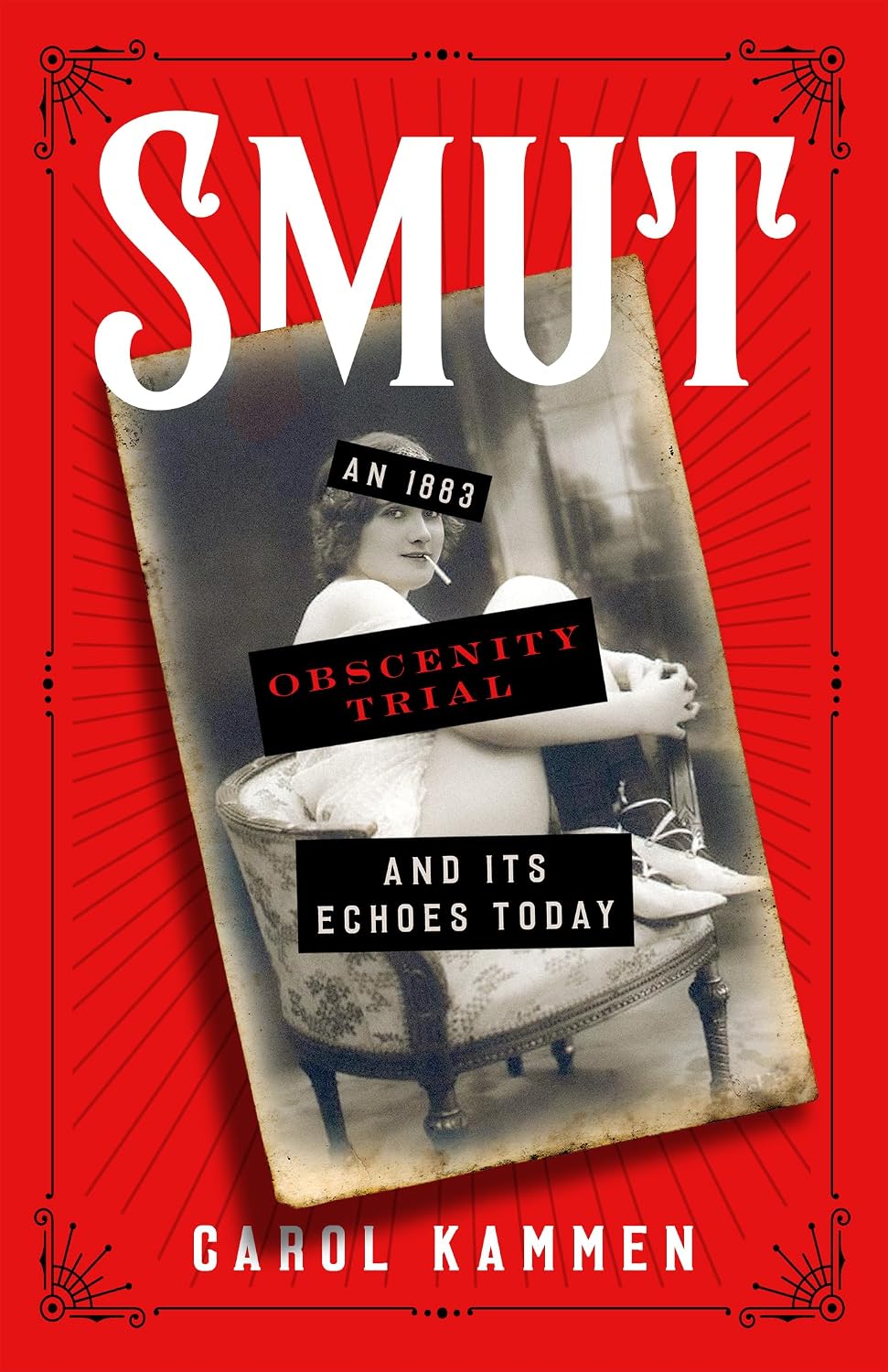
The title of this book grabs your attention with huge letters screaming SMUT. As provocative as a monkey-grinder in church is the bright red cover with its photo of a proud young woman sitting on an old-fashioned chair, arms clasped around her bare legs down to her black stockings and satin heels, with ribbons lacing up her ankles. She looks directly at the camera, almost defiantly, with a half-smile and a cigarette dangling from her lips. As author Carol Kammen explains, the woman and her strip-teasing sisters were reviled by the Society for the Prevention of Crime, founded in 1877 in New York City, and hounded by Anthony Comstock, the most prominent Puritan in 19th-century America.
A onetime salesman in Manhattan, the deeply religious Comstock, a special agent of the U.S. Post Office, became outraged by the advertisements for birth control in newspapers and the availability of what he deemed “obscene materials.” He banged his drum so loudly that Congress passed the Comstock Act of 1873, which criminalized the use of the U.S. Postal Service to transfer such materials and banned the mailing of contraceptives and abortifacients. The Comstock Act remains in effect today, and “Comstockery” became a term of derision meaning overzealous moral censorship.
Now comes Kammen, a retired senior lecturer in history at Cornell University, who has written in Smut a breezy tract on prurient sex. She’s found bits and pieces of an obscure obscenity trial that allow her to compare 1883’s mores governing morality to those of 2026. Sadly, she concludes, there’s not much difference between then and now. No progress. Little enlightenment.
The Society for the Prevention of Crime, an all-male committee of 100, functioned as the community chastity belt in the late 19th century, not unlike those in President Trump’s orbit who’ve imposed sweeping new restrictions on abortion following the Supreme Court’s overturning of Roe v. Wade in 2022, which eliminated nearly 50 years of federal protections and returned the matter of women’s bodily autonomy to the states.
Professor Kammen centers her story on the trial of Jefferson and Helen Beardsley of Ithaca, New York, who were arrested for “selling and exhibiting obscene pictures.” The Beardsleys were found guilty, fined $300 (approximately $10,000 in 2026), and spent anywhere between four and six months in prison. The author believes the outcry for “social purity” then is just as earsplitting today. As the French proverb posits, “Plus ça change, plus c’est la même chose.” The more things change, the more they stay the same.
Pornography exploded following the invention of photography in the early 19th century. When Jefferson Beardsley attended the Centennial Celebration in Philadelphia in 1876, the first official World’s Fair to be held in the U.S., he purchased several pornographic French photos, which he later distributed and sold back home in Ithaca, leading to his arrest and the trial Kammen documents.
At one point during that trial, a witness was asked to describe some of Beardsley’s photographs:
“One was a female sitting in a chair and playing with her private parts with her fingers, trying to get them into it as much as anything else. Another one was a lady in a hammock without any clothes on, lying there as if she was asleep or waiting for somebody to come along. Then there was another with a bottle, I think it was, sitting there with a bottle between her legs or something of that kind. A bottle or something else.”
A few paragraphs later, Kammen interrupts her narrative:
“At this point, we have to say wow! In an era when piano legs were covered so as not to offend anyone, and limbs were not mentioned if they belonged to a female, and women’s skirts were long to conceal their extremities, this testimony is starkly frank. I would doubt that we would hear the same words in a courtroom today. But in 1883 in New York it was necessary to describe the obscenity observed in order to make the case. And to do so under oath.”
The last words in this review go to Kammen, a grandmother, who writes that her grandson suggested she publish this book under a pseudonym. The professor admits she does not find pornography interesting, but she feels that the Beardsley trial offers a valuable way to discuss public morality, social control, the role of women in society, the dissemination of knowledge, and the growth of the village of Ithaca, now world-renowned as the home of Kammen’s own Cornell, which sits high above Cayuga Lake.
“SMUT is also a caution,” she warns, “because today it is frightening to see the talk of those who refuse to accept women in modern society and laws that intend to yank women back into the nineteenth century. That, of course, is the echo and the threat inherent in SMUT.”
Kitty Kelley is the author of seven number-one New York Times bestseller biographies, including Nancy Reagan, Jackie Oh!, and Elizabeth Taylor: The Last Star. She is on the board of the Independent and is a recipient of the PEN Oakland/Gary Webb Anti-Censorship Award. In 2023, she was honored with the Biographers International Organization’s BIO Award, which is given annually to a writer who has made major contributions to the advancement of the art and craft of biography.