The bestselling author delivers another gem in this topical Grandpa v. Militia adventure.
“What the hell? White Nationalist goons stealing children from church parking lots? Rural sheriffs telling him to go pound sand? A manic ex-cop showing him how to shoot people in the front pocket?…Is this what the world had come to? Eight years in the woods only to emerge and find everything had gotten crazier?”
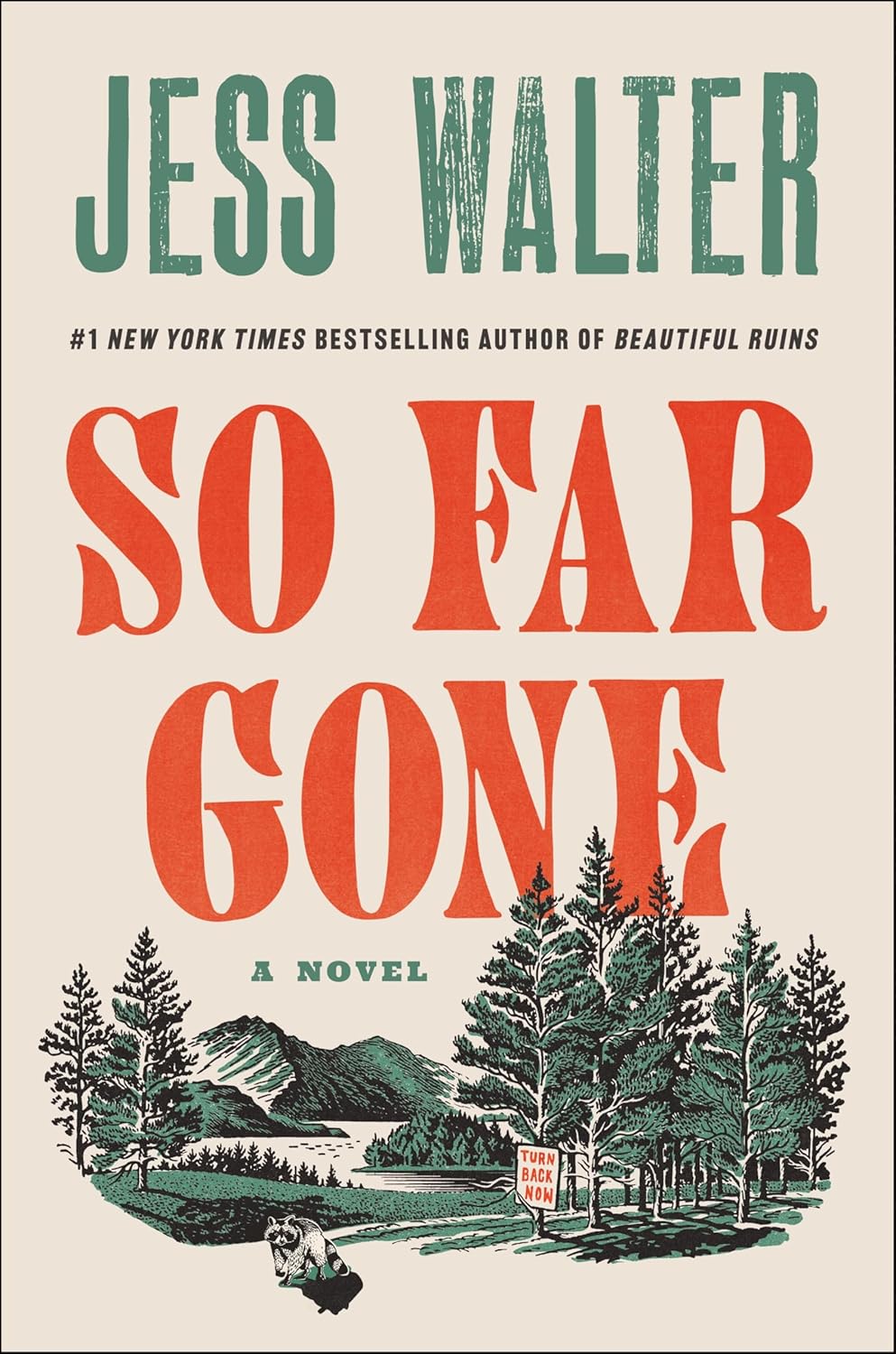
Yes, reader, this is indeed what the world has come to in Jess Walter’s new novel, So Far Gone.
Rhys Kinnick, a retired journalist in his 60s, has spent the past eight years living off the grid in a remote cabin north of Spokane, Washington. His solitary life began on Thanksgiving Day in the wake of the 2016 election. When his right-wing, religious-extremist son-in-law, Shane, veered into to yet another diatribe about vast elitist conspiracies and media complicity, Kinnick reached his breaking point and, after a physical altercation with Shane, dismantled his life and sought refuge in books and writing in the woods.
Kinnick’s eight-year seclusion ends abruptly when his daughter Bethany’s neighbor arrives at his doorstep with his two grandchildren, 9-year-old Asher and 13-year-old Leah. Shane is away training for holy war with his “men’s group,” aka militia, at the Rampart, the Idaho compound of the Church of the Blessed Fire. Bethany has also disappeared, leaving behind only a note saying she had to go “in a hurry” and asking the neighbor to take the children to Kinnick.
The parents had been arguing because Shane wanted to move the whole family from Spokane out to the compound and betroth Leah to the pastor’s 19-year-old son. While Kinnick and the kids are speculating as to where Bethany could be now, Asher blurts out, “Or maybe Dad killed her.” He can’t articulate why he says this, so Kinnick tries not to panic, but when he takes them to Asher’s chess tournament, members of Shane’s militia show up, attack Kinnick, and take Asher and Leah back to the compound.
Clock ticking, with no car, computer, or phone, the reclusive Kinnick must call upon his few remaining friends to help him shift out of his Luddite lifestyle, get the children back, and find Bethany. He also has to figure out how to repair his relationships with the grandkids he barely knows anymore and with his daughter, who faced the death of her mother (Kinnick’s ex-wife) and her strained marriage without his support.
Among his allies are his laid-back and nurturing neighbors, Joanie and Brian, his no-nonsense journalist ex-girlfriend, Lucy Park, and Chuck Littlefield, a self-described “old, tired, half-horny, twice-divorced cop with bad knees, three estranged kids and emotional dysregulation and bipolar issues,” who promptly becomes Kinnick’s loyal partner and cheerleader in the search.
Walter demonstrates his usual talent for creating self-aware-yet-charmingly-flawed characters who draw us into the story on a level deeper than the will-he/won’t-he level of plot. But to be fair, Kinnick has strong political views, so a reader’s own politics might well determine how close they feel to him. His assessment of Shane is someone who:
“…had traded his mild drug habit for a Jesus-and-AM radio addiction — ‘Real Jews’ and ‘real patriots’ and ‘black-on-white crime’ and ‘owning the libs’ and the ‘lame-stream media’ and the ‘vast conspiracy’ perpetrated on ‘real Americans.’ This raw sewage had been seeping into American drinking water for years, until it eventually contaminated the mainstream, and won over enough Shanes to convince the chattering TV heads and Twitter-taters that such half-assed conspiracies were a legitimate part of the body politic, that somehow, they had to do with white, working-class people getting the short end of some imaginary economic stick.”
Even the ex-cop character gets a turn decrying militias, with “their semiautomatic rifles BabyBjörned to their fat guts like the shithead soldier/cop-wannabes they were (even though none of them had the stones to go and join the actual military, or the brains to pass a simple law enforcement test).”
Some will nod along with such passages; others may see them as soapbox moments. Either way, Walter always pulls the focus back to his characters and their relationships. He also balances light and dark in a striking chiaroscuro narrative.
Although the premise sounds like a madcap adventure, and Walter’s customary wit sparkles throughout, there are darker undercurrents in motion. The perspective rotates among multiple characters, including the endearingly awkward Asher, but we spend the most time with Kinnick, who struggles to come to terms with a world that has, in many ways, passed him by. This is very much a book of our times, reflecting on issues like Christian Nationalism, the disappearance of newspapers and decline of journalism, the enduring environmental and health devastation of uranium mining, and opioid addiction, with its attendant increase in crime. The more Kinnick confronts the militia, the more darkness surrounds him.
As Kinnick tracks his family through the Pacific Northwest, Walter takes full advantage of the drives to provide rich descriptions of the region’s landscape:
“In the passenger seat, Leah stared out the window as they hurtled through the stark terrain of Central Oregon and Eastern Washington: dry canyons, craters, buttes, and the sudden sharp ledges of rocky foothills; abandoned gas stations, tumbledown barns and lonesome farms, miles and miles of wheat fields and soybean and onions, giant metallic windmills slowly turning in the breeze. It was all so desolate, so far removed from the lush, windward side of the Cascades.”
Having driven through these areas myself, I can attest to the feeling of wonder at such vastly different environments on either side of the mountains. Whereas I was uneasy thinking about the damage one errant cigarette butt could wreak in the arid east, traveling the area through Walter’s eyes opens up the beauty in the desolation.
And this sense of beauty amidst peril is, perhaps, the best place to conclude this review. So Far Gone is one more example of Walter’s ability to capture the splendor and horror, love and rage, and failure and redemption of our country. It is a testament to the complexity of our hearts, always beating toward hope and forgiveness.
Tara Campbell is a writer, teacher, Kimbilio Fellow, and fiction co-editor at Barrelhouse Magazine. She teaches flash fiction and speculative fiction and is the author of two novels — including, most recently, City of Dancing Gargoyles — two hybrid collections of poetry and prose, and two short-story collections.

.png)