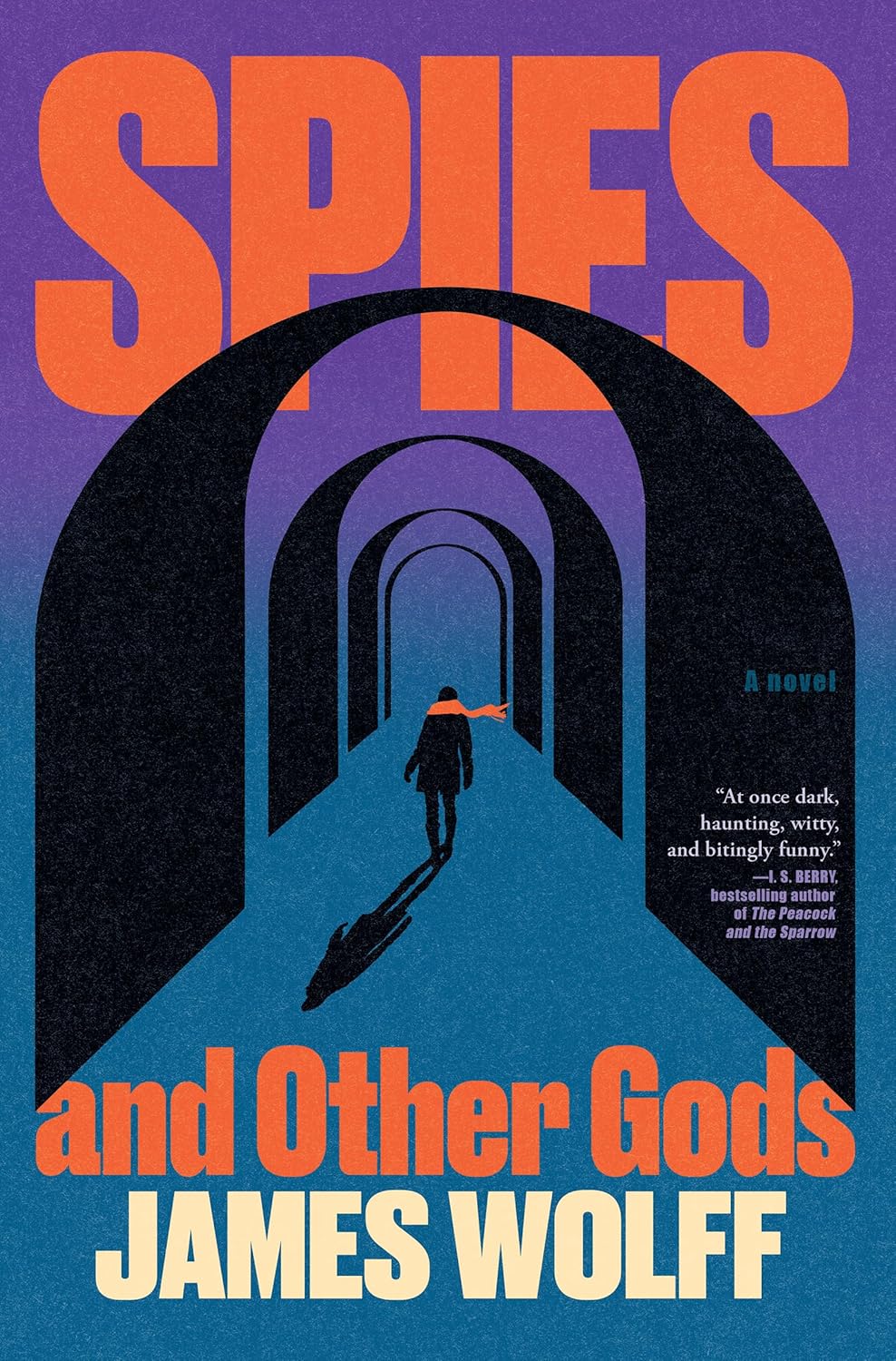
Spies and Other Gods: A Novel
- By James Wolff
- Atlantic Crime
- 272 pp.
- Reviewed by Bruce J. Krajewski
- May 14, 2026
What price a life of subterfuge?
“There’s something divine, something godlike about spying. No one knows what you guys are doing, how you’re doing it, why you’re doing it,” says the dentist Zak in James Wolff’s Spies and Other Gods. “You’re massively powerful yet totally unaccountable. We assume that God and spies have our own best interests at heart but the evidence is so far mixed.”
Zak isn’t actually a spy, but he spends much of the time spy-adjacent and thus feels justified in offering an assessment. However, he misses that spies operate in a vast Cloud of Unknowing. As John le Carré wrote in his memoir, The Pigeon Tunnel, he spent his early days in British Intelligence “delivering I knew not what to I knew not whom.” In Wolff’s novel, the spies keep secrets both from one another and from rival agencies. In fact, the head of the main operation in Spies and Other Gods realizes too late that members of his own team have manipulated him without his knowledge.
Lies, concealment, and deception — the fundamental tools of spycraft — can manifest a world of paranoia, a feeling that reality is an illusion, that every action must be premeditated, that spontaneity is dangerous, that no one can be trusted. The conversations you have turn out to be, as le Carré put it, “as much about what to conceal as about what to say.” Two of the novel’s main characters are friendless, demonstrating the human toll of their chosen world. It’s Immanuel Kant’s nightmare: everyone treating everyone else as a means to an end.
(If you feel such a description applies only to this fictional world, not so fast: The cover of Spies and Other Gods informs readers that James Wolff wrote the book, yet no such person exists. In the acknowledgments, the author thanks his two children, “who are not satisfied in the slightest with my explanation for why their father’s real name isn’t on the front.”)
The plot involves spies in several countries hunting an assassin code-named CASPIAN, believed to be a chemistry professor at the University of Tehran. CASPIAN travels widely and kills without leaving a trace; one of Zak’s patients might know somebody who knows somebody connected to him. Zak, for his part, isn’t aware of CASPIAN’s identity and is unsure about his own past and why someone from his youth — a man named Ali, whose father would leave Ali with Zak’s family for weeks at a time while he was away on business — mistreated him.
Zak feels hurt by Ali, but Ali can’t understand why Zak is haunted by childhood events and won’t let them go. Still, Ali doesn’t quite possess the maturity he sees as lacking in Zak. Like Zak (whom he dismissively calls Zaki), the adult Ali hasn’t put the past behind him, either. Further, he resents Zak:
“I know exactly how my father felt about me, Zaki. That I am an embarrassment, that I bring shame upon the family, that he wishes I was more like Zaki with his good grades and strong physique.”
Entwined in the search for the assassin is a subplot involving Aphra McQueen, a former academic at St. Andrew’s. She lands a job with the government and quickly develops a reputation as “the Poirot of Parliament.” In short order, a parliamentary group hires her to scrutinize the documents from a complaint made by a whistleblower at a U.K. spy agency. Aphra both impresses and exploits people. She, too, is driven by a secret.
After an employee at the agency frames her by planting a classified file among her belongings, Aphra out-spies the spies in her own quest to find CASPIAN. That search leads her to Zak, whom she soon ensnares. Zak and Aphra end up traveling to France together to meet with Ali, the one person who might know CASPIAN’s true identity…
I’ll stop here to preserve the rest of the story’s riddles and not spoil the ending.
With so much epistemological uncertainty at play among the characters in Spies and Other Gods, the unexpected is always just around the corner. The author handles the plotting like reverse origami, unfolding secrets in an order that allows their consequences to gain momentum right up to the final reveal, which deserves a “Voila!”
Wolff never overplays a scene. Anytime bathos or luridness peeks over a wall, he retreats, opting instead to allow the reader to mentally complete the vignette. You’ll exit this book knowing more about what it takes to be a spy, including how to rehearse your lies in order to withstand questioning — a skill any parent who has ever invoked the Tooth Fairy (or written under a pseudonym) must master.
Bruce J. Krajewski has written commentary for the Ancillary Review of Books, the Guardian, the Los Angeles Review of Books, LitHub, the Dublin Review of Books, and other publications.