Spinosaur Tales: The Biology and Ecology of the Spinosaurs
- By David Hone and Mark P. Witton
- Bloomsbury Sigma
- 320 pp.
- Reviewed by Mariko Hewer
- February 6, 2026
The lineage of an elusive yet fascinating dinosaur is teased apart with thoughtfulness and rigor.
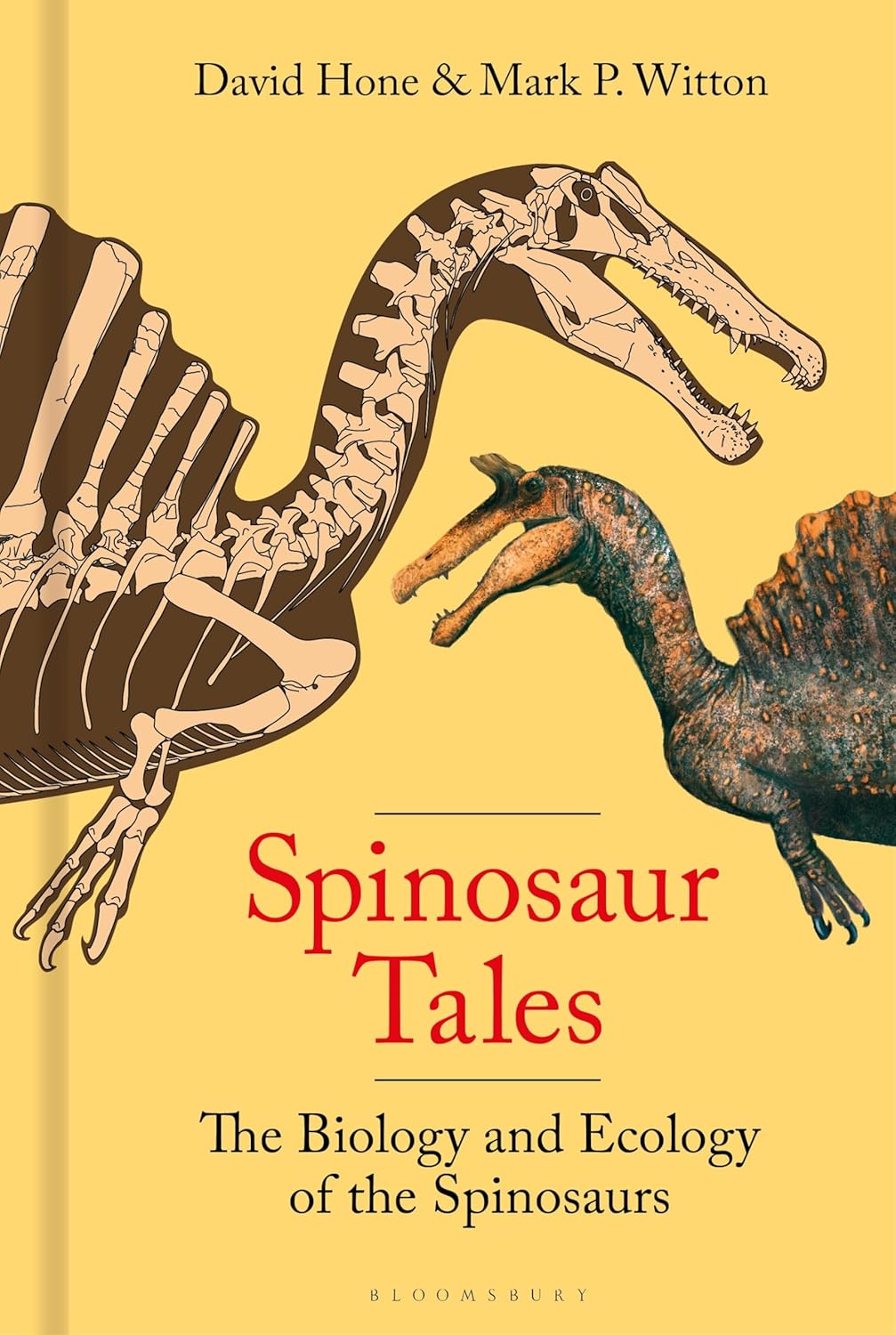
Constructing the life record of a dinosaur species from a few fragmented fossils can seem an insurmountable job, yet in Spinosaur Tales, David Hone and Mark P. Witton do just that. Together, the authors present well-reasoned arguments and conjectures about the lives of these gargantuan creatures, with Witton’s meticulous illustrations adding heft to our imaginary mental reconstructions.
In their introduction, Hone and Witton suggest that one of the reasons Spinosaurus and its relatives are so “keenly discussed” is that they are “known from a dearth of material.” Indeed, until recently, this dinosaur was represented only by the surviving description and drawings of its holotype (or specimen designated as the species name-bearer), which was destroyed during World War II. Bones and teeth that began to surface in the latter part of the 20th century have allowed for increased scrutiny and speculation about these enigmatic animals.
Similarly, the authors note, one of the difficulties with distinguishing between evolving species when using data from only a few specimens is determining delineation. They use an elegant and simple analogy:
“We might think of this like a rainbow: there are clear individual bands like red and yellow, but where red stops and yellow starts, or if we should include orange as a separate intermediate between them, and how we split the colours further where red becomes orange and orange becomes yellow, is harder to agree on…there may not be a definitively ‘right’ or ‘wrong’ interpretation, as it might depend on our methods of assessing colours, or our philosophy on how they should be divided.”
Having offered these caveats, Hone and Witton venture into the murky world of spinosaur anatomy. Attempting to dispel the persistent myth that spinosaurs were particularly strong swimmers, they explain that the dinosaurs’ massive back sails are “structures best described as perpetual drag creators,” adding, “The 2m tall sail of an adult Spinosaurus is so big that the top of this would need to be 3m below the surface (and so need water more than 6m deep) in order to swim effectively. For an animal also burdened with positive buoyancy, a lot of energy would be spent diving to and maintaining that kind of depth.”
(As someone who recently enjoyed watching spinosaurs cavort with a mosasaur in “Jurassic World: Rebirth,” I was disappointed by this discovery!)
As the authors examine various aspects of spinosaur biology and ecology, they offer additional broadly applicable tidbits about studying dinosaur remains. For example, they tell us, “A rough rule for studying dinosaur tracks is that the trackmaker’s leg length was about four times the track length.” They also explain that “the torso vertebrae of theropods and sauropods were partly hollow and air-filled…Spinosaurs had bony air spaces throughout their cervical, dorsal and sacral vertebrae, making their skeletons lighter than their external appearance suggests.”
The scientists are able to make some assertions with confidence — [on nictitating membranes]: “Given their universal presence in crocs and birds, it’s all but guaranteed that dinosaurs would have had these third eyelids” — and they’re honest when they feel themselves to be on less certain footing.
When discussing various Spinosaurus species, they note, “this chapter will be coloured by our authorial perceptions and understanding of theropod taxonomy…In the interest of fairness, we are attempting a broad-brush approach by including some questionable species in our roster.” Seems like a fair explanation.
Hone and Witton treat spinosaurs with respect throughout their book, which makes it somewhat surprising that they twice refer to Tyrannosaurus Rex and its brethren with words that feel judgmental, once calling T. Rex a “multi-tonne monster,” and later referring to a class of “tyrant dinosaurs.” Assuming these are not scientific classifications, one wonders why scientists would apply value judgments to what, after all, are mere animals trying to survive.
Nevertheless, Spinosaur Tales will delight dinosaur fanatics and casual readers alike. Its balance of science and speculation is well suited to its unique subject matter.
Mariko Hewer is a freelance editor and writer as well as a nursery-school teacher. She is passionate about good books, good food, and good company.