Storm at the Capitol: An Oral History of January 6th
- By Mary Clare Jalonick
- PublicAffairs
- 336 pp.
- Reviewed by Chris Rutledge
- January 6, 2026
We knew what it was when we saw it.
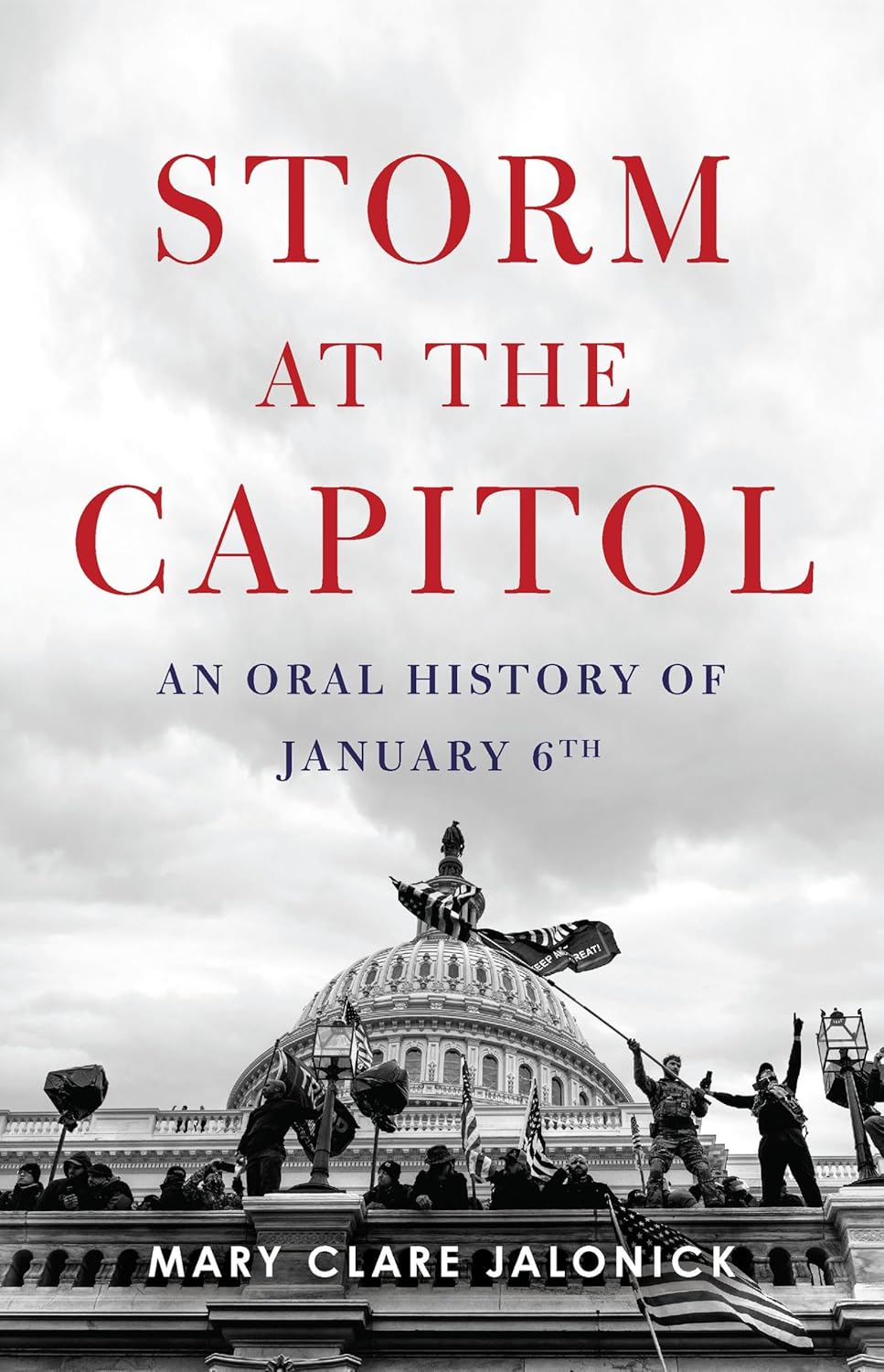
This book will make you very angry. Storm at the Capitol is an oral history told by those who were at the U.S. Capitol on January 6, 2021. On that tragic day, domestic terrorists attempted to subvert democracy. If you’re like this reviewer, you’ll find it hard to go more than a few pages without wanting to throw the book across the room, furious all over again about what happened that afternoon and amazed that some people still don’t grasp how serious it was.
Author Mary Clare Jalonick is an Associated Press reporter with several years of experience working at the Capitol, so she was uniquely positioned to see things as they unfolded in real time. She and her colleagues were in immense danger throughout the day. The rabid mob that set upon the building came armed and was out for blood.
Jalonick does a fine job describing the attack. She gives us an hour-by-hour recap of what happened in the words of those who were there — on both sides of the aisle and both sides of the barricades. This breadth of perspectives is what gives the book its strength.
To briefly recap, spurred on by President Donald Trump, thousands of protesters marched on the Capitol, overran police barricades, and briefly took over the building as Congress was certifying the lawful election of Joe Biden. Many in the mob called for the murders of the vice president — “Hang Mike Pence!” — and Speaker of the House Nancy Pelosi. The day degenerated as soon as the vote count began.
Contrary to revisionist historians, this was no peaceful protest. As Chad Pergram, a correspondent for Fox News (of all places) stated on the air at the time, and as Jalonick quotes, “This is the worst incursion of an American government institution since the British invaded the White House and the Capitol during the War of 1812.” That a network so openly sympathetic to Trump would use such words is telling.
Lawmakers saw it for what it was, too. In the words of Senator Chris Murphy (D-Conn.), “You had a lot of very shaken staff…a lot of people sort of crying…we obviously knew something terrible could be happening.” And as reported by Representative Pat Fallon (R-Tex.), “Glass went flying…Someone screamed, ‘Rounds fired, rounds fired!!’”
Particularly damning are the words of the insurrectionists themselves, who, for the most part, felt they’d done nothing wrong. “I made sure I was at the front…because I wanted that ‘Q’ to be on TV. I wanted Q to get attention,” recalled Doug Jensen of Iowa. Q refers, of course, to QAnon, a conspiracy-fueled cult whose members believed the election had been stolen despite clear and compelling evidence to the contrary.
Jalonick also quotes Jason Riddle, whose own courage ran out:
“I couldn’t find [my friends]. So I ran. I ran until it looked like I was in a different town.”
To be clear, he wasn’t fleeing because he felt guilty or ashamed; he’d simply lost the backup of his fellow insurgents.
Lawmakers from both parties tried to stem the tide, even though many Republicans would later deny there’d been an attack at all. Among the Democratic heroes were Maryland representative Jamie Raskin, who was there to certify the election mere days after his son’s suicide, and New Jersey representative Andy Kim, who was memorably filmed later that night on his hands and knees, cleaning up the sacred ground of the Capitol Rotunda.
The author takes pains to quote Republicans who also stood their ground, unwilling to give up the democracy they were elected to serve even though the 2020 election hadn’t gone their way. She gives us South Dakota senator Mike Rounds, who recalled that “somebody (was) trying to tell us not to do our job, and it (was) disrupting the peaceful transfer of power.”
She also shares the image of Pence, who would not leave the Capitol despite the mob’s calls for his execution. In the words of his chief of staff, Marc Short, “For the world’s greatest democracy, to see a…fifteen car motorcade fleeing the Capitol would send all the wrong signals.”
More amusing are the recollections of Senator Susan Collins (R-Maine). She was concerned about the attempted coup, sure, but seemed more interested in how it impacted her personally. Officials “brought us water and salads and sandwiches to eat,” while the Senate was in lockdown, she recounts, and at the end of the ordeal, “I was a bit nervous about trying to drive home…I can never find a parking place that late.” Democracy almost fell, but parking is important, too.
The strongest voices come from the brave officers who fought off the crowd. Jalonick quotes such heroes as Detective Phuson Nguyen of DC’s Metropolitan Police, who recalled, “I was choking, and I was trying to get up…In my head…I thought it was it for me.” And she shares the words of Officer Michael Fanone, who has become an outspoken critic of the attempted whitewashing of the insurrection:
“They seized the ammunition that was secured to my body. They began to beat me…I heard chanting…‘Kill him with his own gun.’”
In the end, democracy held. Despite some additional last-minute maneuvering by Republican lawmakers, Joe Biden’s certification as president-elect was completed in the early hours of January 7, 2021. We can take some comfort in the fact that our government endured. But knowing the insurrectionist-in-chief was returned to office in 2024, we must ask ourselves: For how much longer?
[Editor’s note: Mary Clare Jalonick will speak with Manu Raju at Politics and Prose in Washington, DC, on Friday, Jan. 9th, at 7 p.m. Learn more here.]
Chris Rutledge is a husband, father, writer, nonprofit professional, and community member living in Silver Spring, MD. Besides the Independent, his work has appeared in Kirkus Reviews, American Book Review, and countless intemperate Facebook posts, which will surely get him into trouble one day.