Strange People on the Hill: How Extremism Tore Apart a Small American Town
- By Michael Edison Hayden
- Bold Type Books
- 320 pp.
- Reviewed by William Rice
- April 22, 2026
An oddly (and overly) personal account of tumult in West Virginia.
Journalists have been injecting themselves into their reporting for a long time, at least since the advent of the novelistic “New Journalism” in the 1960s. So, complaining about it now may seem about as useful and up-to-date as carping about rock ‘n’ roll being too loud. But there are different levels of authorial involvement in a story ostensibly about something else, and sometimes that level is too high (just like rock sometimes actually is too loud).
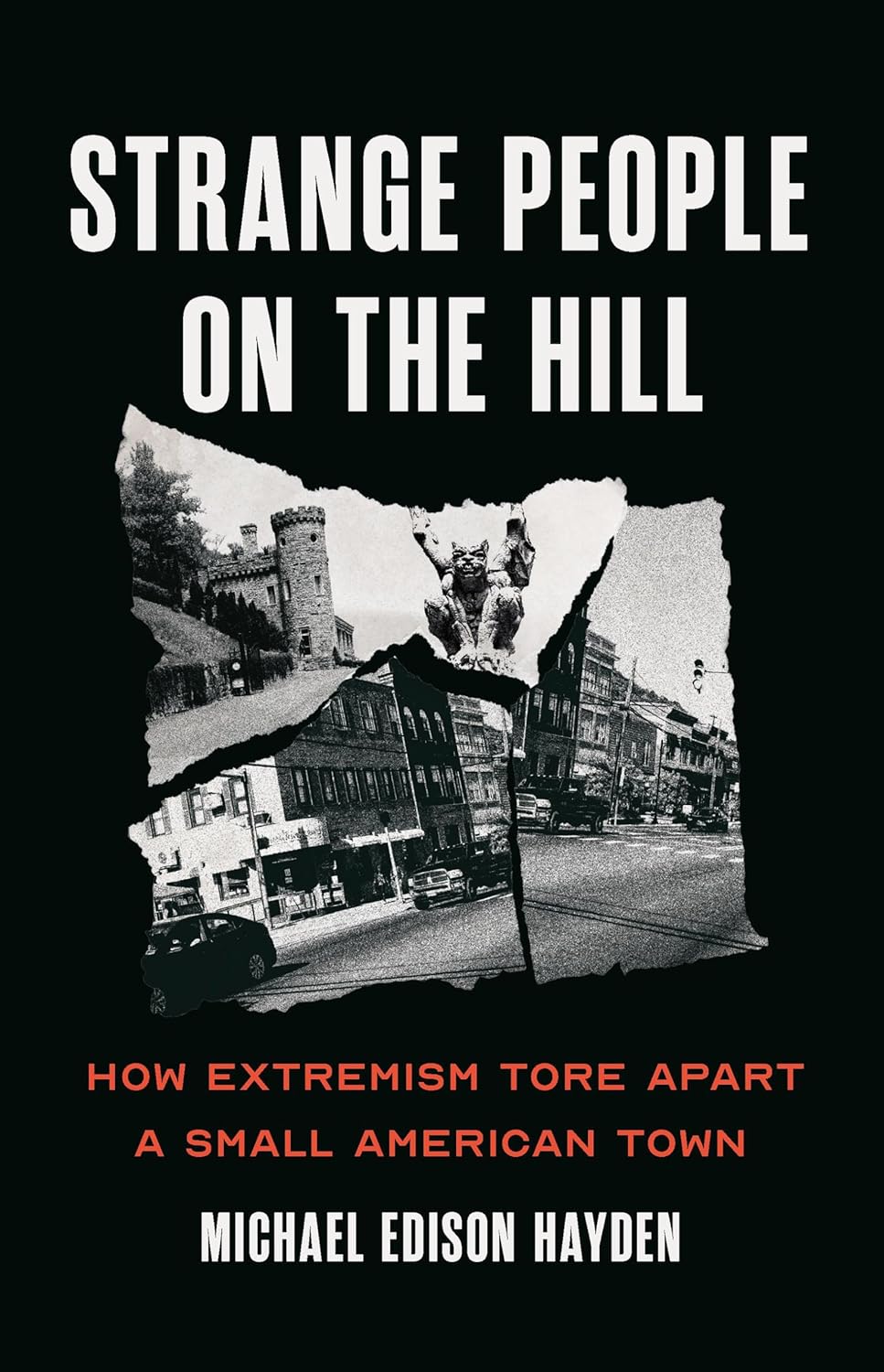
Such is the case with Michael Edison Hayden’s Strange People on the Hill. What, according to the subtitle, is supposed to be about “How Extremism Tore Apart a Small American Town” is really mostly about the personal travails of the writer.
The town in question is Berkeley Springs, West Virginia, an ancient resort town about two hours west of Washington, DC. Travelers in the 18th and early 19th centuries went there for the healing waters — waters still available to our 21st-century author, who takes full advantage of them.
Berkeley Springs isn’t your typical red-state community. Rather, like Austin, Texas, it is a dot of liberal sentiment in a sea of conservative thought populated by artists and LGBTQ transplants from DC and other progressive areas. It’s this lefty profile that creates the tension when a right-wing organization buys a literal castle overlooking the town.
The organization is an anti-immigrant outfit called VDARE, founded by a British-American agitator named Peter Brimelow. When the denizens of Berkeley Springs learn of the new owners of the 19th-century fortress that sits up a short hill from downtown, they reach out to the Southern Poverty Law Center (SPLC) for help. The SPLC has categorized VDARE as a white supremacist group. Hayden — who has been tracking and writing about VDARE for a while — travels south from New York City to offer advice and consolation at a public meeting.
He doesn’t imbed himself in the community but rather commutes down from Manhattan on several occasions. (Being a city dweller, he apparently does not own a car; we always hear what make and model he has rented for each road trip.) Despite his irregular attendance, Hayden grows very close to several locals: They have him over for meals and even as a houseguest. When the author shows signs of a mental-health crisis, townsfolk spot it and express alarm.
As a Washington native who lived for several decades in eastern coastal Maine, I have some experience with the cultural conflict between residents with longstanding familial ties to a rural place and eager newcomers. I was expecting this book to be an explication of that phenomenon. But this tale is one of newcomers versus newer newcomers. If there are any residents of Berkeley Springs or its environs with deep roots in the area, we don’t meet them. And, presumably, it’s among that same population that we’d likely find vocal proponents of VDARE, but we don’t make their acquaintance, either.
Moreover, what seems to tear the town apart doesn’t relate directly to the unwelcome newcomers but rather to the kind of petty resentments and conflicts that often plague small communities. What ultimately brings down VDARE isn’t local reaction to its move to Berkeley Springs but an attorney general’s lawsuit filed hundreds of miles to the north in New York state.
The story is bookended by covid-19 and Donald Trump’s reelection. Over those four-and-a-half years, the author goes through a lot: a marital separation, an increasingly toxic relationship with his employers at SPLC, and a mental breakdown that lands him in a psychiatric hospital. But none of those tough times can be traced to his reporting from Berkeley Springs.
Hayden does offer an enlightening account of the symbiotic relationship between political extremists and those who try to keep tabs on them. Even though Brimelow and his wife frequently attack Hayden in the media, they still sometimes answer his calls and emails. The conflict often comes off more as a family spat than a deep ideological divide.
There’s a particularly telling scene when Hayden and an accomplice, who’ve sneaked into a VDARE party under false names, are confronted by the Brimelows in the castle’s front hall. Rather than a screaming match or fisticuffs, what follows includes jocular reminiscences about subtle shots the author has taken at the couple in the past.
Hayden also provides a backstage view of turmoil at the SPLC, a liberal icon whose internal struggles have in recent years overshadowed its work on civil rights. Hayden becomes a shop steward of his union, which makes him a target of management retaliation, and his relationship with his employer goes downhill from there.
In the end, Hayden declares his love for Berkeley Springs, the physical beauty of the area, and its residents. I’m sure I’m not the only reader glad to hear it. But I’m probably also not the only one who wonders why we were brought along on what turns out to be a hyper-personal journey of discovery, not a useful report from the front lines of the culture wars.
William Rice is a writer for political and policy-advocacy organizations.