Strangers in the Land: Exclusion, Belonging, and the Epic Story of the Chinese in America
- By Michael Luo
- Doubleday
- 560 pp.
- Reviewed by Peggy Kurkowski
- June 12, 2025
Alarmed by today’s rampant nativism? The 19th century suggests you hold its beer.
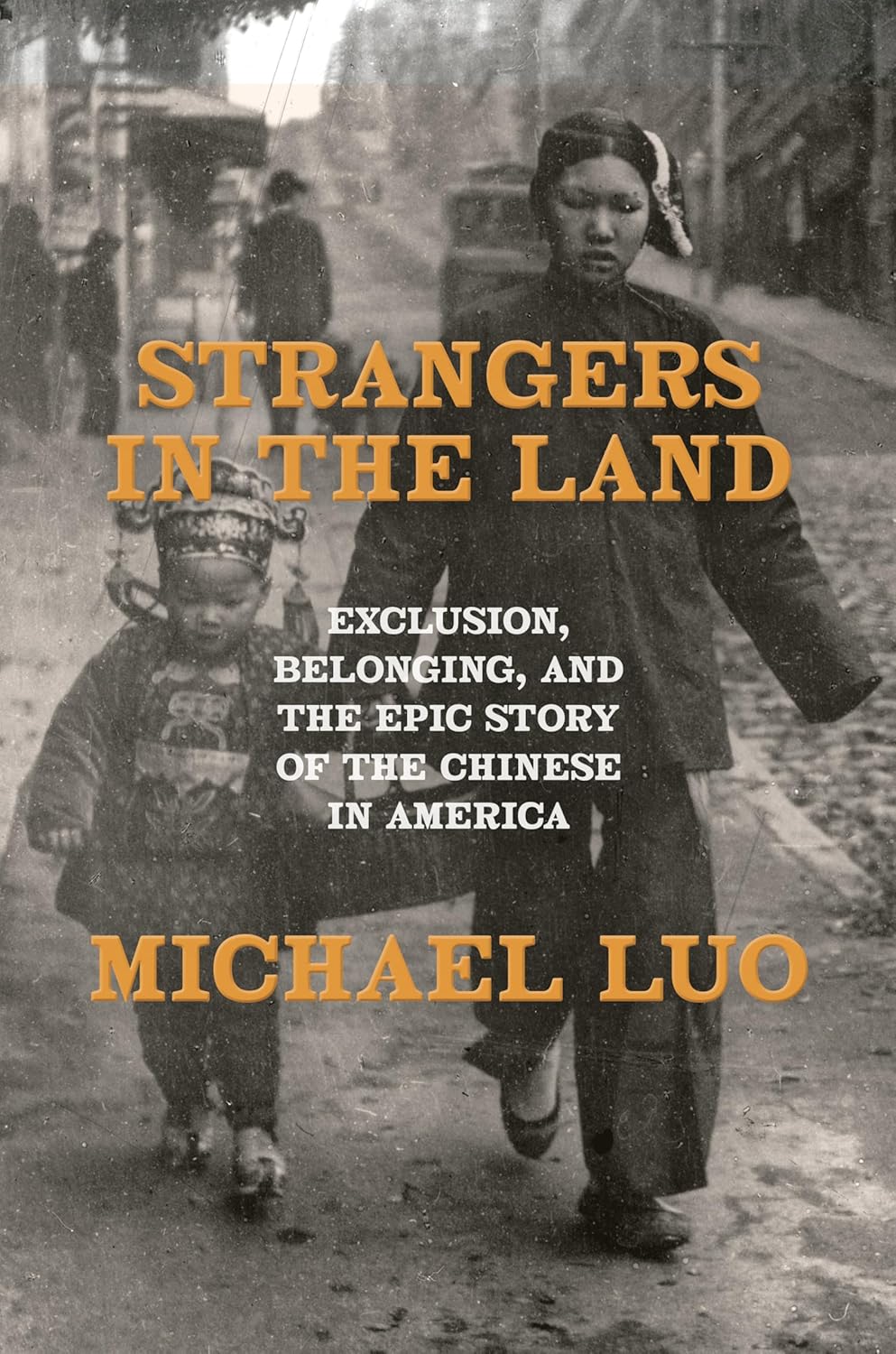
The fraught history of the Chinese immigrant experience in America is revealed in the dramatic stories told in Michael Luo’s urgent study, Strangers in the Land. A child of Taiwanese immigrants, Luo, an editor at the New Yorker, chronicles the Chinese journey in a deeply researched and, at times, personal narrative of how these immigrants fought for the right to become Americans.
He begins his book with a shocking story of a sidewalk encounter in 2016, when a woman shouted at him, “Go back to China!” On the eve of the first election of Donald Trump, Luo recognized in this ugly moment a “curtain of nativism” descending upon the country. It made him question whether his own children, two generations removed from his parents’ experience, “would ever feel like they truly belonged in this country.”
With this raison d’être, Luo answers an ignorant insult with a passionate history of how the Chinese came to the U.S. and how they persisted against unimaginable hatred to claim their share of the American Dream. He begins in the middle of the 19th century, when tens of thousands of Chinese migrants arrived on the West Coast to labor in the mines and build the transcontinental railroads. As their numbers grew, so did white America’s concerns about the “unassimilable” Asians in their midst. At first welcoming the migrants and appreciating their stoic work ethic, the U.S. government soon began to restrict immigration from China through exclusionary laws based solely on race.
The “truest measure of a country’s values” is found in who it is willing to admit into its “family of citizens,” Luo contends. Following the end of the American Civil War in 1865, the newly reunited nation faced a “conundrum” over the rise of Chinese migration to the Pacific coast. The growth of Chinese migrant communities in California, particularly “Chinatown” in San Francisco, added to the rising racial tensions as the country went through an economic downturn in the late 1860s and 1870s.
Although seen as taking jobs away from unemployed white laborers, the Chinese, Luo writes, were “usually not in direct competition with most white workers,” moving instead in labor pools of lower-wage, less-skilled work. Nevertheless, “anti-coolie” clubs sprang up throughout San Francisco, with angry white mobs targeting Asians. At best, entire towns would run out the Chinese. At worst, the migrants would be beaten or lynched.
But it was not just the West that saw such riots. Luo looks to the East Coast, as well, to document how the desirability of Chinese workers for growing industries pitted business owners against the fury of white labor leaders perpetuating “the coolie falsehood.” This false premise, first promulgated in California, claimed that the Chinese were nothing more than “indentured workers, laboring in servitude.”
Discrimination against the Chinese spread from west to east and finally into the halls of Congress; President Chester A. Arthur signed the Chinese restriction bill (known today as the Chinese Exclusion Act) into law in 1882. It barred all Chinese immigration to the U.S. for 10 years and made Chinese immigrants ineligible for naturalization. Notes Luo:
“For the first time in its history, the United States had closed its gates on a people based on their race.”
Luo employs a cacophony of voices to frame his broader canvas of Chinese persecution and persistence. Among them are Yung Wing, the first Chinese student to attend Yale, and Ah Sing, who became “the first Chinese immigrant to fight for his right to remain in the United States during the exclusion era.” Luo emphasizes the human narrative at the expense of a more chronological outline, but this approach does provide stark drama and firsthand insights into the stormy weaving of Chinese people into the fabric of America. The sheer abundance of stories and detailed minutiae, however, bogs down the flow at times.
The story of Chinese human rights, immigration, and citizenship in America is especially timely given China’s rise as a geopolitical power, which Luo says raises anew “the bugbear of the unassimilable Other in our midst.” The number of state laws currently looking to restrict the right of Chinese citizens to buy property is one measure of the racist “oriental invader” trope returning to haunt the community. It’s just one of the troubling facts revealed in Strangers in the Land, a lavishly detailed, inspiring, and sometimes infuriating exploration of why a true sense of belonging remains elusive for so many Chinese Americans.
Peggy Kurkowski is a professional copywriter for a higher-education IT nonprofit association by day and major history nerd at night. She writes for multiple book-review publications, including Publishers Weekly, Library Journal, BookBrowse Review, Historical Novels Review, Independent Book Review, Shelf Awareness, and the Independent. She hosts her own YouTube channel, “The History Shelf,” where she features and reviews history books (new and old), as well as a variety of fiction. She lives in Colorado with her partner (quite possibly the funniest Irish woman alive) and four adorable, ridiculous dogs.