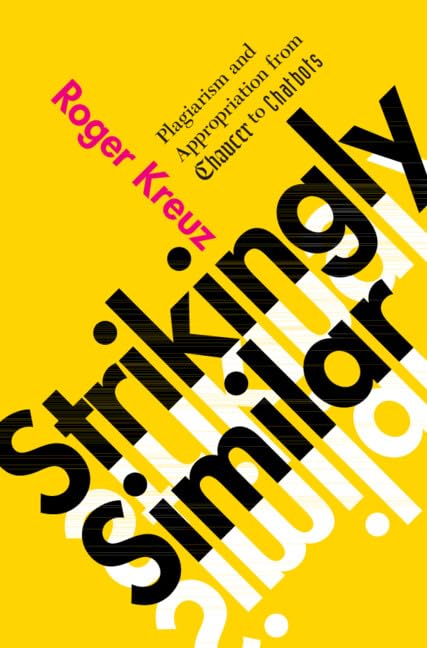
Strikingly Similar: Plagiarism and Appropriation from Chaucer to Chatbots
- By Roger Kreuz
- Cambridge University Press
- 256 pp.
- Reviewed by William Rice
- January 26, 2026
A profoundly dull examination of an otherwise compelling topic.
Few texts, it would seem, are less likely to be the product of plagiarism than an early review (such as this one) of a new book. There’s simply nothing relevant out there to steal. So whatever its quality, Gentle Reader, you can at least rest assured that the following work is exclusively my own.
The same cannot be said with confidence about almost any other creative product. That’s the unsettling message of the dutifully reported Strikingly Similar: Plagiarism and Appropriation from Chaucer to Chatbots by Roger Kreuz. Students, teachers, musicians, orators, politicians: No one, it seems, is above lifting the ideas of others and offering them up as new.
Causes vary. Kreuz begins his exploration with the winner of a 1930s radio composition contest who’d simply copied a published essay he admired in blissful ignorance that such was not allowed. In pre-modern times, writers regularly retold stories, the appropriation smiled upon — assuming the retelling improved on the original.
It’s only with the regimentation of copyright protection over the past two centuries or so that our current conception of plagiarism has taken hold. Now that we all at least pay lip service to the idea that stealing words and ideas is as bad as stealing someone’s wallet, the response to a charge of plagiarism ranges from angry denial to admission accompanied by a plea of mitigating circumstances. (Sloppy note-taking is a popular excuse.)
Kreuz acknowledges that the term “plagiarism” covers a wide variety of sins, from swiping long passages word for word to presenting a storyline or song too similar to something already in circulation. He reports that linguist John McWhorter has proposed assigning a sliding scale of guilt similar to the degrees accorded acts of murder, from negligence to premeditation.
The dawning of the digital age has made both plagiarism and its detection simpler than ever. Theft is as easy as one, two, three (highlight, copy, paste), while electronic word searches instantly zero in on purloined prose. But given the sheer volume of creative works rolling off the assembly line, Kreuz estimates that the perpetrators are decisively beating the detectives.
Assisting the thieves is the frequent institutional disinclination to name the problem, let alone do anything about it. Universities heavily invested — financially and reputationally — in a famous scholar, for instance, would just as soon sweep a few thefts under the carpet. Kreuz theorizes that the guiltless ease with which we can all violate copyright online makes plagiarism feel more acceptable:
“…[T]he consumption of intellectual property without paying for it may function as a gateway drug that normalizes the act of appropriation.”
The book notes the divergent consequences of being outed as a plagiarist. Sometimes, careers and lives are ruined. Then there’s the case of Joe Biden, guilty of what the book calls the “highest-profile example of plagiarism in U.S. history.” The first time he ran for president, in 1988, Biden was caught giving a speech that heavily borrowed from the remarks of a leading British politician. The scandal knocked him out of the race but obviously didn’t finish him.
Dealing as it does with hot topics like the nature of ideas, the possibility of originality, dirty dealing, and offended innocence, plagiarism is an emotional subject. But all the fizz is gone in Kreuz’s plodding presentation. He explains in his introduction that his project began as a spreadsheet, and that’s the technocratic spirit that pervades the work: We march from one bloodless instance to another, always adequately informed but never thrilled. He generally sticks soberly to the words “plagiarism” and “appropriation,” eschewing jazzier synonyms; the worst label he slaps on the act is the snooze-inducing “problematic.”
Still, while the going may be dry for the reader, compiling the book was apparently a gut punch for the author. He says somewhat sheepishly, “I must confess that this odyssey has dented my faith in human nature.” That’s surprising because his findings felt to me like a confirmation of human nature: often lazy and forgetful, sometimes malicious, usually lacking critical self-awareness. If you think about how careless most people (including yours truly) are in a variety of human endeavors — from housekeeping to relationships — it’s hardly amazing that they would steal somebody else’s creative output if it was easy to do and conferred some sort of benefit on the thief.
Is any of this book stolen goods? There’s no way of knowing for sure without looking up each of the carefully cited sources. But it seems unlikely any of this text was swiped, as deliciously ironic as such a theft would be. The first reason to assume all of the work here is original is that the author would be particularly fastidious in order to avoid said irony. The second, alas, is that nothing in its construction is compelling enough to have warranted stealing.
William Rice is a writer for political and policy-advocacy organizations.