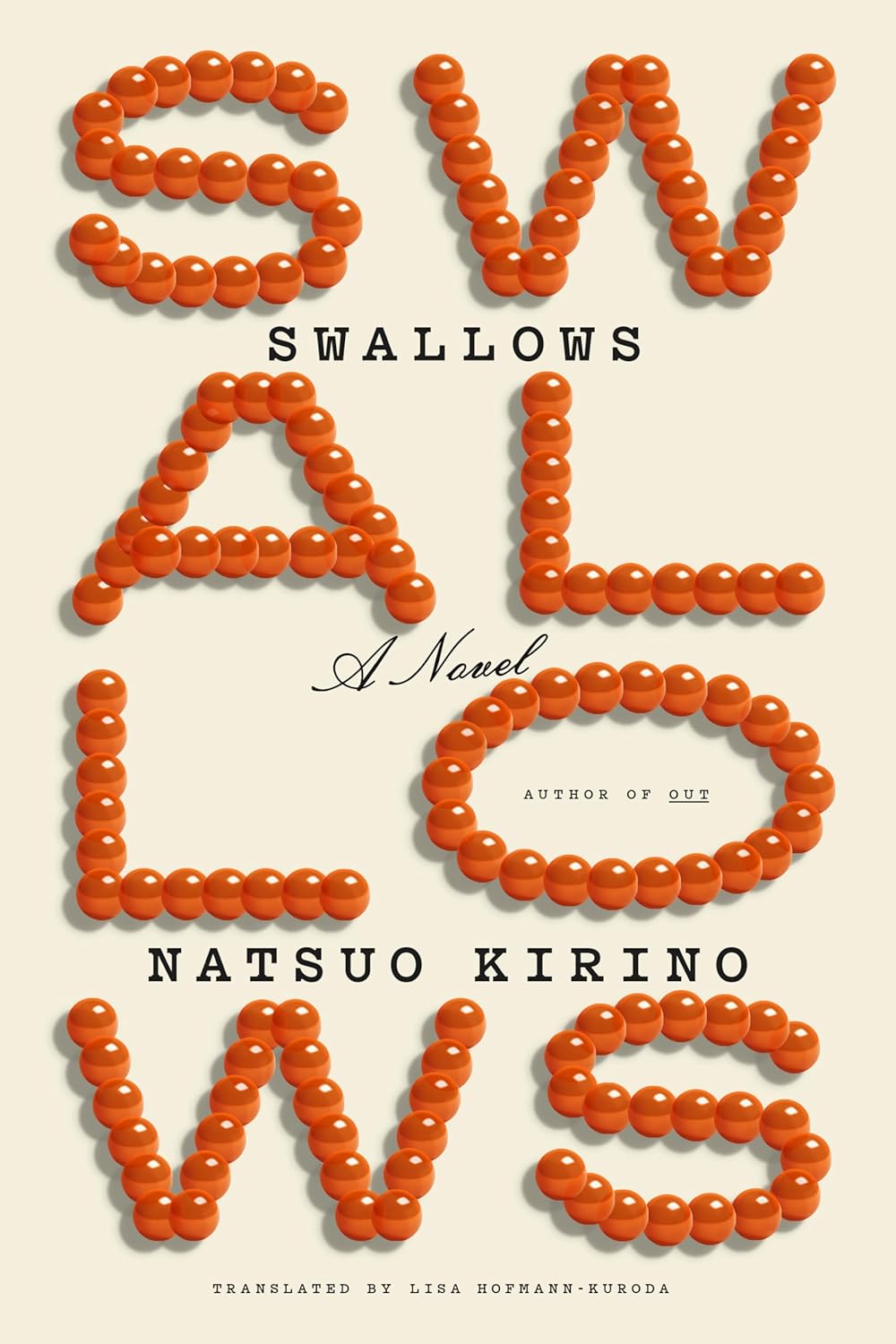
Swallows: A Novel
- By Natsuo Kirino; translated by Lisa Hofmann-Kuroda
- Knopf
- 352 pp.
- Reviewed by Kate Preziosi
- September 24, 2025
Which comes first: the mother or the egg?
In Natsuo Kirino’s 1997 novel, Out, overnight-shift workers –– mostly women in their 40s and 50s –– stand for hours at a Tokyo factory conveyor belt, assembling bento boxes. The cheap lunches are then ferried to convenience stores all over the city, where office workers carelessly pick them up, gobble them down, and toss the remains.
Out was the first of Kirino’s novels to be translated into English. The latest is Swallows, which follows another woman on the fringes of Japanese society.
Riki is exhausted and desperate after years of working a series of dead-end, low-wage jobs. When her friend suggests donating her eggs to a Tokyo fertility clinic for more than three times her monthly salary, Riki is wary but ultimately drawn in by the money.
After her first appointment, the clinic staff gives Riki a white envelope filled with cash for the train home. It’s both a gesture of goodwill and a not-so-subtle reminder of the wealth and ease that have always been beyond her grasp. In a fitting callback to the invisible labor performed by the women in Out, she spends the money on a bento box.
Unlike Out, a classic violent thriller, Swallows trades in a quieter, bloodless apprehension. The novel is a theater of good intentions, where characters perform civility while coldly appraising one another’s value and which assets they can extract for their own gain. Underneath everyone’s tight smiles and white lies are sharp teeth, ready to be bared.
In an under-the-table deal, Riki ultimately agrees to be both an egg donor and surrogate for a wealthy couple. It’s a savvy and effective plot device that gives Kirino plenty of room to explore the moral ambiguities of value, consent, and control between the parties.
While at the fertility clinic –– a cheery pink space with pictures of mommies and babies on the walls –– for her interview, Riki is subjected to thinly veiled questions aimed at drawing up an ideal profile that the agent can sell to prospective parents: that of a gainfully employed, well-educated, physically attractive young woman from a “good” family. This kind of woman doesn’t need the money –– she just wants to do something selfless for others.
It’s unclear whether such unicorn women exist, but the questions serve their purpose. Riki feels like a distressed asset. She is 29 years old (right at the age cutoff for egg donation), works a part-time temp job, can only afford thrift-store clothes, and comes from a poor family in a rural town. Her “eggs were definitely more like the grade-C eggs you’d find at Miyoshi Mart,” Riki thinks. “Who would choose those?”
It turns out, her eggs are extremely valuable to Motoi and Yuko Kusaoke. Riki looks so much like the wife, Yuko, that she could be mistaken for Yuko’s sister. The couple could easily pass Riki’s genetics off as their own.
The Kusaokes choose a private room in a white-tablecloth restaurant for the site of their first meeting with Riki. Like the agency’s interview questions, the setting efficiently conveys the couple’s net worth and pedigree, while making Riki feel at a disadvantage.
The husband, Motoi, launches into a lengthy speech about why he’s seeking a Japanese surrogate. “Asking someone from a foreign country…seemed so transactional,” he says. Instead, they’d like someone whom they feel “a sense of kinship with.” Readers know from his private conversations that, after learning Yuko cannot have children, Motoi is pursuing surrogacy out of a myopic need to “see how his DNA would manifest in his own offspring.” He isn’t too sentimental about the details.
Despite this honorable posturing, Riki is savvy enough to intuit that kinship is not on offer. To Motoi, she isn’t a person, she’s a commodity: “10,000,000 yen in exchange for her womb,” she thinks to herself. In return, she views the couple as a “once-in-a-lifetime business opportunity” to beat an economic system that’s hostile to single women.
As they’re preparing to leave the restaurant, Motoi hands Riki another white envelope. “Please, use this to get yourself a taxi home,” he says. “Your body is very valuable to us now.”
Although the clinic agent refers to their agreement as “a simple contract…more of a memo, really,” Motoi treats it as a binding accord through which he tries to exert control over Riki’s living situation, actions, and movements. “Once she gets pregnant,” he later says to Yuko, “she needs to do what we tell her to.”
Often, Kirino’s dialogue is so blunt and ruthless that it reads like a comic-book villain’s monologue rather than that of a real human character. When Motoi and his mother, Chimiko, are discussing what will happen after Riki gives birth, Chimiko suggests they retain Riki for a bit longer:
“I’m sure she’ll do it if we pay her. Isn’t she strapped for cash? Besides, separating her from the children right after she gives birth seems cruel. Why not let the kids feel their mother’s love for the first year of life?”
In the novel’s second act, the characters’ motivations swing so dramatically, and with so little explanation, that I’m left with the impression of pawns haphazardly darting around a game board. It serves to underscore how precarious the situation is: None of these would-be parents has thought through what it would mean to raise a child, and given their extralegal agreement, any one of them could walk away and wash their hands of the whole situation.
Unfortunately, this chaos leaves the book’s greater questions –– Whom does a body belong to? What is a mother? Who holds the rights to a child? –– largely unresolved.
Kate Preziosi is a New York-based writer and editor. Her reviews have appeared in Literary Hub, the Rumpus, and the Brooklyn Rail, among others.