Sweet Home Feliciana: Family, Slavery, and the Hauntings of History
- By Rashauna Johnson
- Cambridge University Press
- 368 pp.
- Reviewed by Nicole Schrag
- March 26, 2026
A deeply researched, deeply sobering chronicle of rural Louisiana.
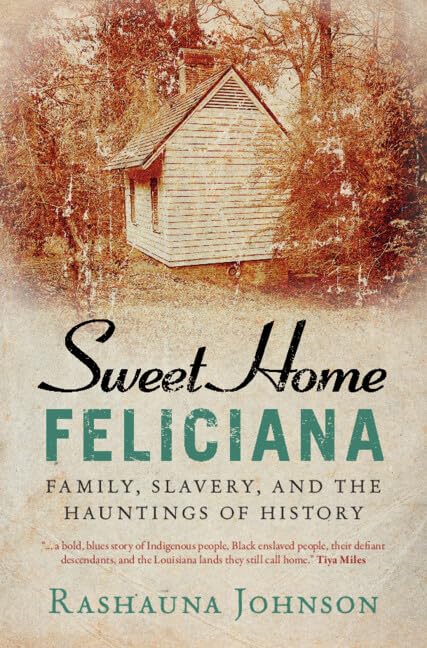
It’s hard to imagine an adult in the United States who hasn’t heard of New Orleans, the subject of Rashauna Johnson’s 2016 book, Slavery’s Metropolis. Feliciana, though, is another story. Johnson is an associate professor of history at the University of Chicago, and her new academic monograph, Sweet Home Feliciana, offers an in-depth history of Feliciana — a rural region of Louisiana bordering Mississippi — from the colonization of Indigenous lands to post-Civil War Reconstruction and beyond.
In the mid-19th century, the area was divided into the East and West Feliciana parishes, and it’s also where some of the author’s ancestors are from. While many formerly enslaved Black people left for cities or the North after emancipation, many more remained in the places where they’d lived, established families, and built communities. This book focuses on those who stayed.
Johnson weaves family stories and records into her narrative. She opens with a moving preface in which she analyzes her cousin’s memorial suit, made for Mardi Gras, and so introduces readers to the questions about her family’s history that inform the book’s larger sweep. In the final chapters, she notes how documents referencing her ancestors place her family squarely within the region’s history of slavery, emancipation, and ongoing anti-Black violence.
In between these bookends, Johnson paints a rich picture of a place that could’ve easily been written off as an antebellum backwater, arguing persuasively for its complex global significance. Feliciana did have plantations owned by white families and worked by enslaved Black people. But long before that, it was home to Tunica Indians and was later subject to conflict among the Spanish, French, and American governments — and those who would rebel against them.
Slavery took on different forms under these varying authorities, and Johnson explores how the changes in colonial power and revolutions abroad impacted everyday life and “sparked an epic freedom fight from below.” Among other things, she documents rebellions of attempted self-liberation, escape, and the fierce maintenance of family ties at great personal risk.
She also shows how police juries and other entities were established in the 19th century, often with the purpose of supporting the intensifying exploitation of the enslaved through surveillance and punishment and the bolstering of the social and economic positions of white people. She chronicles the local government’s provision of social services for the poor, the arrival of Jewish shopkeepers to the area, and the presence of 91 free Black people (compared to about 8,700 enslaved people) in West Feliciana’s 1840 census.
Johnson’s chapter on the Civil War contains a remarkable account of the siege at Port Hudson (a site to which the Felicianas were connected by rail), a Confederate defeat that looms large in “Lost Cause” histories and in which Black soldiers were instrumental to the Union’s victory. In her final chapters, she narrates how Reconstruction and Jim Crow played out in the Felicianas via voter intimidation and suppression, sexual violence, and labor exploitation.
The rigorously researched Sweet Home Feliciana is written for an academic audience, yet I think most readers will find it accessible if they’re willing to work through Johnson’s densely packed references. The range and depth of her archival sources are vitally important not only due to the scholarly nature of the project, but also given that “bad-faith critics” have been known to “object to the most basic facts of Black history.”
I anticipate that the most difficult aspect of the book for many will not be its academic style so much as the heaviness of its subject matter. While Johnson makes an effort “to avoid gratuitous and pornographic” representations of Black suffering, she notes that “the archives of settler colonialism, slavery, war, and Jim Crow are simply brutal.”
The author shares in her epilogue that one of the book’s early readers suggested she might frame the narrative in a more hopeful way, emphasizing the progress made over time. But Johnson doesn’t endeavor to tell a story of progress:
“These pages do not contain the happiest of histories, and nothing guarantees the happiest of futures.”
Instead, she believes there might be “joy” in “telling sad and beautiful truths about people of African descent, our sojourns in these United States, and the defiance we carve into these lands.” Those willing to listen to these truths will find them in abundance here.
Nicole Schrag is a writer, critic, and educator based in Tampa, Florida. You can find more of her work at nicoleschrag.com.