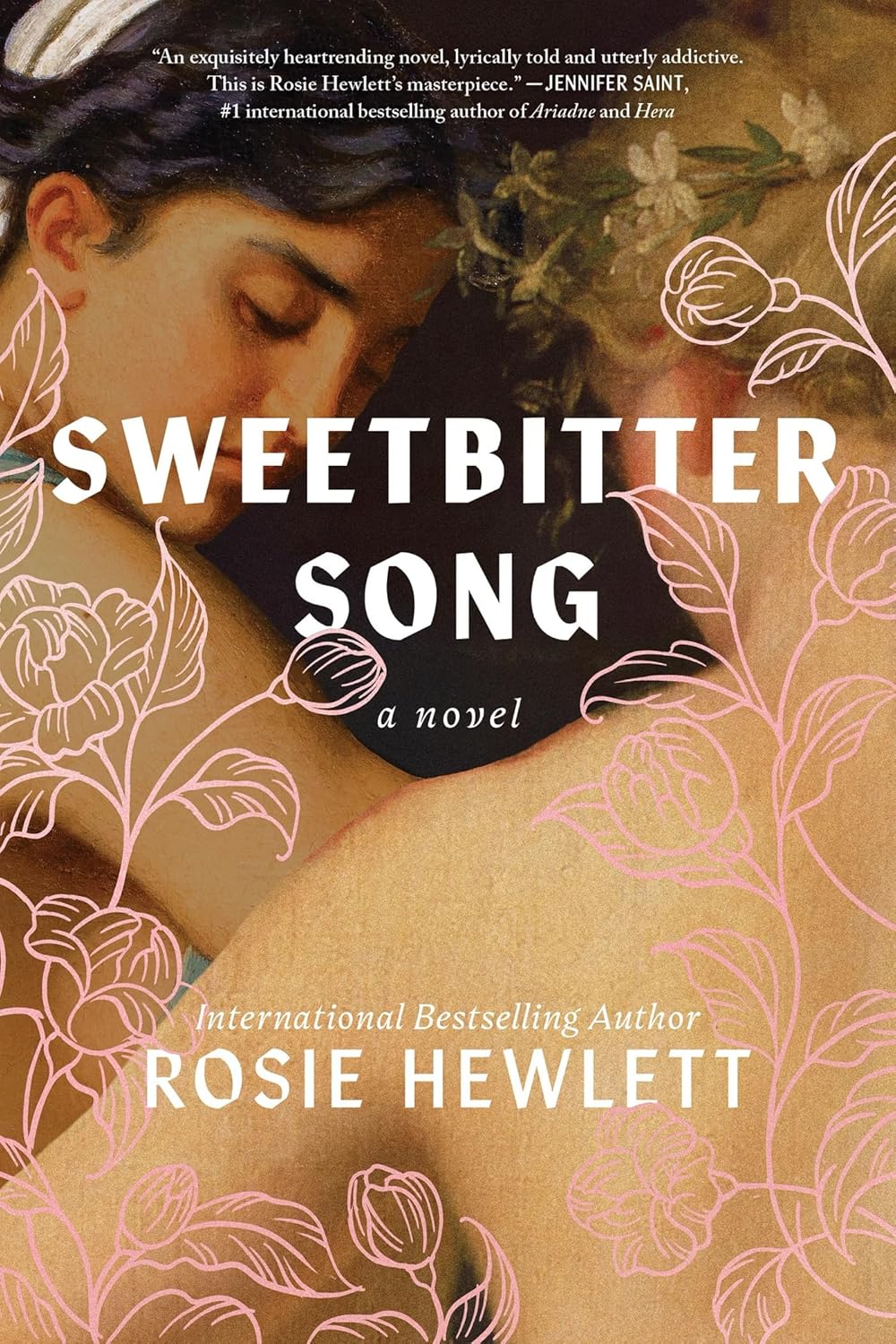
Sweetbitter Song: A Novel
- By Rosie Hewlett
- Sourcebooks Landmark
- 512 pp.
- Reviewed by Beth Kanell
- April 9, 2026
Odysseus’ Penelope finds sisterhood — and possibly more — in a female slave.
Nine-year-old Melantho is a slave to the royal household in Sparta. Uneducated but loved by her mother, she’s so naïve that when a summons arrives for her from the king, she thinks she’s headed into a great adventure. Her mother’s tears and warnings bounce off her as she eagerly goes from the crowded servants quarters to the beauty of the royal family’s chambers.
As any hungry kid would, when Melantho finds herself alone in a room where food is heaped on great platters, she pops a few bites in her mouth, then a few more, only to discover she’s being observed. The grey-eyed princess Penelope can’t help but be entertained by Melantho’s audacity. Not at all naïve herself, the princess maneuvers to save Melantho from the brutal sexual attention in store for her from the king’s nasty brother.
Despite Melantho’s retreat into unmolested slavery (if such a thing exists), a spark ignites between her and the princess. Although a slave, Melantho is sensitive to the massive power radiating from the royals, and it appeals to her. At the same time, an observation she makes resonates with Penelope: A woman’s life is not a free one even if she isn’t enslaved.
Soon, Penelope begins to teach Melantho to question ever-larger truths, asking, “Must divine power only manifest in women as beauty?” This big-sister-style coaching blossoms on fertile ground. When the clever princess orchestrates an arrangement to keep Melantho’s family safe but the girl still in bondage, Melantho dares to reveal what she truly desires:
“I wanted to be free.”
Readers familiar with the mythology of Ancient Greece will quickly realize that Rosie Hewlett’s Sweetbitter Song is an ambitious reimagining of the life of Odysseus’ wife, Penelope, who’s usually portrayed as loyal during her husband’s prolonged voyages, shrewdly stringing along the many suitors thronging her presumed widowhood. In this novel, however, Hewlett suggests that Penelope enjoys Odysseus’ absence. In fact — in a twist hinted at by the book’s opening quote from Sappho — she finds more than room to breathe; she finds herself drawn ever closer to Melantho.
For her part, Melantho, now grown and reunited with Penelope in Itaca after years of separation, feels something stir, too:
“For a moment, I allowed myself the simple, secret pleasure of admiring her — that beautiful, striking face that consumed so much of my mind. Too much, perhaps. I don’t know what you call them, those moments between breaths, the spaces between heartbeats, but Penelope seemed to occupy every one of mine.”
The author’s retellings of the Medusa and Medea tales were award-winning bestsellers, so it’s no surprise that this historical romance, like those earlier novels, is deepened by explorations of slavery (of both body and mind), class differences, early feminist ideals, and the value of loyalty. Hewlett offers in Sweetbitter Song a skilled narrative, a detailed look at long-ago history and culture, and that irresistible component of good fiction: a chance to observe and applaud the personal growth of characters. (A caveat: Her strong focus on the two protagonists leaves other characters underdeveloped, a small drawback to an otherwise vivid saga.)
Some readers may question whether Penelope’s skeptical remarks about the gods — made while teaching Melantho about them — are plausible given our modern assumptions about the credulity of ancient peoples, but Hewlett subtly suggests that men and women have always been able to recognize and utilize legends. She is also quick to direct any attention given to such matters back to her heroines, as here, when Melantho recounts a “perfect day” in order to distract Penelope during a difficult and dangerous childbirth. “All I wanted was to have a thousand more days just like that,” she tells the princess. Opening her eyes after speaking, she finds Penelope looking at her:
“her gaze burning like twin silver flames. She said nothing, but the silence was a living thing between us, as bright and terrifying as a bolt of Zeus’s lightning ripping open the sky.”
From this lush, evocative writing, Hewlett must at last knot up the narrative threads, and her final chapters can’t help being less remarkable than what preceded them. Nonetheless, she chooses an ending that will surprise those familiar with The Iliad and The Odyssey, one that may or may not provide Penelope and Melantho an escape from the enslavement each has endured.
Beth Kanell lives in northeastern Vermont among rivers, rocks, and a lot of writers. Her award-winning feature articles, short stories, and novels include The Bitter and the Sweet (2024), This Ardent Flame, and The Long Shadow (SPUR Award). Her poems seek comfortable seats in small, well-lit places. Find her memoirs on Medium and her reviews in the Independent, as well as at Historical Novels Review and https://kingdombks.blogspot.com.