Swell: Stories
- By Son Bo-mi; translated by Janet Hong
- Two Lines Press
- 240 pp.
- Reviewed by Alice Stephens
- September 2, 2026
This collection is a study in the infinite possibilities of fiction.
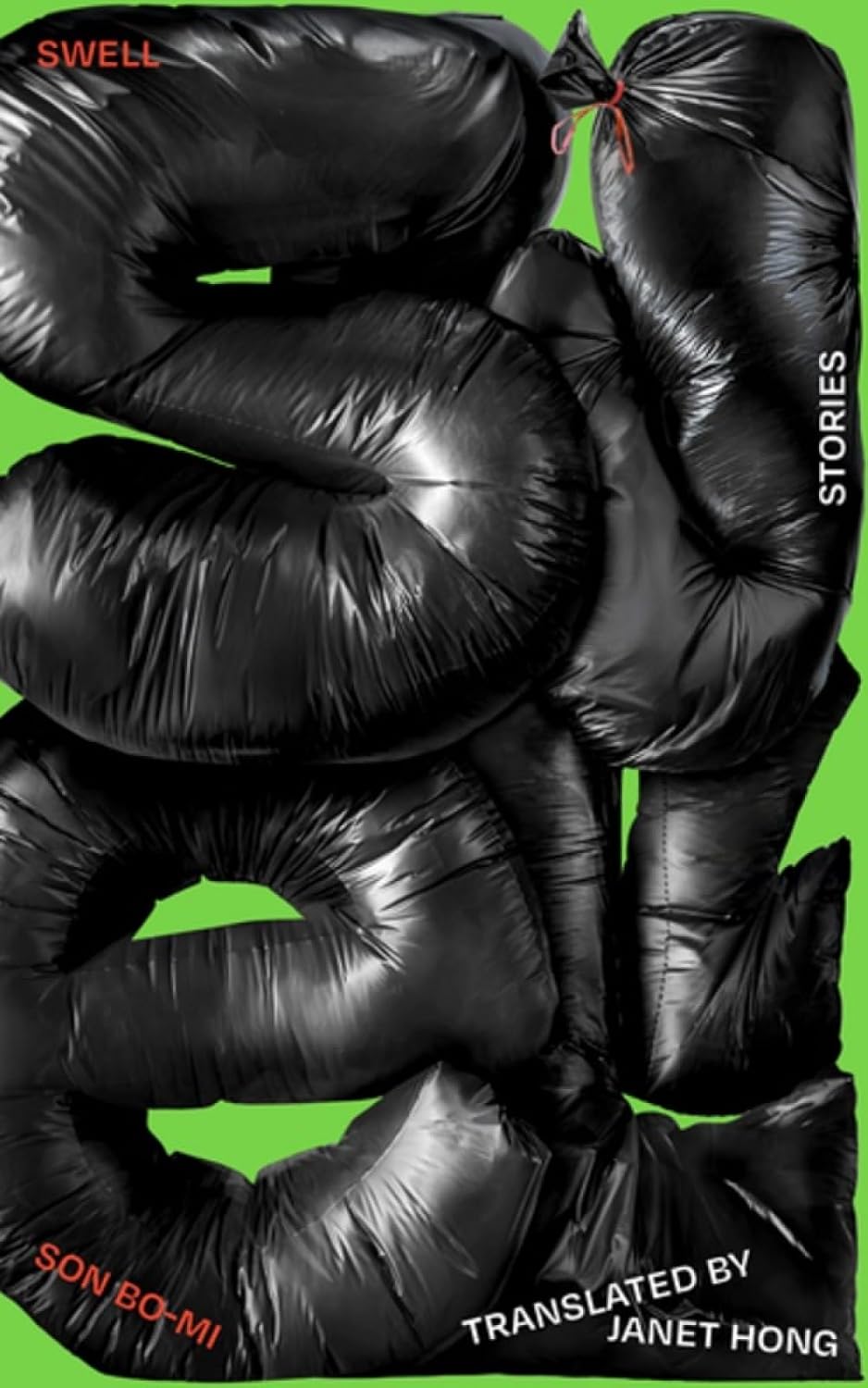
Reading Son Bo-mi’s Swell is like entering an alternate universe that can only be accessed through the art of fiction. The collection’s nine stories demonstrate the impossibility of a narrative’s fixed meaning, as characters try to reconcile their perceptions and memories with those of other characters, and tales are told and retold.
In the first story, “Blanket,” a writer recalls the end of his friendship with the man who told him a story about his boss, Jang, which the writer then uses in an acclaimed book. He muses, “To be honest, I don’t think I truly believed Jang was even real. He seemed more like a character who existed only in stories, someone who drifted into our conversations, hovered in our midst for a moment, then vanished when his part was done.” Then, the writer meets Jang in a bar. Within the first two pages, the reader is introduced to a flexible and disorienting world of stories and counter-stories, sometimes related in separate tales and sometimes in the very same one.
Swell begins and ends with the same story, though the person who dies and the one who survives are switched, while the site and circumstances of the death(s) stay the same. That is the beauty of fiction: There are no constraints except those imposed by the author. This makes for thrilling reading.
The title of a book, Leaving Liz, pops up several times like a familiar friend, each mention changing the angle on the book in a cubist-like portrait. Just as every reader brings their own interpretation to a text, so does every character in Swell voice their unique assessment of events. Jang, talking to the author of the book in which he’s mentioned, shares that it was a fun read. His only criticism has nothing to do with the fact that the author appropriated Jang’s tragedy for his own purposes.
A Mr. Jang appears in the second story, “Downpour,” but with a different job and background. Early in “Downpour,” Son advises the reader that “each detail [is] an essential element to the construction of our story.” As two narratives of two unhappy couples build, the details of one couple’s story reflect and contrast with the details of the other, until the two stories become enmeshed.
Son has no compunction about bending historical facts — or what has been accepted as fact — to enhance her narration. “Give Them the Lindy Hop” — the titular story of the collection when it was published in South Korea in 2013 — begins with quotes from a nonexistent book and documentary. The story is an inquiry into the film, called “Dance, Dance, Dance,” by director Gil Gwon-yong. It was maligned when it first came out, only to be reevaluated 10 years later when Gil dies by suicide.
After his death, another film, “Give Them the Lindy Hop,” also gets renewed attention, as its co-director asserts that it “was essentially a one-man work by Director Gil.” Or was the creative mind really that of Gil’s wife, Heo Jimin? The only time Gil spoke of his marriage was in an interview with a novelist named Son Bo-mi, and rumors about the relationship abound. The questions accumulate, and then the answer is revealed. But Son, in her capacity as the author of Swell, isn’t satisfied:
“But was it, really? Had all the mysteries been solved?”
Of course not. Art can never be tidily explained, and an artist is never the sole creator of their work, but rather carries the influence and ideas of untold multitudes.
The translation by Janet Hong deftly conveys an affectless, quotidian tone that doesn’t stray into histrionics or wonder but keeps calm in the face of Kafkaesque confusion. Much of the text is dialogue, as characters relate stories to each other, frequently trying and failing to reconcile their personal experience with another’s, and Hong ably captures the rhythm of these often contentious conversations.
Strange and surreal, Swell is a fascinating exploration of the malleability of storytelling. Son Bo-mi is unconstrained by readers’ expectations, co-opting even the legendary Babe Ruth and changing the details of his life for the sake of art, as if to declare that all the world’s a fiction.
Alice Stephens is the author of the novel Famous Adopted People. Her historical novel, The Twain: A Tale of Nagasaki, is forthcoming in February 2027. She is currently working on a collection of autofictional short stories about her adoption.
.png)