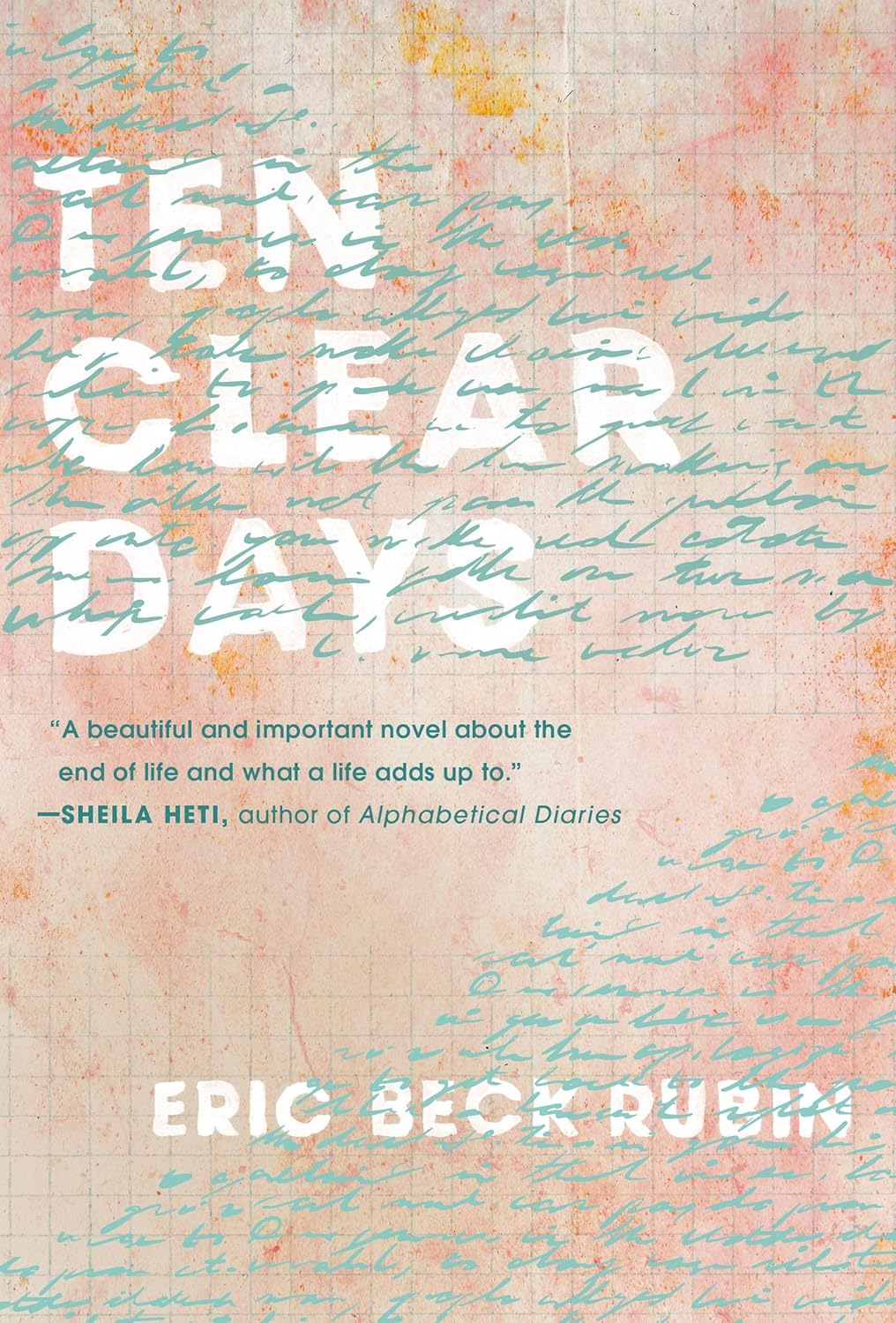
Ten Clear Days
- By Eric Beck Rubin
- Turtle Point Press
- 192 pp.
- Reviewed by Clifford Garstang
- May 28, 2026
An elderly matriarch and Holocaust survivor asserts her right to die.
In 2016, the Parliament of Canada enacted legislation that allows eligible adults to request medical assistance in dying. Several states in the U.S. have adopted similar, though far more restrictive, laws. The controversial practice of helping terminally ill patients end their lives raises numerous ethical questions.
Is providing aid in dying doing harm to the patient in contravention of the medical profession’s guiding principle to “do no harm”? Does society have a duty to protect vulnerable people, or should we honor a patient’s right to choose? In identifying appropriate restrictions on the act of aiding death, do we risk sliding down a slippery slope? Can a patient even give informed consent when faced with such an irreversible choice?
Eric Beck Rubin’s moving new novel, Ten Clear Days, based on his own family’s saga involving the death of his grandmother, explores these questions and much more. Mary Beck, the matriarch of a large family, has had a heart attack and stroke and is now in Sunnybrook Hospital in Toronto, where doctors are treating her. With the insertion of a stent, they tell the family that Mary is on the road to recovery.
One of her daughters is present, and her son, the youngest of her three children, soon arrives. The eldest child, another daughter, has just landed at Heathrow but immediately returns to Toronto upon hearing the news. During the course of the narrative, various grandchildren and spouses also appear at Mary’s bedside, providing comfort, moral support, and opinions regarding her care.
Mary makes it clear from the outset that she wants to die. She is 83 years old and, we learn, survived the Holocaust as a child. Her daughters disagree as to whether her wishes should be followed — she has a Do Not Resuscitate order in place — but the real question is what the hospital is required to do to comply with Canada’s Medical Aid in Dying law. The hospital is represented by a doctor who explains to Mary and the family the procedure it must follow, designed to ensure that the patient is competent by repeating her wish to die over a period of “ten clear days.”
The author presents the novel as a record of Mary’s hospital stay as transcribed by an employee known as the Observational Record Author, shortened to “Au.” As might be expected, this record is divided into days, tracking the course of the 10-day protocol. Au. includes everything that happens in the patient’s room: family conversations, doctors’ and nurses’ visits, and the patient’s reactions. Supplementing the record, Au. also explores external sources, including interviews with Mary’s old friends and fellow Holocaust survivors, as well as research conducted by her grandson Eric for his dissertation.
(Eric, of course, is the novel’s author, and the dissertation cited, “Then Cover the Abyss with Trance,” is his actual dissertation — its title taken from an Emily Dickinson poem — about the representation of the Holocaust in modern literature.)
These asides give Mary’s life, and the book, extraordinary depth. We learn, for example, about her childhood in Hungary, her family’s harrowing experiences before and during World War II, and the suffering of her friends. One section recounts the horrific massacre of Jews in Budapest, now memorialized by 60 pairs of iron shoes set into concrete at the edge of the Danube River.
Mary has made it clear that she wants to die, but questions remain. Her doctors believe treatment would likely lead to near-full recovery. One asks, “Mrs. Beck, are you determined to go on resisting any and all treatment that might be beneficial to you?” She replies, “I am.”
Are the answers Mary gives to the questions mandated by law sufficient to justify implementation of the final protocol? And why, exactly, does she want to die? Her daughter Claire makes the case:
“Being a survivor is not a lifetime sentence. Life is not supposed to be a punishment for a crime you didn’t commit.”
One of the most touching moments in the story involves a poem by Goethe, the first line of which is also the book’s epigraph: “Kennst du das Land, wo die Zitronen blühn?” Eric visits Mary, and they are alone in the hospital room when she recites this line and asks if he knows the poem. Of course he does, he tells her. Later, another grandson reads the entire poem to the assembled family, beginning, “Do you know the land where lemon trees grow?”
Although Ten Clear Days borrows from the experience of the author’s family and incorporates his own research into the Holocaust, it tells a complicated and important tale of family dynamics and medical ethics writ large. While it depicts most of the secondary characters in shadow and outline only, Mary herself comes alive on the page even as she wishes for death. Rubin renders the fullness of her life — her suffering, loss, and the devoted family she produced — in a way that is both structurally innovative and deeply loving.
Clifford Garstang is the author of three novels, The Last Bird of Paradise, Oliver’s Travels, and The Shaman of Turtle Valley; a novel in stories, What the Zhang Boys Know, winner of the Library of Virginia Literary Award for Fiction; and two story collections, House of the Ancients and Other Stories and In an Uncharted Country. He is also the editor of Everywhere Stories: Short Fiction from a Small Planet, a series of anthologies of stories set around the world.