The Afterlife Project: A Novel
- By Tim Weed
- Podium
- 262 pp.
- Reviewed by Raima Larter
- June 19, 2025
Is far-future time travel the key to repopulating the Earth with humans?
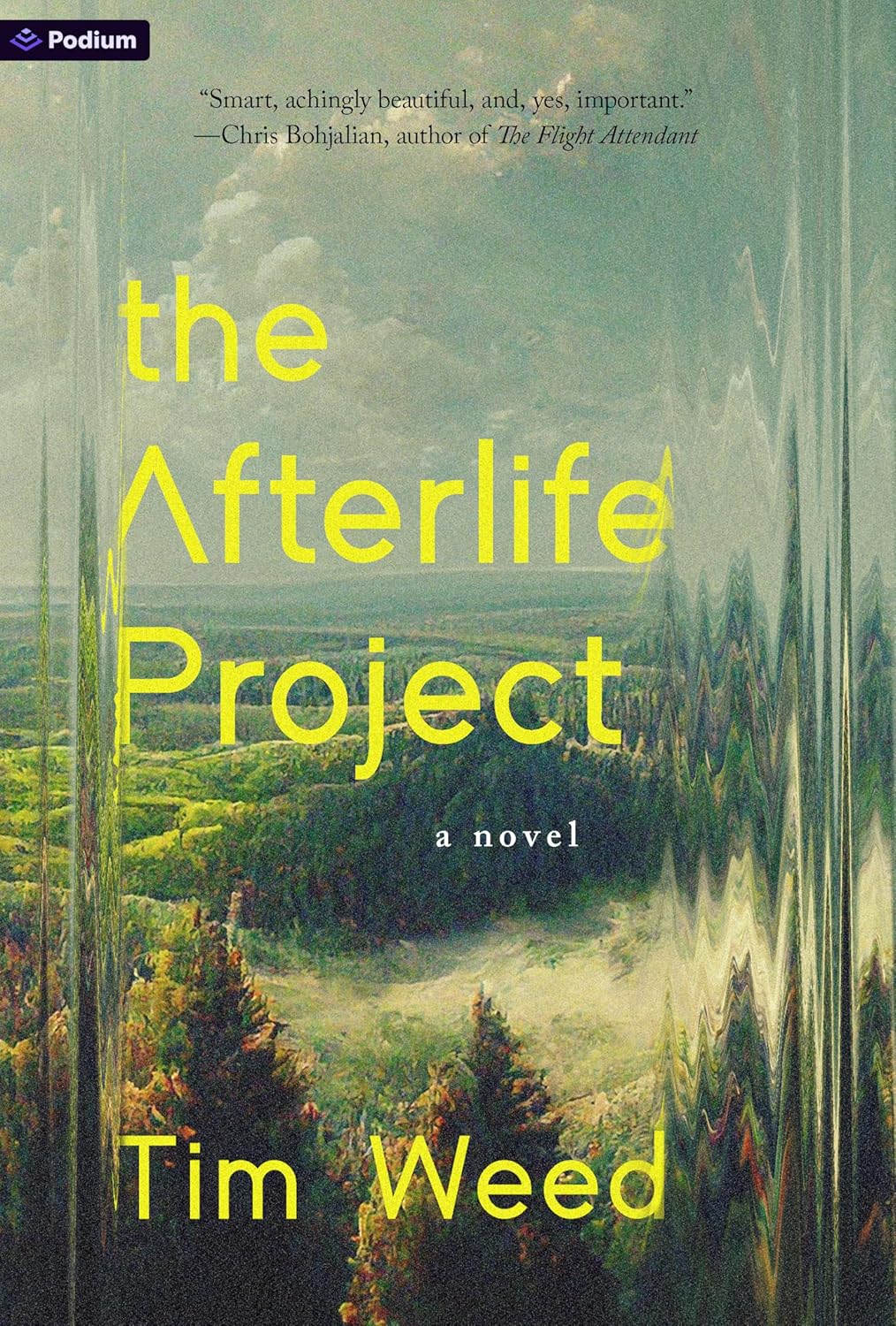
What would you do if you were the last human on Earth? This is the situation Nick Hindman finds himself in as he and his team of scientists work to save our species from extinction. Their plan has a name, “the Afterlife Project,” and it involves sending Nick far into the future — 10,000 years ahead — to find a way, against seemingly insurmountable odds, to repopulate the planet.
The writing in Tim Weed’s new novel is as lush and beautiful as the far-future Earth itself. When Nick is released from the “Time Dilation Sphere” that has brought him to this period, he encounters a world covered with forest and inhabited by a rich variety of animal and plant life. The descriptions are gorgeous; here is just one example among many:
“The spring rains come. The hardwoods blossom and bud, mushrooms poke their eager heads up out of leaf litter, and down on the lowland lakes and streams the mayflies hatch in shimmering clouds.”
Whether Nick will find a way to bring humanity back is the question that hangs over The Afterlife Project and propels the story. Weed tells this tale by alternating between Nick’s far-future world and something closer to our current time, where we follow the team who sent him on. The present-day story is told through the journal of a physician known as Al. Other members of the team include Natalie Quist, a physicist and inventor of the time-travel technology; Natalie’s brother Tollie; and a second man, James.
Most of the action is recounted in Al’s journal as her team sails across the Atlantic to search for people who might help them achieve their goal. The narrative also includes flashbacks — primarily in the Nick sections — that show what the planet was like before the team set out on their quest and help flesh out the characters.
Like all time-travel tales, the mechanism by which a person can be sent thousands of years into the future is vague and hand-wavey. The fact that Weed includes cold fusion as part of the technology will probably disappoint some fans of hard sci-fi, but I had no trouble overlooking this detail. There are also some questionable aspects of the story behind the demise of humankind by, essentially, our own hand, but I (unfortunately) found it believable that we’d be brought down by well-meaning attempts to geo-engineer our way out of a climate crisis we created.
An unusual aspect of the novel is its very small cast of characters, although that’s also not surprising given that the story is basically about the end of the human race. Our travelers who cross the ocean do find a few others eventually, but Nick is largely alone in his future world. He does his best to survive the loneliness, as illustrated in this scene about halfway through the book, shortly after two cats appear at his campsite:
“The new cat becomes a regular presence on the ledge, putting a bit more weight on her bony frame from regular feedings. She and the tom cat take to grooming each other, soon becoming an inseparable pair. Nick finds himself crediting them with a degree of intelligence that he might have been reluctant to assign to their species in the time before.”
This notion that animals in the far future might’ve achieved a higher intellect after 10,000 years of evolution is another of those unlikely scientific details that will bother sci-fi purists. While it’s unlikely this could happen, here, too, I could see where the author was coming from. This plot point allows for some sort of intelligent, self-aware witness to be present in a world where there otherwise might be none.
The team in the present-time part of the story has each other, at least, and even though they encounter a few people in the course of their adventures, it’s clear the world is rapidly running out of humans. But although the characters are desperate to save their species from extinction, it’s not clear whether the author agrees that that’s a good thing.
Members of the species disappearing in this story (i.e., us) might find this view depressing, but it seems Weed is trying to say that the Earth will survive even if we don’t. It may sound nihilistic to imagine a future without people, but The Afterlife Project provides a thought-provoking look at how beautiful the world could be without anyone like us in it.
Before moving to Colorado, Raima Larter was a chemistry professor and government scientist who secretly wrote fiction and poetry and tucked it away in drawers. She has published three novels, a nonfiction book, and numerous short stories. Her most recent book is The Kiss Catastrophe, a sci-fi first-contact story. She also serves as nonfiction editor for Utopia Science Fiction Magazine.

.png)