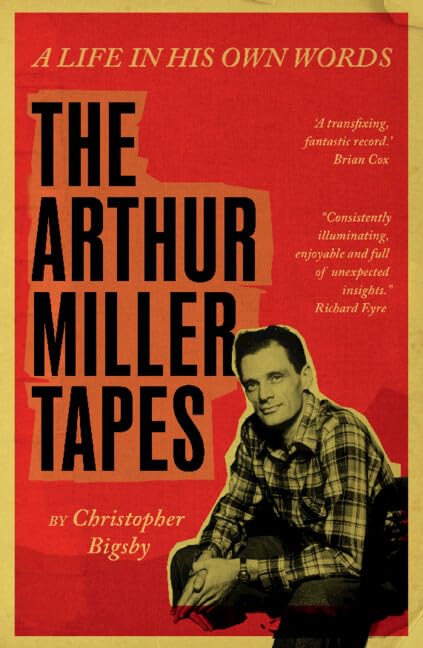
The Arthur Miller Tapes: A Life in His Own Words
- By Christopher Bigsby
- Cambridge University Press
- 384 pp.
- Reviewed by Kitty Kelley
- May 15, 2026
A reverie for an esteemed playwright.
Arthur Miller owned Broadway for eight glorious years. The playwright dominated the 20th-century American theater from 1947 to 1955 with productions of All My Sons, Death of a Salesman, The Crucible, and A View from the Bridge.
Death of a Salesman (1949) won a Pulitzer Prize, a Tony Award, and a New York Drama Critics’ Circle Award, establishing Miller as a commanding voice on the stage. Still, some critics felt his plays did not showcase the best of American society after World War II, particularly All My Sons (1947), a drama about a family whose happiness unravels as secrets about the father’s wartime profiteering are revealed, forcing a confrontation with his culpability in the deaths of 21 pilots. Although it ran for 328 performances on Broadway and garnered both Tony and New York Drama Critics’ Circle awards, Miller was stung by the criticism.
“I don’t really think, excepting for a New York Times critic, Brooks Atkinson, I ever had a critic on my side,” he lamented. Little of what Miller wrote after 1968 was reviewed favorably in the U.S., forcing him to find his success abroad, particularly in London.
Now comes Christopher Bigsby, a British literary analyst, with The Arthur Miller Tapes: A Life in His Own Words. Bigsby has written extensively about Miller, including a two-volume biography of the playwright’s life, 1915-1962 and 1962-2005, in addition to six other books devoted to the man. Bigsby recalls receiving his role as authorized biographer after New York drama critic Martin Gottfried wrote what Miller felt was a bruising biography, which, Bigsby writes, the playwright “especially despised, having refused all cooperation with a man who had written hostile reviews of his work.”
Bigsby’s taped conversations with Miller cover the playwright professionally and personally, with chapters devoted to his three wives — Mary Slattery (m. 1940; div. 1956), Marilyn Monroe (m. 1956; div. 1961), and Inge Morath (m. 1962; died 2002) — and, following them, his partner Agnes Barley (2002-2005). Miller was never without a woman in his life.
Miller admitted to “violent” self-absorption during his first marriage; “I could have been a monk in a cell for all my relationships mattered.” During a dinner with Leonard Bernstein, he became angry with Mary, who’d proudly told the composer all about A View from the Bridge. “I was very resentful she presumed to do that, which was beastly of me, because she was being proud of it,” recalled Miller, “but such was my absolute need to control my work.” At one point, Bernstein asked Miller to write a play he could musicalize. “I was not about to do that,” said Miller, “because I felt I was more important than he was.”
That same hardheaded egocentrism emerged during his marriage to Inge after their second child, Daniel, was born with Down syndrome. Miller thought it best to bring the child up “among people who he could possibly not compete with [and with whom] he wouldn’t feel different.” The Millers left the hospital without their little boy, although no specifics are provided about the professionals who took custody of the baby. Miller told Bigsby it was all for the best, and Bigsby doesn’t press for specifics, being more sensitive friend than probing interviewer.
By 1994, Miller declared Broadway a mere steppingstone for young actors to make movies. “[They] can’t make any money to speak of in the theatre. So, when they get good, they go.” In fact, he was quite despairing of the theater that launched him. In Miller’s day, ticket prices climbed from $4.40 to $10. Today’s prices have escalated to $495 and higher for a single orchestra seat.
One of Bigsby’s 22 chapters is dedicated to Miller’s appearance before the House Un-American Activities Committee, in which he denies ever being a card-carrying Communist Party member but admits to attending many party meetings for writers in the 1940s and 1950s. Miller never named names, unlike Elia Kazan, Lee J. Cobb, and Clifford Odets. As he said later, “Of course, I blamed them, but I have to say, for good or ill, it made me more despairing and more angry at the government. Why does everybody have to be strong in order to be an artist? Why do they have to go through this hell from their own government in a democratic society?”
Arthur Miller died on February 10, 2005, the same day of the same month on which Death of a Salesman premiered on Broadway. His tombstone reads simply, “ARTHUR MILLER WRITER.” The playwright would be pleased with Christopher Bigsby’s illuminating recollection of their friendship, in which the author allows his revered friend to spread his multicolored wings, proud as a peacock.
Kitty Kelley is the author of seven number-one New York Times bestseller biographies, including Nancy Reagan, Jackie Oh!, and Elizabeth Taylor: The Last Star. She is on the board of the Independent and is a recipient of the PEN Oakland/Gary Webb Anti-Censorship Award. In 2023, she was honored with the Biographers International Organization’s BIO Award, which is given annually to a writer who has made major contributions to the advancement of the art and craft of biography.