The Astronaut Children of Dunbar Street: A Memoir
- By Wiley Wei-Chiun Ho
- Douglas & McIntyre
- 272 pp.
- Reviewed by Bob Armstrong
- October 19, 2026
Their parents in Taiwan, immigrant siblings raise themselves in Canada.
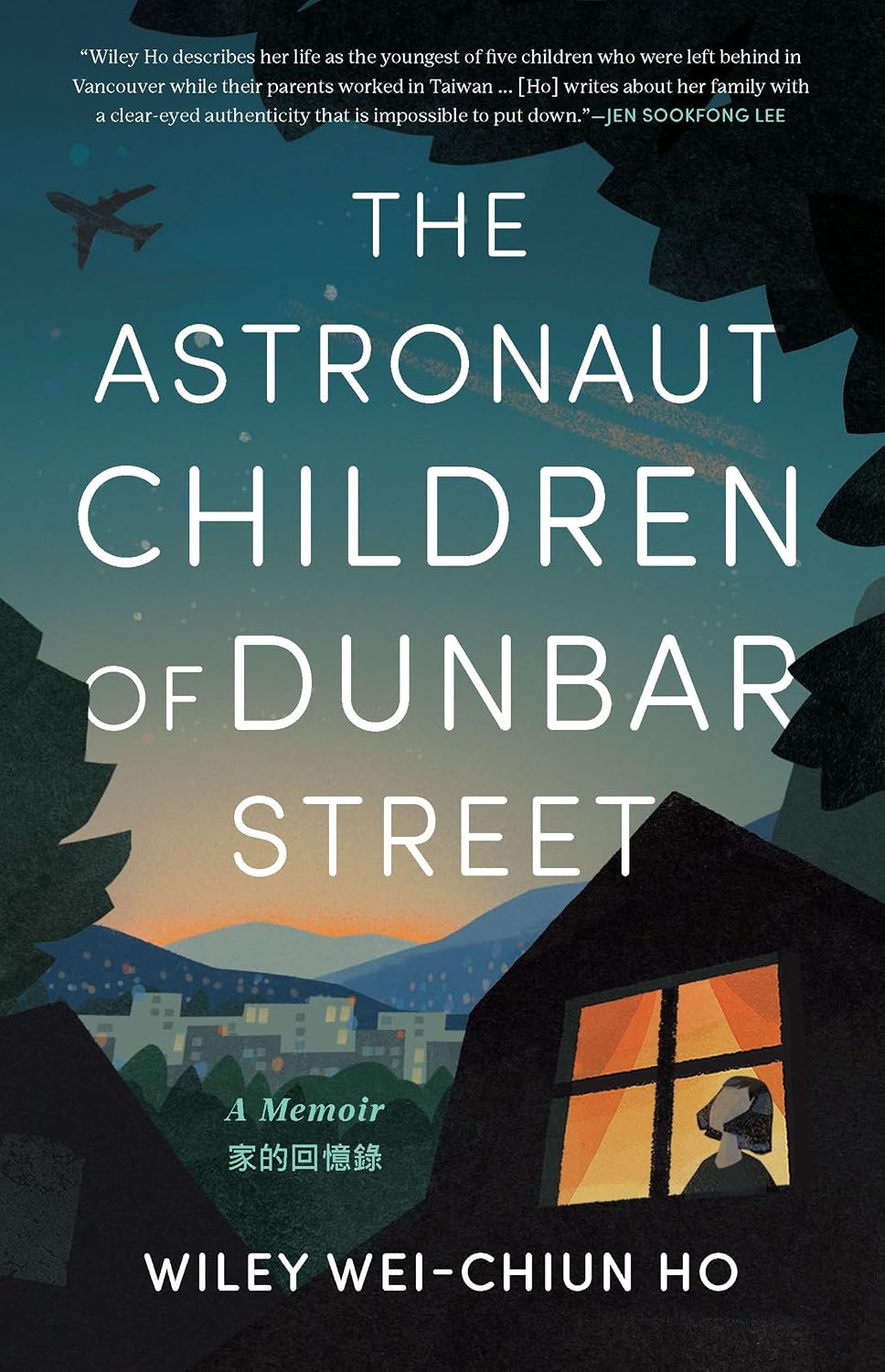
The plane on the runway lifts off for Taiwan. Twelve-year-old Wiley Wei-Chiun Ho brushes off a few tears as she turns away from the panoramic bay window at Vancouver International Airport. On that plane, her parents. One-way tickets. They will not be returning to Canada except for rare visits.
Pretty frightening, but also quite an adventure for a kid. Ho left the terminal and went back home to a six-bedroom house. The youngest of five children, she, her three sisters, and their brother were in the same predicament. All would be cooking, cleaning, and taking care of the house while going to school in British Columbia. On orders from their parents, the girls’ brother, as the eldest, would supervise the household.
Yeah, sure.
“My sisters and I exchanged looks of horror,” Ho writes in The Astronaut Children of Dunbar Street, “our 21-year-old brother, taciturn and impatient with us seemed the worst possible choice for a guardian.”
Still, his anointing provides many amusing asides in Ho’s memoir, which is also filled with the confusion, loneliness, and heavy emotional toll brought on by her parents moving an ocean away. Yet, for the most part, it was all for one and one for all among the squabbling siblings, who meant a lot more to each other once their parents went AWOL.
Five years before that fateful day at the airport, Ho’s family had immigrated to Canada. Her father, a surgeon in Taiwan, felt the political stability, security, and respect for individual freedom in Canada would be far better for him, his wife, and their children than living under constant threat from Communist China. The flaw in his thinking only hit home when he discovered his Taiwanese medical degree wouldn’t be recognized in Canada. Worse, in Taiwan, Ho’s parents were “big shots.” In Vancouver, they were “nobodies.”
With her father’s dream shattered and the family’s finances dwindling, Ho’s parents decided to return home, where they were highly respected somebodies, and where the cash flow from a doctor’s salary could easily support them and their “astronaut children.” This above-the-clouds Canadian term, seldom heard in the U.S., denotes immigrant kids of Asian or Southeast Asian origin living without their parents.
(The American analog might be “latchkey kids” of the 1980s, a term that referred to the offspring of working parents who came home to an empty house after school. The big difference? Even if these kids had to fix their own dinner, Mom and Dad eventually showed up each night. Not so on Dunbar Street.)
Diasporic children frequently develop a sense of resilience, self-reliance, and self-worth that serves them well as they mature into adulthood. As Ho’s narrative makes clear, however, parental absence can’t help but create feelings of abandonment, loss, and resentment, too, even when those parents go to great lengths (as hers did) to maintain a bond by visiting as often as possible and paying their kids’ living and education expenses.
There were only two rules in Ho’s parentless home: Study hard and stay out of trouble. So it was for all five siblings, although Older Brother failed in his parents’ eyes by not going to medical school as his father and grandfather had done. The importance of the doctor track is vividly illustrated by the author’s own name. “My father had lifted my English name from John Wiley & Sons,” she explains, “the publisher of his medical textbooks.”
How’s that for assimilation under the thumb of the dominant culture? Although not quite as outrageous, Wiley’s father appears to have followed in the footsteps of British mathematician Frank Featherstone Bonsall, who named his two cats A and B.
Like her dad, Ho very much wanted to fit in. “As new immigrants, we were eager to follow the rules and customs of mainstream culture.” Doing so, it turns out, was far less difficult than living without her parents — or expressing her feelings toward them. “Growing up, we never said I love you out loud,” Ho writes. “It was not part of our family ethos to declare love.” But that is exactly what she’s done by writing The Astronaut Children of Dunbar Street, an immigrant’s tale that offers a fine mix of tenderness and tenacity.
Bob Armstrong in the author of No Exit from Vietnam (Pen & Sword Military) and a contributing writer to the online magazine Thursday Review.