The Biggest Lie: The Prehistory of American Fascism, 1818-1915
- By Joseph Kelly
- Bloomsbury Publishing
- 400 pp.
- Reviewed by Peggy Kurkowski
- November 4, 2026
Turns out, the pernicious ideology was homegrown.
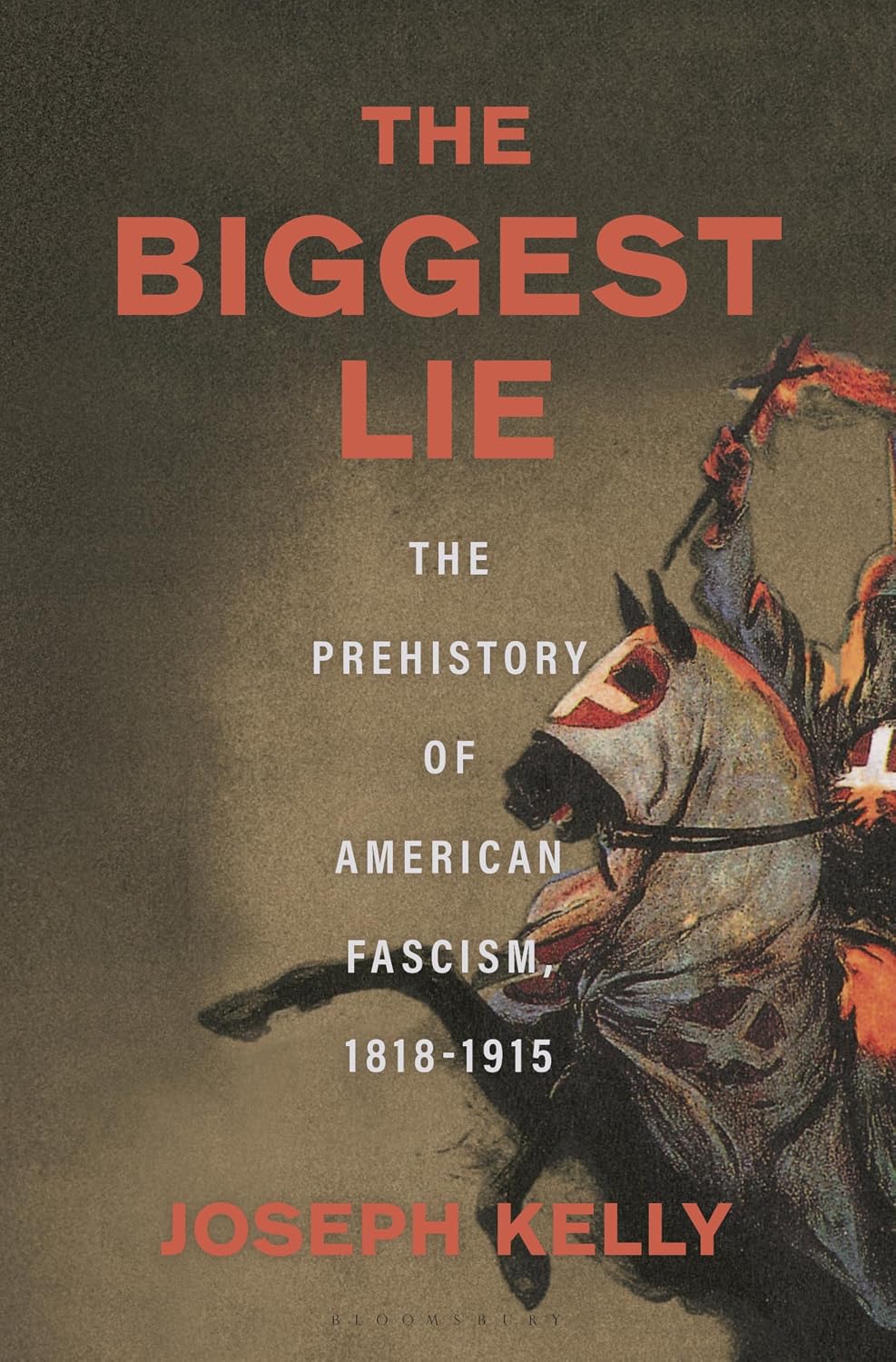
The startling origins of fascism in the 19th-century American South emerge with compelling clarity in historian Joseph Kelly’s The Biggest Lie. Many can be forgiven for mistaking fascism as a 20th-century European import, but the truth is far more unsettling. Kelly argues that fascism was “a native weed, a homegrown American phenomenon” that developed in tandem with the spread of slavery in the antebellum South and eventually radiated outward into a hierarchical Anglo-Saxon nationalism (“the biggest lie”).
He develops his thesis over three sections that consider the nation in three critical stages: the new republic (colonial/revolutionary era), the second republic (the Civil War/Reconstruction), and the American empire (the Gilded Age/turn of the century). A crucial ideological and philosophical divergence occurred between the new-republic period and the second, he contends: From 1776 until the 1820s, most Americans believed in the Jeffersonian notion that “all men are created equal,” but this belief fractured with the Missouri Compromise of 1818.
As the young nation gobbled up territories and formed new states, the balance of power between free and slave states became a flashpoint for the small cadre of men — the Southern planters — whose finances were wedded to slavery. Their answer to this threat to their livelihood? Promoting a new, “fringe” idea that all men are not created equal.
Kelly meticulously develops his theory of a Southern “Herrenvolk democracy” (master-race democracy) through the actions and words of its main proponents, from politicians to faux intellectuals, as well as anthropologists promulgating junk science about so-called differences between whites and Black and Indigenous peoples. Tapping into a rich vein of archival and primary sources, he builds a convincing case for how elite, monied slaveowners used scare tactics to bring the Old South’s non-slaveholders — mostly poor Scots Irish “plain folk”— to accept their proslavery views. Fears of slave insurrections and “replacement” were weaponized by these white supremacists as useful bogeymen to “terrify people into abandoning their principles.”
While the Civil War raged, the seeds of this white supremacy were already blooming and would, after the war, begin to sprout in the rest of the country. The biggest lie in American history then, Kelly argues, is white supremacy and the toxic ethno-nationalism that sprang up around it. There were, however, many people across regions and races who denounced the lie, including the inimitable Ida B. Wells, the educator and writer who publicly fought against the discriminatory “separate but equal” laws of the Jim Crow South, and W.E.B DuBois, the brilliant sociologist whose The Souls of Black Folk helped usher in modern liberalism. That book, writes Kelly, was the watershed work that “got through to several northern white intellectuals and philanthropists” and allowed a larger movement of liberal-minded Americans to push back against the Herrenvolk strain of democracy.
Moving from the second republic to American empire in the age of Theodore Roosevelt, the author turns a sharp eye to the divisions between labor and property, citing the “confluence between racial caste and the exploitation of labor.” Concerns among Americans by 1900 that “the greatest danger in the modern world was the tyranny of the rich” is a sentiment modern readers will recognize. One of Kelly’s key themes is how a minority of people with money and power can sow extreme social animosity, political instability, and individual suffering through the promulgation of white nationalism.
That’s not the end of the story, of course, as America grapples once again with pervasive white ethno-nationalism under the Trump administration, one that pits those who believe all men are created equal against those who do not. The Biggest Lie, therefore, offers a cogent and forceful examination of fascism’s roots in the antebellum South, but it can’t predict when or if those roots might finally be ripped out.
Peggy Kurkowski is a professional copywriter for a higher-education IT nonprofit association by day and major history nerd at night. She writes for multiple book-review publications, including Publishers Weekly, Library Journal, BookBrowse Review, Historical Novels Review, Foreword, Shelf Awareness, and the Independent. She hosts her own YouTube channel, “The History Shelf,” where she features and reviews history books (new and old), as well as a variety of fiction. She lives in Colorado with her partner and four adorable, ridiculous dogs.